
The Middle East (1828–1971 CE): Qajar and …
Years: 1828 - 1971
The Middle East (1828–1971 CE): Qajar and Ottoman Struggles, Oil Empires, and Cold War Realignments
Geography & Environmental Context
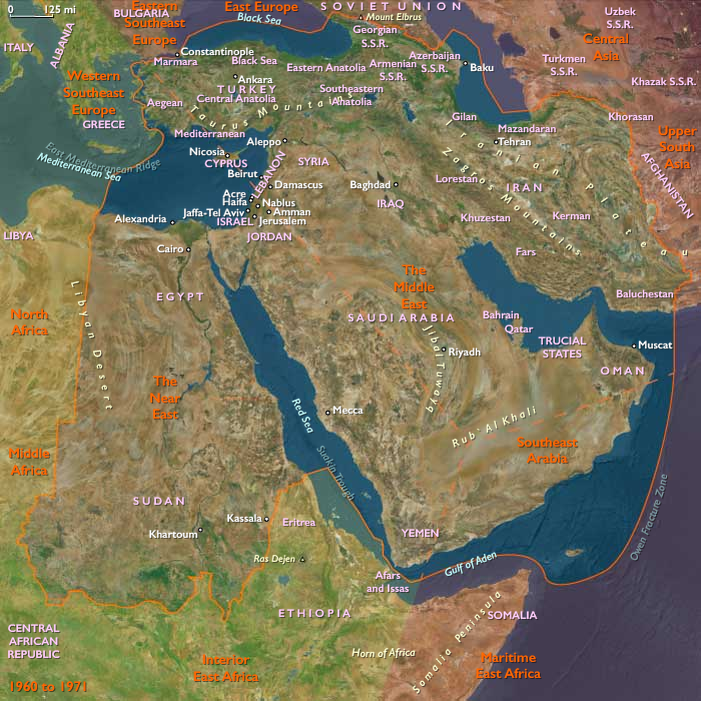
The Middle East includes Iraq, Iran, Syria, Armenia, Georgia, Azerbaijan, Qatar, Bahrain, the United Arab Emirates, most of Turkey (except its European and southwestern parts), eastern Jordan, nearly all of Lebanon, eastern Saudi Arabia, and northern Oman. Anchors include the Tigris–Euphrates basin, the Zagros and Caucasus ranges, the Iranian plateau, the Caspian littoral, the Levantine corridor, and the Persian/Arabian Gulf. This subregion connected Mediterranean, Russian, and Indian Ocean worlds while enduring pressures from empire, revolution, and global energy demand.
Climate & Environmental Shifts
The waning Little Ice Age gave way to modern warming trends, but aridity remained dominant. The Fertile Crescent endured cycles of drought and flood, disrupting agriculture. The Caspian and Persian Gulf coasts supported fisheries and palm groves, while deserts of Iraq, Syria, and Arabia constrained settlement. Earthquakes (notably in Iran and Turkey) punctuated the landscape. After the mid-20th century, dams like the Aswan High Dam’s regional counterparts (e.g., Iran’s Karaj Dam, Turkey’s Keban project) sought to control rivers and support hydroelectricity.
Subsistence & Settlement
-
Agriculture: Wheat, barley, and rice dominated in Mesopotamia and Iran’s plains; date groves thrived in Basra, Khuzestan, and Gulf oases. Tobacco, cotton, and citrus became key cash crops in Syria, Lebanon, and northern Iran.
-
Pastoralism: Nomadic and semi-nomadic tribes (Bedouin, Bakhtiari, Kurdish, Turkmen) persisted, though sedentarization campaigns curtailed mobility in the 20th century.
-
Urbanization: Cities like Baghdad, Damascus, Tehran, Tabriz, Aleppo, and Baku grew as administrative centers. Beirut blossomed as a Levantine port; Gulf towns like Manama, Doha, and Dubai remained small but were transformed by oil after the 1950s.
-
Oil settlements: From the 1900s, Abadan, Kirkuk, Dhahran, and Bahrain became boomtowns linked to Anglo-Iranian and American oil companies.
Technology & Material Culture
-
19th century: Telegraph lines, railways (Berlin–Baghdad, Hejaz, Trans-Iranian), and steam navigation linked the region to Europe.
-
20th century: Oil refineries, pipelines (Kirkuk–Haifa, Abadan–Mediterranean), and dams modernized infrastructure. Cars, radios, and cinemas spread after WWII; by the 1960s, televisions and concrete apartment blocks reshaped urban life.
-
Everyday life: Bazaar craft traditions—carpets, textiles, ceramics—coexisted with imported mass goods. Mosques, churches, and synagogues continued as architectural anchors.
Movement & Interaction Corridors
-
Imperial routes: Russian expansion in the Caucasus (taking Armenia, Georgia, Azerbaijan) and British routes through the Gulf redefined boundaries.
-
Trade: Caravans from Iran and Iraq moved wool, carpets, and livestock; steamships carried oil and pilgrims.
-
Pilgrimage: Shiʿi shrines at Najaf and Karbala attracted millions; Sunni routes to Mecca drew eastern pilgrims via Basra and Gulf ports.
-
Oil corridors: Tankers carried Gulf crude to Europe and Asia; pipelines bound Kirkuk and Abadan to Mediterranean ports.
-
Diaspora & labor: Armenians, Assyrians, and Kurds migrated amid wars; Palestinian refugees after 1948 and 1967 transformed Jordan, Lebanon, and Syria.
Cultural & Symbolic Expressions
-
Religion: Islam predominated (Sunni in Anatolia, Syria, Iraq; Shiʿi in Iran, southern Iraq, eastern Arabia); Christian minorities (Armenian, Assyrian, Maronite, Greek Orthodox) and Jewish communities remained vital until large-scale emigration after 1948.
-
Intellectual life: The Nahda (Arab Renaissance) spread through Beirut, Damascus, and Baghdad; Iranian reformers blended constitutionalism with Shiʿi thought.
-
Arts & media: Persian poetry, Arabic novels, Turkish press, and Levantine theater flourished; postwar Egyptian cinema circulated regionally. Radio speeches—Nasser, Mossadegh, Baʿath leaders—became political rituals.
-
Identity movements: Pan-Arabism, pan-Islamism, and early pan-Turkism shaped discourse. Kurdish nationalism emerged, while Zionist movements abroad affected regional politics through immigration to neighboring Palestine.
Environmental Adaptation & Resilience
-
Irrigation: Canals in Iraq and Iran expanded, though salinization plagued Mesopotamian soils.
-
Oases: Wells, qanats, and date-palm agroforestry sustained Gulf and Iranian plateau communities.
-
Nomadic strategies: Seasonal migration and diversified herds buffered risk; modern states sought to sedentarize tribes, often disrupting resilience.
-
Urban adaptation: Markets, hammams, and communal charities supported survival in famine and flood; post-WWII welfare states extended these functions through subsidies and public works.
Political & Military Shocks
-
Ottoman decline & Russian advance: Russo-Persian wars led to treaties (Turkmenchay 1828) ceding Caucasian lands to Russia. Ottoman Syria and Iraq faced autonomy movements.
-
Iran: The Qajar dynasty (1789–1925) managed concessions to Britain and Russia, sparking nationalist protest; the 1906 Constitutional Revolution curtailed monarchy briefly.
-
Iraq: British occupied Mesopotamia in WWI; mandate rule (1920–32) preceded monarchy and eventual 1958 revolution.
-
Syria & Lebanon: French mandate (1920–46); independence brought coups and eventual Baʿathist ascendancy.
-
Turkey: Atatürk’s republic (1923) reformed Anatolia’s western and central regions, overlapping with this subregion’s borders in Adana and southeastern Turkey.
-
Oil politics: 1901 D’Arcy concession (Iran), 1908 oil discovery at Masjed Soleyman, and formation of Anglo-Iranian Oil Company (later BP). Gulf sheikhdoms signed British treaties, setting the stage for independence in the 1960s–70s.
-
Arab–Israeli conflict: Though Israel itself lies outside this subregion, wars of 1948 and 1967 deeply reshaped its neighbors—Jordan lost East Jerusalem, Syria lost the Golan, Lebanon absorbed refugees.
-
Revolutions & coups: Egypt’s Free Officers inspired Iraq (1958) and Syria (1963); Iran’s Mossadegh nationalized oil (1951) before a 1953 coup restored the Shah.
Transition
Between 1828 and 1971, the Middle East was remade from Ottoman and Qajar borderlands into a set of oil-rich nation-states entangled in global power struggles. Early decades saw imperial encroachment, concessions, and mandates; the 20th century brought oil exploitation, nationalist revolts, and Cold War alignments. The rise of Baʿathism, Arab socialism, and pan-Islamic calls reshaped identity, while Gulf emirates edged toward independence under British withdrawal (1971). By the end of this period, pipelines, refineries, and revolutionary movements had replaced caravan and oasis rhythms, making the Middle East both the strategic heart of the Cold War and the stage for new conflicts over sovereignty, resources, and ideology.
People
Groups
- Georgians
- Armenian people
- Jews
- Christians, Armenian Apostolic Orthodox
- Christians, Maronite
- Muslims, Sunni
- Muslims, Shi'a
- Muslims, Ibadi
- Oman, First Imamate of
- Druze, or Druse, the
- Persia, Safavid Kingdom of
- Mount Lebanon Emirate
- Russia, Tsardom of
- Cyprus, Ottoman
- Yaruba dynasty
- Omani Empire
- Al Qasimi (Adnani Arabian tribe)
- Abu Dhabi, Emirate of
- Ra's al-Khaymah, or Ras al-Khaimah, Emirate of
- Russian Empire
- Persia, Hotaki Ghilzaid Kingdom of
- Sharjah (ash-Shariqah), Emirate of
- Wahhabism
- Ajman, or 'Ujman, Emirate of
- Kuwait, Sheikhdom of
- Saud, House of
- Umm al-Qaywayn, or Umm al-Quwain, Emirate of
- Persia, Qajarid Kingdom of
- Dubai, Emirate of
- al-Fujayrah, or Fujairah, Emirate of
- Britain (United Kingdom of Great Britain and Ireland)
- Georgia within the Russian Empire
- Bahrain, Emirate of
- Trucial States
- Armenia, Russian
- Bahrain, British protectorate of
- Muscat and Oman
- Mount Lebanon Mutasarrifate
- Syria, Ottoman viyalet of
- Qatar, Emirate of
- Mount Lebanon, Ottoman mutasarrifate of Beirut, or
- Qatar, British Protectorate of
- Azerbaijan Democratic Republic
- Armenia, Democratic Republic of
- Georgia, Democratic Republic of
- Syria, French Mandate of
- Armenia, Soviet Socialist Republic of
- Persia, Pahlavid Kingdom of
- Iraq, Hashemite Kingdom of
- Union of Soviet Socialist Republics (USSR), or Soviet Union
- Britain (United Kingdom of Great Britain and Northern Ireland)
- Saudi Arabia, Kingdom of
- Georgian Soviet Socialist Republic
- Azerbaijan Soviet Socialist Republic
- Lebanon, Republic of
- Syria, or Syrian Arab Republic
- France (French republic); the Fourth Republic
- France (French republic); the Fifth Republic
- United Arab Republic (U.A.R.; Arab Republics of Egypt and Syria)
- United Arab Republic
- Iraq, First Republic of
- United Arab Republic (U.A.R.; Arab Republic of Egypt)
- United Arab Emirates (U.A.E.)
- Bahrain
- Qatar, State of
Topics
- Tanzimat
- Armenian Massacres of 1909
- World War, First (World War I)
- Armenian Massacres of 1915
- World War, Second (World War II)
- Cold War
- Dhofar Rebellion
Subjects
Regions
Subregions

Related Events
Showing 10 events out of 19829 total
Years: 1828 - 1971
People
Groups
- Georgians
- Armenian people
- Jews
- Christians, Armenian Apostolic Orthodox
- Christians, Maronite
- Muslims, Sunni
- Muslims, Shi'a
- Muslims, Ibadi
- Oman, First Imamate of
- Druze, or Druse, the
- Persia, Safavid Kingdom of
- Mount Lebanon Emirate
- Russia, Tsardom of
- Cyprus, Ottoman
- Yaruba dynasty
- Omani Empire
- Al Qasimi (Adnani Arabian tribe)
- Abu Dhabi, Emirate of
- Ra's al-Khaymah, or Ras al-Khaimah, Emirate of
- Russian Empire
- Persia, Hotaki Ghilzaid Kingdom of
- Sharjah (ash-Shariqah), Emirate of
- Wahhabism
- Ajman, or 'Ujman, Emirate of
- Kuwait, Sheikhdom of
- Saud, House of
- Umm al-Qaywayn, or Umm al-Quwain, Emirate of
- Persia, Qajarid Kingdom of
- Dubai, Emirate of
- al-Fujayrah, or Fujairah, Emirate of
- Britain (United Kingdom of Great Britain and Ireland)
- Georgia within the Russian Empire
- Bahrain, Emirate of
- Trucial States
- Armenia, Russian
- Bahrain, British protectorate of
- Muscat and Oman
- Mount Lebanon Mutasarrifate
- Syria, Ottoman viyalet of
- Qatar, Emirate of
- Mount Lebanon, Ottoman mutasarrifate of Beirut, or
- Qatar, British Protectorate of
- Azerbaijan Democratic Republic
- Armenia, Democratic Republic of
- Georgia, Democratic Republic of
- Syria, French Mandate of
- Armenia, Soviet Socialist Republic of
- Persia, Pahlavid Kingdom of
- Iraq, Hashemite Kingdom of
- Union of Soviet Socialist Republics (USSR), or Soviet Union
- Britain (United Kingdom of Great Britain and Northern Ireland)
- Saudi Arabia, Kingdom of
- Georgian Soviet Socialist Republic
- Azerbaijan Soviet Socialist Republic
- Lebanon, Republic of
- Syria, or Syrian Arab Republic
- France (French republic); the Fourth Republic
- France (French republic); the Fifth Republic
- United Arab Republic (U.A.R.; Arab Republics of Egypt and Syria)
- United Arab Republic
- Iraq, First Republic of
- United Arab Republic (U.A.R.; Arab Republic of Egypt)
- United Arab Emirates (U.A.E.)
- Bahrain
- Qatar, State of
Topics
- Tanzimat
- Armenian Massacres of 1909
- World War, First (World War I)
- Armenian Massacres of 1915
- World War, Second (World War II)
- Cold War
- Dhofar Rebellion
Subjects
Regions
Subregions