
The Middle East: 1696–1707 CE Challenges …
Years: 1696 - 1707
The Middle East: 1696–1707 CE
Challenges to Ottoman Authority and Rising Regional Powers
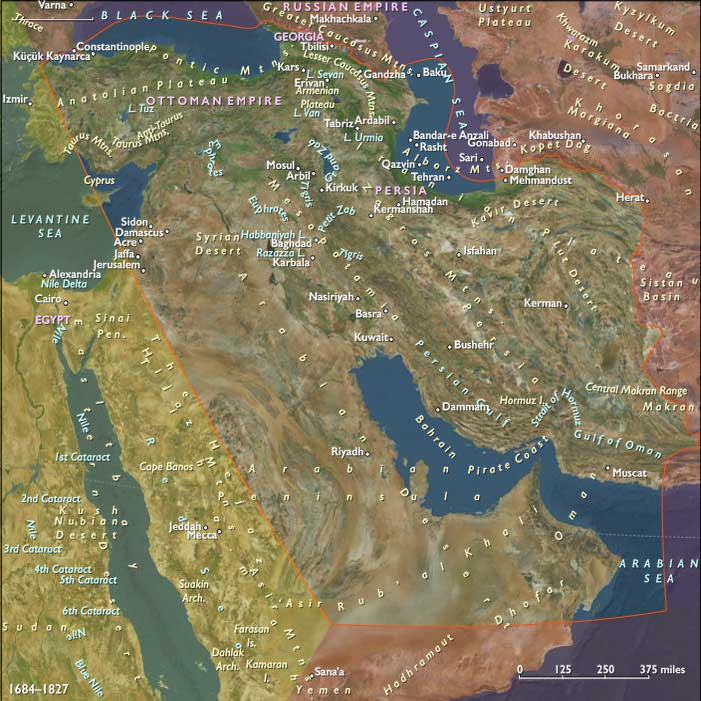
At the dawn of the eighteenth century, the Ottoman Empire faces mounting administrative difficulties, weakening central authority, and intensified local autonomy. The vast Ottoman territories from Anatolia to Syria are increasingly managed through localized governance, where pashas often exert significant independence. This decentralization fosters local power bases and intensifies internal divisions, though the Ottomans continue to rely on the traditional millet system to maintain stability among diverse religious and ethnic communities.
In Lebanon, continued feuds among Druze, Maronite, and Shia groups follow the fading legacy of Fakhr ad-Din ibn Maan, whose death in 1635 had marked the end of significant centralized Lebanese autonomy. Nevertheless, Lebanon remains economically active, benefiting from trade through Beirut and maintaining strong commercial links with European merchants, particularly those from France and Britain.
The Safavid Empire in Persia is undergoing severe stress during this era. Since the death of Shah Abbas I, Safavid power has eroded significantly, compromised by internal strife, maladministration, and the resurgence of tribal loyalties. The empire struggles to maintain control over distant provinces, especially in Iraq and the Caucasus, where rival Ottoman influence persists. Additionally, the rise of Afghan tribal confederations to the east further undermines Safavid stability, foreshadowing deeper crises to come.
Iraq, positioned between Ottoman and Safavid spheres, remains fractured. Sunni-Shia divisions deepen due to intermittent Ottoman and Persian rule, while local tribal confederations like the Muntafiq and Kurdish groups in the north, notably the Baban Dynasty, assert near-total autonomy. Ottoman administrative presence in Baghdad remains nominal and primarily concerned with taxation and trade oversight, doing little to curb tribal independence.
Oman, under the Yarubid Imamate, continues to strengthen its maritime empire. After fully expelling the Portuguese and consolidating Muscat and other coastal cities, the Omanis extend their influence along East African shores, securing economic dominance in the western Indian Ocean. This maritime ascendancy positions Oman as an influential regional power, effectively managing trade between India, Africa, and the Middle East.
In the Persian Gulf, European influence—primarily British and Dutch—grows steadily, fostered by trade alliances initially formed against Portuguese hegemony. These powers compete to control lucrative routes to Persia and India, significantly affecting local political dynamics. Iranian attempts to assert control over coastal cities are limited by ongoing internal Safavid challenges and external competition.
The geopolitical divisions of Armenia and Georgia persist as the Ottomans and Safavids continue to vie for dominance in the Caucasus. Armenia remains largely under Ottoman administration through the millet system, with significant Persian influence persisting around Lake Sevan and Erevan. Georgian principalities maintain precarious autonomy amid external pressures, balancing Ottoman, Safavid, and local noble interests.
Legacy of the Era
Between 1696 and 1707 CE, the Middle East witnesses intensified decentralization and local autonomy, weakening traditional imperial structures. Regional powers, particularly Oman, emerge significantly stronger, reshaping maritime trade networks. Safavid decline accelerates, signaling the eventual collapse of centralized Iranian power. The period sets the stage for profound transformations as the balance of power shifts decisively toward local dynasties and external influences in the eighteenth century.
Groups
- Omanis
- Muslims, Sunni
- Muslims, Shi'a
- Muslims, Ibadi
- Venice, (Most Serene) Republic of
- Al-Muntafiq
- Ottoman Empire
- Persia, Safavid Kingdom of
- Levant Company, or Turkey Company (in full: Company of Merchants of England trading to the Seas of the Levant)
- France, (Bourbon) Kingdom of
- Habsburg Monarchy, or Empire
- Yaruba dynasty
- Oman, Second Imamate of
- Baban
Commodoties
Subjects
Regions

Subregions
Related Events
Showing 10 events out of 29101 total
Years: 1696 - 1707
Groups
- Omanis
- Muslims, Sunni
- Muslims, Shi'a
- Muslims, Ibadi
- Venice, (Most Serene) Republic of
- Al-Muntafiq
- Ottoman Empire
- Persia, Safavid Kingdom of
- Levant Company, or Turkey Company (in full: Company of Merchants of England trading to the Seas of the Levant)
- France, (Bourbon) Kingdom of
- Habsburg Monarchy, or Empire
- Yaruba dynasty
- Oman, Second Imamate of
- Baban
Commodoties
Subjects
Regions
Subregions