
The Middle East: 1624–1635 CE Rise …
Years: 1624 - 1635
The Middle East: 1624–1635 CE
Rise of the Yarubids and the Liberation of Oman
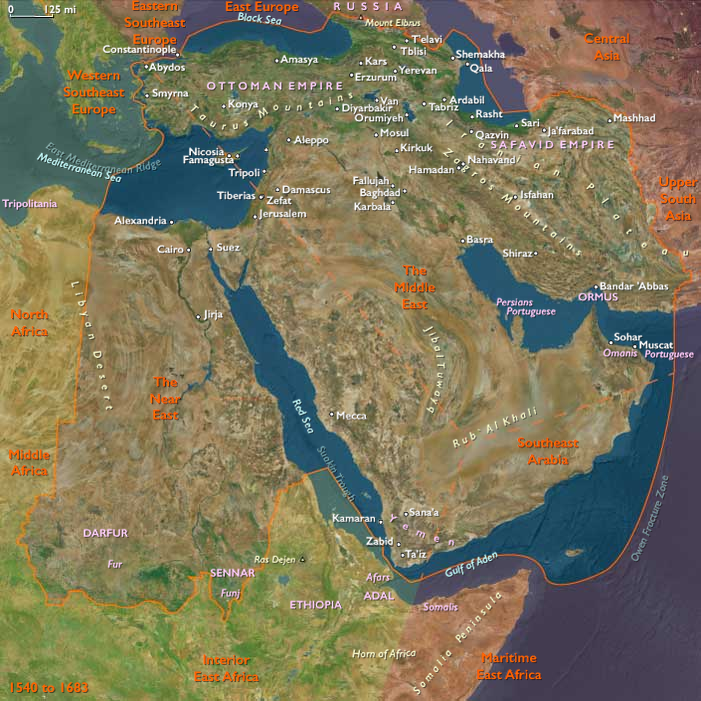
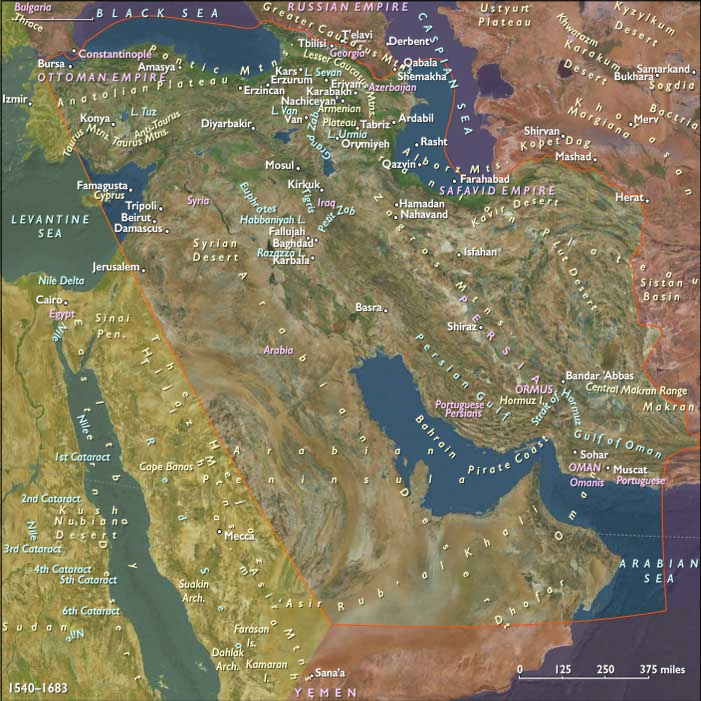
In 1624, the Yarubid dynasty emerges in Oman, marking the end of a brief restoration of Nabhani rule that had begun around 1600. Imam Nasir bin Murshid bin Sultan al-Ya'aruba (r. 1624–1649), a member of the Ya'rub tribe, is elected to lead the newly founded Yarubid imamate—Oman's fifth. Under his rule, Oman unifies its fragmented tribes with the goal of expelling the Portuguese, who have occupied Muscat since 1508, fortifying the city to protect their vital sea lanes.
Imam Nasir relocates the capital to Nizwa, an ancient center of Ibadi authority, strengthening his legitimacy. His forces achieve key victories, retaking towns and fortresses from Portuguese control. In 1633, the Omani army liberates Julfar (modern Ras al-Khaimah). These efforts coincide strategically with English attacks on Portuguese holdings, collectively weakening Portuguese dominance and contributing to a significant shift in regional power dynamics.
Fakhr al-Din II’s Expansion and Ottoman Reaction
In Mount Lebanon, Emir Fakhr al-Din II ibn Maan continues to consolidate and expand his authority, fostering religious tolerance and economic prosperity. His openness to European influences, particularly from Tuscany, introduces advanced agricultural methods and new industries, significantly enhancing the region’s economy.
However, Fakhr al-Din's growing autonomy and foreign alliances alarm the Ottoman authorities. Sultan Murad IV (r. 1623–1640) sees Fakhr al-Din’s semi-independent emirate as a threat to Ottoman sovereignty. By 1633, tensions escalate, and the Ottoman Empire prepares to assert its dominance over Mount Lebanon more forcefully.
Ottoman–Safavid Conflict and Baghdad’s Strategic Importance
The ongoing rivalry between the Ottoman Empire and Safavid Persia persists, particularly over the crucial city of Baghdad. The Safavid ruler Shah Abbas I (r. 1588–1629) defends Baghdad effectively until his death in 1629, after which internal weaknesses emerge under his successor, Shah Safi (r. 1629–1642).
Recognizing the Safavid vulnerability, Ottoman Sultan Murad IV renews military offensives. By 1635, Murad IV personally leads Ottoman forces into Persian territories, initiating preparations to reclaim Baghdad, reinforcing the city’s symbolic and strategic significance in the Ottoman–Safavid conflict.
Cultural and Economic Flourishing in Isfahan and Aleppo
Isfahan remains a vibrant cultural and artistic hub, continuing significant architectural projects under Shah Abbas I and his successor, Shah Safi. Major construction efforts maintain Isfahan’s role as a center of Safavid cultural and political power.
Meanwhile, Aleppo continues to flourish economically under Ottoman rule, serving as a critical commercial link between Europe and the Middle East. Its markets attract European merchants eager for textiles, spices, and luxury goods, strengthening economic ties and facilitating cultural exchanges between East and West.
Legacy of the Era
The period between 1624 and 1635 is marked by notable geopolitical changes: the Yarubid dynasty significantly alters the power structure in Oman, expelling Portuguese colonial forces; Fakhr al-Din II’s independent policies challenge Ottoman supremacy, prompting a decisive imperial response; and the renewed Ottoman–Safavid rivalry underscores Baghdad’s centrality in Middle Eastern geopolitics. Collectively, these developments reshape regional dynamics, setting the stage for future conflicts and alliances.
People
Groups
- Omanis
- Muslims, Sunni
- Muslims, Shi'a
- Muslims, Ibadi
- Ottoman Empire
- Portuguese Empire
- Qizilbash or Kizilbash, (Ottoman Turkish for "Crimson/Red Heads")
- Persia, Safavid Kingdom of
- Mount Lebanon Emirate
- Yaruba dynasty
Topics
Commodoties
Subjects
Regions
Subregions
Years: 1624 - 1635
People
Groups
- Omanis
- Muslims, Sunni
- Muslims, Shi'a
- Muslims, Ibadi
- Ottoman Empire
- Portuguese Empire
- Qizilbash or Kizilbash, (Ottoman Turkish for "Crimson/Red Heads")
- Persia, Safavid Kingdom of
- Mount Lebanon Emirate
- Yaruba dynasty
Topics
Commodoties
Subjects
Regions
Subregions