
The Near and Middle East (1540–1683 CE) …
Years: 1540 - 1683
The Near and Middle East (1540–1683 CE)
Ottoman–Safavid Rivalries, Omani Seas, and Pilgrimage Heartlands
Geography & Environmental Context
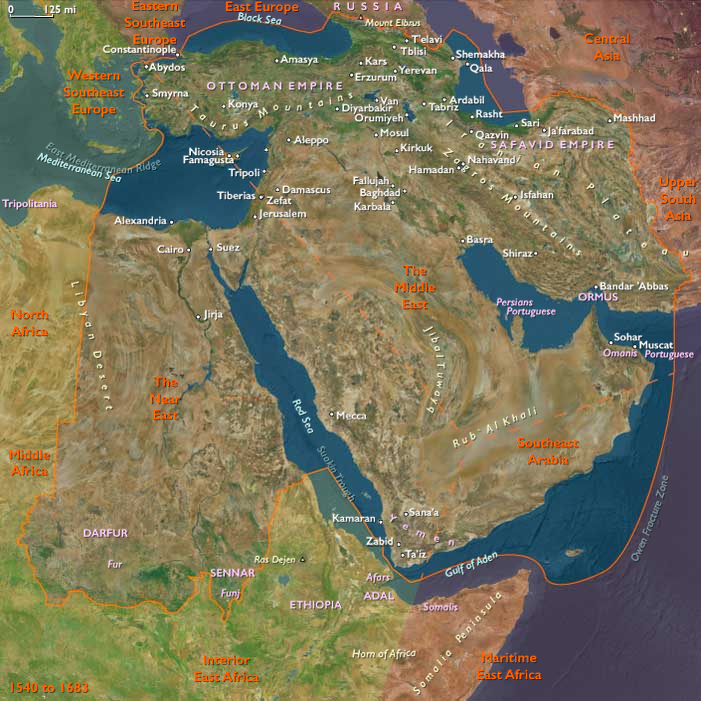
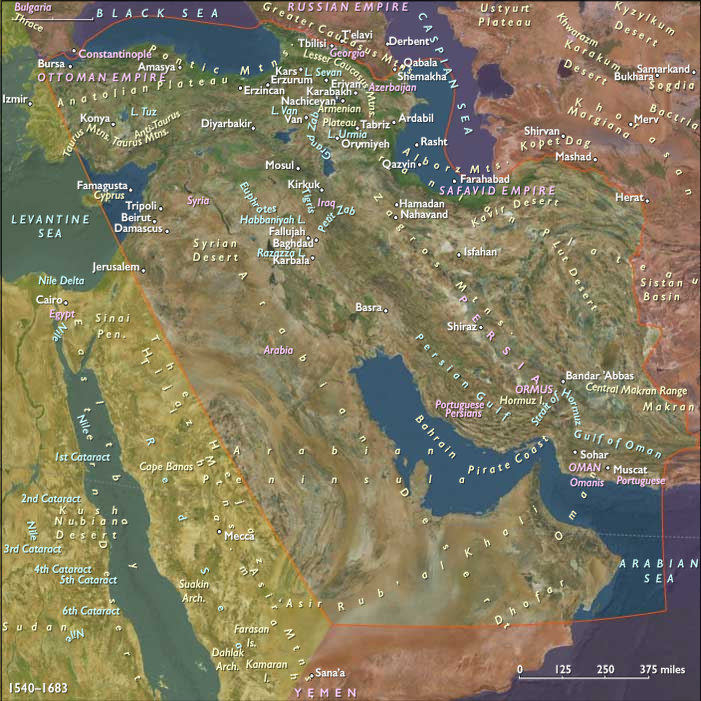
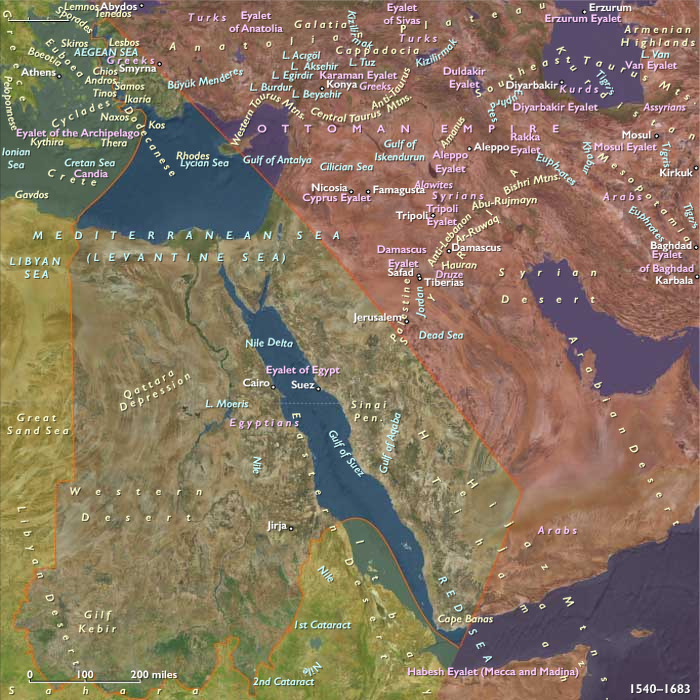
From the Balkans–Anatolia hinge through Syria–Iraq–Iran to the Persian Gulf, Caucasus, and Arabian Sea, this region braided imperial capitals, caravan corridors, and monsoon coasts. Its subregions—The Middle East (Iraq, Iran, Syria, the Caucasus, most of Anatolia, Gulf littorals) and Southeast Arabia (Dhofar–Hadhramawt–Mahra and Socotra)—interlocked with the Near East (Egypt, the Hejaz, the Levant, SW Anatolia, SW Cyprus). Anchors included the Tigris–Euphrates andNile basins, the Zagros and Caucasus ranges, the Hejaz pilgrimage corridor, and the Gulf and Red Sea sea-lanes. Monsoonal seas, irrigated deltas, terrace highlands, and desert tracks together sustained one of the early modern world’s great crossroads.
Climate & Environmental Shifts
Under the Little Ice Age, cooler winters and variable rains stressed granaries and routes:
-
Egypt alternated between low and high Nile floods; famine years punctuated prosperity.
-
Syria–Iraq–Iran endured drought–flood swings; earthquakes shook the Levant and Iran.
-
Hejaz and Arabian coasts faced water scarcity and cyclones; Dhofar–Hadhramawt’s erratic khareef rains tested terraces.
Resilience rested on canals, qanats, cisterns, and grain redistribution.
Subsistence & Settlement
-
Middle East heartlands:
-
Ottoman provinces (Syria, Iraq, Anatolia) combined wheat–barley belts with orchard and pastoral zones; Aleppo, Baghdad, and Diyarbakır linked steppe to sea.
-
Safavid Iran shifted irrigated oases and garden cities (Isfahan) toward silk, carpets, and staple grains; Caspian rice and sericulture buttressed exports.
-
Caucasus valleys mixed vineyards, orchards, and transhumance, feeding caravan towns (Tiflis, Yerevan).
-
-
Near East:
-
Egypt’s Nile grain fed Cairo’s vast market; Levant terraces produced olives, vines, and citrus; Hejaz oases provisioned pilgrims.
-
-
Southeast Arabia:
-
Dhofar frankincense groves, date gardens, and herds sustained oasis towns; Hadhramawt wadis produced dates and grains; Socotra blended resin harvests, fishing, and herding.
-
Technology & Material Culture
Qanats, canals, and terrace walls underwrote agriculture; caravanserais stitched routes to markets. Urban crafts—textiles, metalwork, glass, ceramics, sugar—flourished from Cairo to Isfahan and Aleppo. Gunfounding advanced in both empires; Ottoman and Safavid courts raised mosques, madrasas, bridges, and gardens. In Southeast Arabia, lateen-rigged dhows, coral-stone mosques, and tower houses marked ports; Hadhrami merchants endowed zāwiyasand manuscript schools.
Movement & Interaction Corridors
-
Imperial arteries: Ottoman roads and river convoys tied Aleppo–Mosul–Baghdad–Basra; Safavid routes linked Isfahan–Tabriz–Yerevan–Baku and the Caspian.
-
Seaways: The Red Sea (Suez–Jidda–Mocha) and Persian Gulf (Basra–Hormuz–Muscat) funneled Indian Ocean commerce.
-
Pilgrimage: Annual hajj caravans from Cairo, Damascus, and Anatolia converged on Mecca, sustaining a continent-spanning service economy.
-
Omani ascent: After 1624 the Yaruba rebuilt fleets, expelled Portugal from Muscat (1650), and projected power to Zanzibar and Mombasa, re-routing Gulf–East African trade.
-
Hadhrami diaspora: Traders and scholars radiated to Gujarat, the Deccan, East Africa, and Southeast Asia, remitting capital and learning home.
Cultural & Symbolic Expressions
-
Ottoman Sunni order employed the millet system to organize multi-confessional cities; Aleppo and Beirut prospered as Levantine marts.
-
Safavid Iran consolidated Twelver Shi‘ism, culminating under Shah ‘Abbas with Isfahan’s artistic “golden age.”
-
Lebanon’s Fakhr al-Din (1591–1635) experimented with autonomy, diplomacy, and reform, briefly expanding Druze–Maronite cooperation before Ottoman reassertion; Beirut grew as a commercial hub.
-
Literary florescence: The Thousand and One Nights reached canonical form, emblem of the period’s Persian–Arab–Indian storytelling circuits.
-
Southeast Arabia: Hadhrami Sufi lineages (sayyid houses) and incense rites in Dhofar interwove piety, trade, and landscape; Socotran oral lore mapped winds and reefs to ritual calendars.
Environmental Adaptation & Resilience
-
Hydraulic buffers: Nile dikes, Anatolian/Syrian canals, and Iranian qanats mitigated lean years; terrace systems in the Levant and Cyprus conserved soil–water.
-
Urban provisioning: Waqf endowments, granaries, and price controls stabilized staple supplies.
-
Pastoral and maritime strategies: Steppe and Bedouin herders shifted herds with rainfall; coastal communities diversified with fishing, date–grain mixes, and monsoon timing.
Political & Military Shocks
-
Ottoman–Safavid rivalry: From Chaldiran (1514) to recurrent wars, the fault line ran through Iraq and the Caucasus; Baghdad (1534/35) secured for the Ottomans, while Safavids regrouped under ‘Abbas I.
-
Ottoman consolidation & strain: Syria–Egypt integrated after the Mamluk defeat; Cyprus seized (1570–71) even as Lepanto (1571) checked Ottoman sea power. Provincial revolts and janissary unrest periodically shook Cairo and the Levant.
-
Safavid zenith & after: Shah ‘Abbas (r. 1588–1629) centralized rule, moved the capital to Isfahan, courted trade, and fielded a gunpowder army; post-1629 complacency eroded control.
-
Omani revival: Yaruba fleets drove out the Portuguese along the Oman coast and into the western Indian Ocean, redrawing maritime hierarchies.
-
Lebanese autonomy: Fakhr al-Din’s rise and fall signaled both the possibilities and limits of provincial power within the Ottoman order.
Transition
Between 1540 and 1683, the Near and Middle East stood at the junction of imperial consolidation and oceanic reorientation. The Ottoman–Safavid contest fixed confessional and territorial frontiers; Isfahan and Aleppo–Cairothrived as cultural and commercial capitals; Oman reconfigured Indian Ocean trade after Portuguese decline; Lebanese ports blossomed under Mediterranean ties. Pilgrimage, waqf institutions, and irrigation sustained resilience amid climatic shocks. By the era’s close—on the eve of Vienna (1683) and later 17th-century upheavals—the region remained a mosaic of caravans, ports, and shrines, still central to Afro-Eurasian exchange yet already feeling the pull of emerging Atlantic and Indian Ocean powers.
People
Groups
- Jews
- Christians, Armenian Apostolic Orthodox
- Christians, Maronite
- Muslims, Sunni
- Muslims, Shi'a
- Muslims, Ibadi
- Oman, First Imamate of
- Turkmen people
- Druze, or Druse, the
- Christians, Roman Catholic
- Christians, Eastern Orthodox
- Uzbeks
- Ottoman Empire
- Timurid Empire
- Egypt and Syria, Mamluk Burji Sultanate of
- Portugal, Avizan (Joannine) Kingdom of
- Timurid Emirates
- Ottoman Empire
- Portuguese Empire
- Ottoman Empire
- England, (Tudor) Kingdom of
- Cyprus, Venetian
- Persia, Safavid Kingdom of
- Bahrain, Portuguese
- Russia, Tsardom of
- Cyprus, Ottoman
- Portugal, Habsburg (Philippine) Kingdom of
- Levant Company, or Turkey Company (in full: Company of Merchants of England trading to the Seas of the Levant)
- France, (Bourbon) Kingdom of
- Bahrain, Safavid
- Oman, Second Imamate of
- Yaruba dynasty
- Portugal, Bragança Kingdom of
Topics
- Constantinople, Fall of
- Safavid conversion of Iran to Shia Islam
- Portuguese-Omani Wars in East Africa
Commodoties
Subjects
Regions
Subregions

Related Events
Showing 4 events out of 4 total
Years: 1540 - 1683
People
Groups
- Jews
- Christians, Armenian Apostolic Orthodox
- Christians, Maronite
- Muslims, Sunni
- Muslims, Shi'a
- Muslims, Ibadi
- Oman, First Imamate of
- Turkmen people
- Druze, or Druse, the
- Christians, Roman Catholic
- Christians, Eastern Orthodox
- Uzbeks
- Ottoman Empire
- Timurid Empire
- Egypt and Syria, Mamluk Burji Sultanate of
- Portugal, Avizan (Joannine) Kingdom of
- Timurid Emirates
- Ottoman Empire
- Portuguese Empire
- Ottoman Empire
- England, (Tudor) Kingdom of
- Cyprus, Venetian
- Persia, Safavid Kingdom of
- Bahrain, Portuguese
- Russia, Tsardom of
- Cyprus, Ottoman
- Portugal, Habsburg (Philippine) Kingdom of
- Levant Company, or Turkey Company (in full: Company of Merchants of England trading to the Seas of the Levant)
- France, (Bourbon) Kingdom of
- Bahrain, Safavid
- Oman, Second Imamate of
- Yaruba dynasty
- Portugal, Bragança Kingdom of
Topics
- Constantinople, Fall of
- Safavid conversion of Iran to Shia Islam
- Portuguese-Omani Wars in East Africa
Commodoties
Subjects
Regions
Subregions