
The Middle East: 1341–1198 BCE Empires …
Years: 1341BCE - 1198BCE
The Middle East: 1341–1198 BCE
Empires in Conflict: The Hittite Apex and Regional Transformation
Hittite Dominance and Military Innovation
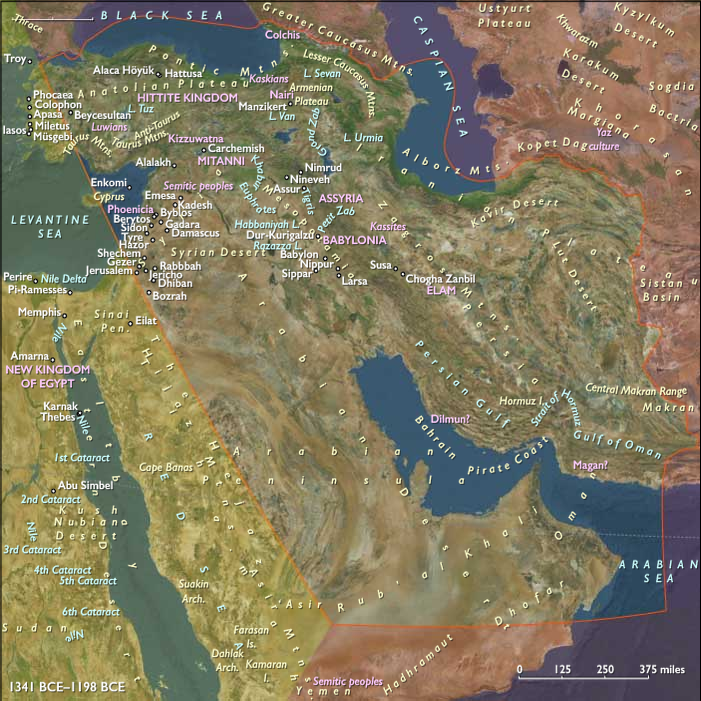
During the fourteenth and thirteenth centuries BCE, the Hittite Empire reached its zenith, controlling territory extending from the Mediterranean Sea to the Persian Gulf. Their military success was largely attributed to innovations in chariot warfare and the early development of iron smelting. Hittite chariots, improved with lighter wheels featuring four spokes instead of eight and repositioned wheels that accommodated three warriors, dominated battles—most notably the largest known chariot battle at Kadesh on the Orontes River around 1274 BCE, where they decisively defeated Egyptian forces. However, despite their military prowess, Hittite dominance faced continuous unrest from vassal states and external threats, eventually contributing to their collapse in the early twelfth century BCE.
Egyptian Retreat and Phoenician Maritime Expansion
With Egypt weakening toward the late fourteenth century BCE, Phoenician city-states—Sidon, Tyre, Byblos, Ugarit, and Arvad—experienced renewed autonomy and significant maritime expansion. Phoenician merchants intensified Mediterranean trade, notably in Tyrian purple dye, cedar timber, luxury glassware, and metal goods, facilitated by advancements in shipbuilding. The invention and dissemination of the alphabetic cuneiform script from Ugarit further revolutionized communication and trade.
Cyprus and Alashiya's Commercial Peak
The Late Bronze Age was a formative period for Cyprus (Alashiya), a vital copper supplier to Egypt, Anatolia, and the Levant. The city of Enkomi flourished as an international commercial hub, adopting a structured urban grid reminiscent of Syrian cities, notably Ugarit. The Cypriot syllabic script was widely utilized, reflecting extensive trade and cultural exchanges with Mycenaean Greece and Near Eastern states. Cyprus remained politically stable as a Hittite client state, experiencing brief direct Hittite intervention around 1200 BCE to secure its crucial copper resources.
Mitanni’s Fall and Assyrian Ascendancy
The Hurrian state of Mitanni, centered on Washshukanni, collapsed under combined pressure from the Hittites and a resurgent Assyria. By 1270 BCE, Mitanni territory split, with Assyria absorbing its eastern portion and the Hittites annexing the west. Assyria, independent once more under rulers such as Ashur-uballit I (1365–1330 BCE), embarked on territorial expansion. Assyrian kings aggressively campaigned southward into Babylonia, temporarily overthrowing Kassite rule under Tukulti-Ninurta I (1244–1208 BCE). Assyria developed extensive botanical gardens and elaborate cultural customs, becoming a dominant Near Eastern power.
Kassite Babylon and Cultural Continuity
Despite intermittent conflicts, Kassite Babylonia endured as a significant regional power. Temples like the Temple of Karaindash at Uruk exemplified Kassite architectural advancements, incorporating sculpted bricks and orientation toward the rising sun. Babylon under Kassite governance remained culturally vibrant, with compositions such as the Enuma Elish epic reflecting its enduring spiritual and cultural centrality.
Middle Elamite Cultural Flourishing
In southwestern Iran, the Middle Elamite Period (circa 1500–1200 BCE) saw an unprecedented surge of cultural and architectural achievements. Under rulers like Untash-Napirisha (1265 BCE), monumental projects such as the temple complex at Choqa Zanbil emerged, demonstrating profound Elamite religious and artistic innovations. The period also marked a definitive linguistic shift toward the Elamite language, emphasizing a distinct cultural identity apart from Mesopotamian traditions.
Technological Innovations and Economic Networks
Economic and cultural exchanges flourished across the region, supported by advanced maritime and overland trade networks connecting Egypt, Cyprus, Anatolia, and Mesopotamia. The Hittites refined iron-smelting technologies by about 1400 BCE, contributing significantly to the onset of the Iron Age. Meanwhile, cities like Nuzi introduced early forms of brass metallurgy, highlighting extensive technological interactions throughout the Middle East.
Nomadic Influence and Regional Instability
Throughout this era, increasing aridity and weakened state control amplified the influence of nomadic groups such as the Ahlamû and the early Aramaeans. These groups, noted for their mobility and military prowess, disrupted established trade routes and challenged settled societies. Such pressures underscored the region’s gradual shift toward greater political fragmentation and the emergence of new social dynamics.
This period, defined by major shifts in power, technological breakthroughs, intensified trade, and increased nomadic influences, significantly reshaped the political and cultural landscape of the ancient Middle East, setting the stage for subsequent historical developments.
People
Groups
- Polytheism (“paganism”)
- Semites
- Larsa, city-state of
- Dilmun (Bahrain?)
- Cyprus, Archaic
- Canaanite culture, ancient
- Hurrians
- Isin, city-state of
- Amorites
- Ebla, Kingdom of
- Erbil (Arbil, Irbil), city-state of
- Nineveh, city-state of
- Ugarit, Kingdom of
- Alalakh, city-state of
- Kassites
- Yamhad, or Yamkhad, Kingdom of
- Hapiru, or Habiru
- Sealand, or Marsh, Kingdom
- Egypt (Ancient), Second Intermediate Period of
- Hyksos, Kingdom of
- Phoenicia
- Aramaeans
- Egypt (Ancient), New Kingdom of
- Mitanni (Hanigalbat), Kingdom of
- Elam, (Middle) Kingdom of
- Arzawa
- Ahhiyawa
- Tyre, Kingdom of (Phoenicia)
Topics
Commodoties
- Weapons
- Hides and feathers
- Glass
- Domestic animals
- Grains and produce
- Ceramics
- Strategic metals
- Beer, wine, and spirits
Subjects
- Commerce
- Writing
- Architecture
- Sculpture
- Painting and Drawing
- Environment
- Decorative arts
- Conflict
- Mayhem
- Faith
- Government
- Custom and Law
- Technology
- Metallurgy
Regions
Subregions
Years: 1341BCE - 1198BCE
People
Groups
- Polytheism (“paganism”)
- Semites
- Larsa, city-state of
- Dilmun (Bahrain?)
- Cyprus, Archaic
- Canaanite culture, ancient
- Hurrians
- Isin, city-state of
- Amorites
- Ebla, Kingdom of
- Erbil (Arbil, Irbil), city-state of
- Nineveh, city-state of
- Ugarit, Kingdom of
- Alalakh, city-state of
- Kassites
- Yamhad, or Yamkhad, Kingdom of
- Hapiru, or Habiru
- Sealand, or Marsh, Kingdom
- Egypt (Ancient), Second Intermediate Period of
- Hyksos, Kingdom of
- Phoenicia
- Aramaeans
- Egypt (Ancient), New Kingdom of
- Mitanni (Hanigalbat), Kingdom of
- Elam, (Middle) Kingdom of
- Arzawa
- Ahhiyawa
- Tyre, Kingdom of (Phoenicia)
Topics
Commodoties
- Weapons
- Hides and feathers
- Glass
- Domestic animals
- Grains and produce
- Ceramics
- Strategic metals
- Beer, wine, and spirits
Subjects
- Commerce
- Writing
- Architecture
- Sculpture
- Painting and Drawing
- Environment
- Decorative arts
- Conflict
- Mayhem
- Faith
- Government
- Custom and Law
- Technology
- Metallurgy
Regions
Subregions