
The Middle East: 129–118 BCE The …
Years: 129BCE - 118BCE
The Middle East: 129–118 BCE
The Seleucid Collapse and Parthian Ascendancy
The period from 129 to 118 BCE signifies a crucial turning point in Middle Eastern history, characterized by the near-complete collapse of the Seleucid Empire and the definitive rise of Parthian power.
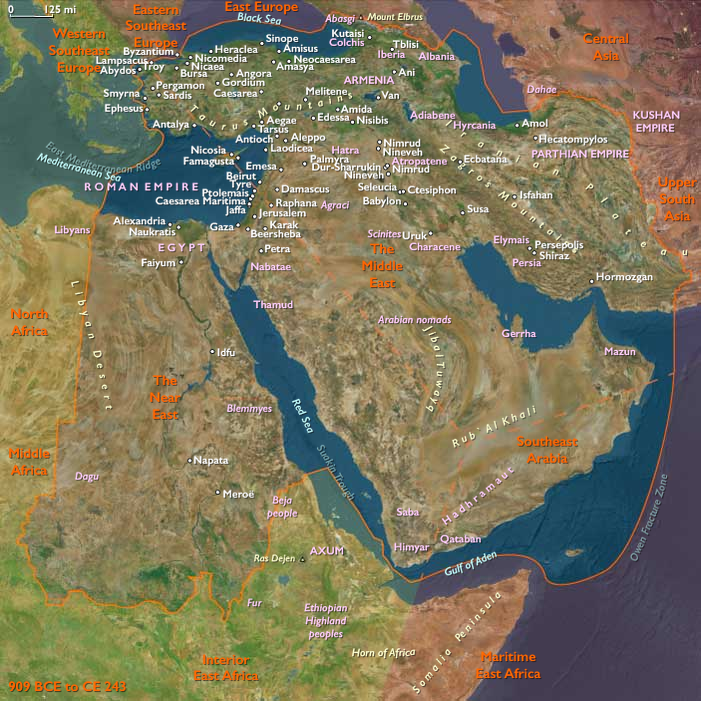
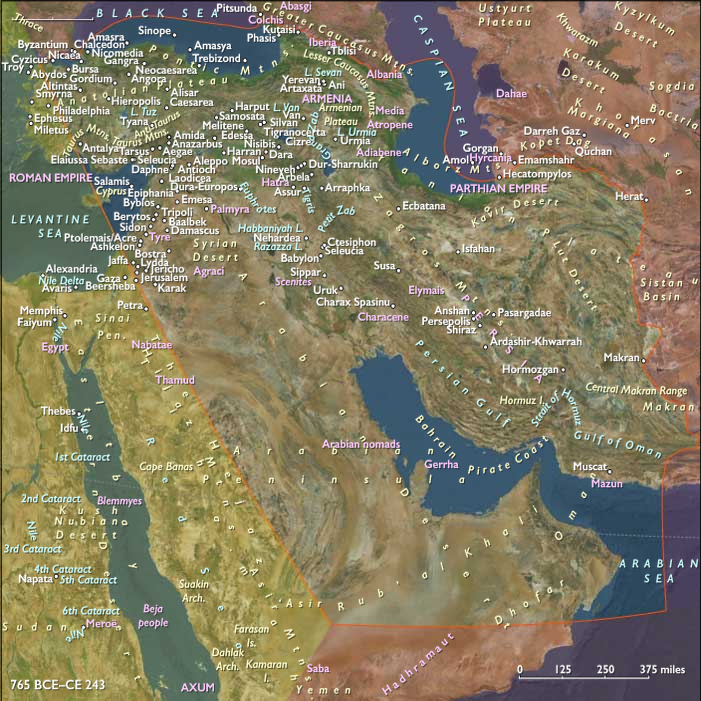
In 129 BCE, the Parthians decisively repel the last major Seleucid attempt at reconquest in a significant battle at Ecbatana, where Seleucid king Antiochus VII is killed. This crushing defeat effectively signals the end of Greco-Macedonian influence east of the Euphrates and severely weakens the already fragile Seleucid state. Following this loss, the Seleucid Empire shrinks dramatically, essentially reduced to a rump state consisting primarily of Antioch and its immediate surroundings.
The Seleucid realm plunges into internal chaos, with multiple claimants battling for control and neighboring states steadily encroaching upon its diminished borders. The return of former king Demetrius II from Parthian captivity only exacerbates the instability. During his second reign, Demetrius holds limited territory and is assassinated around four years later, highlighting the Empire's rapid decline into internal fragmentation.
This era also witnesses profound cultural exchanges between the Greco-Macedonian west and the Persian-influenced east. Greek thought and practices deeply permeate eastern regions, while Persian and Indian sciences, literature, and architectural influences gradually spread westward, leaving enduring legacies.
Significantly, Parthia's westward territorial expansion during these years sets the stage for inevitable conflicts with the rising power of Rome. The resulting Roman–Parthian rivalry will dominate geopolitical dynamics in the Middle East for several centuries.
Thus, the period from 129 to 118 BCE marks the decisive demise of Seleucid dominance, solidifies Parthian power, and initiates a lasting geopolitical rivalry between Parthia and Rome, profoundly reshaping the Middle East.
People
Groups
Topics
Subjects
Regions
Subregions
Related Events
Filter results
Showing 10 events out of 63023 total
Emperor Han Wudi’s reign sees great territorial expansion and a burst of economic and cultural activity.
His armies push north and west into central Asia, east to Korea, and south to the coast.
Commerce with the states of western Asia increases, silk becomes a major export, and inventors discover ways to make paper and porcelain.
Han historiographer Sima Qian writes Shiqi (Shih chi) ("The Records of the Historians"), which will serve as the prototype for the official histories of successive dynasties.
Han scholars direct their efforts to find or reconstruct the Zhou classics banned during the Qin dynasty.
Confucianism begins to replace Legalism as the Han dynasty’s orthodox philosophy.
The Seleucid–Parthian wars have brought about a lasting cultural exchange between East and West.
Greek ideas will be remembered in the East long after they have been forgotten about in the West, while Persian and Indian influences in sciences, literature and architecture will be introduced to western powers such as the Romans.
The westward expansion of Parthia during the war will eventually lead to clashes with the Roman Empire.
The Roman–Parthian Wars will embroil these ancient empires until the third century.
The Parthians drive back the last Seleucid counterattack in 129 BCE, a turning point in the history of the eastern Mediterranean: Greco-Macedonian domination receives a decisive blow, which it will survive for only forty-six more years.
The loss of their king in the battle of Ecbatana together with so much territory sends the already enfeebled Seleucid empire into a decline from which it can never recover.
The Empire becomes a rump state that consists of little more than Antioch and the surrounding lands.
The only reason the Seleucid Empire continues to exist is because the Parthians see it as a useful buffer against the Roman Empire.
Antiochus leaves five children by his queen.
Syria lapses into civil war, with all hopes of empire gone.
Demetrius II returns to Syria after his release form captivity, but during his second reign, he controls only part of the kingdom, and is assassinated about four years later.
Neighboring states begin to gnaw constantly at the edges of the weak and divided kingdom.
Near East (129–118 BCE): Consolidation and Cultural Flourishing
The era from 129 to 118 BCE in the Near East witnesses the ongoing consolidation and territorial expansion of the Hasmonean kingdom in Judaea, alongside continued Hellenistic cultural developments across the region.
In Judaea, the Hasmonean rulers further strengthen their political and military power, consolidating the gains achieved in the preceding decades. Under John Hyrcanus I (ruling from 134 to 104 BCE), the kingdom vigorously asserts its autonomy by annexing neighboring territories, including Samaria and Idumaea. This expansion not only enhances the geographic reach of Judaea but also prompts forced conversions among conquered peoples, notably the Idumaeans, significantly altering the region's demographic and religious landscape.
Culturally, Hellenistic influence remains vibrant. Cities across the Near East continue to serve as dynamic centers of Greek learning, art, and architecture. The interaction between Greek traditions and local customs produces an enriched, syncretic culture visible in urban planning, sculpture, and literary activity. Notably, this era marks further refinements in artistic styles and craftsmanship that will influence subsequent generations.
Legacy of the Era
The period 129–118 BCE is marked by significant geopolitical shifts and continued cultural synthesis. The territorial expansion and religious consolidation of the Hasmonean kingdom lay crucial groundwork for the evolving identity and political dynamics of Judaea. Concurrently, the sustained vigor of Hellenistic culture ensures the continued transmission and adaptation of Greek traditions, deeply embedding them into the cultural fabric of the Near East.
Mediterranean Southwest Europe (129–118 BCE): The Gracchan Reforms and Roman Social Turmoil
The era 129–118 BCE witnesses pivotal developments within the Roman Republic, characterized by profound political and social tensions centered on land reform and wealth redistribution, accompanied by innovations in public communication. These events significantly influence Roman governance, social dynamics, and political culture in Mediterranean Southwest Europe and beyond.
The Gracchan Reform Movement
The Roman Republic faces escalating social tensions stemming from the increasing disparity between Rome's wealthy patrician elite and the disenfranchised plebeian majority. In response, two influential Roman tribunes, brothers Tiberius and Gaius Gracchus, propose sweeping land reform legislation aimed at redistributing extensive patrician landholdings among landless and impoverished plebeian citizens. Their reform efforts also include wider measures addressing economic inequality and social injustice.
Initially, the Gracchi achieve notable legislative successes, rallying popular support and challenging entrenched senatorial interests. However, their reforms threaten the political and economic power of Rome's senatorial aristocracy, prompting fierce opposition from powerful patrician factions.
Tragically, both Gracchi brothers ultimately fall victim to this elite backlash. Tiberius Gracchus is assassinated in 133 BCE, marking the first significant eruption of organized political violence in the Republic, and his younger brother, Gaius Gracchus, meets a similar violent fate in 121 BCE. These assassinations starkly illustrate the increasing volatility and internal conflict plaguing the Roman state, signaling profound future implications for republican governance.
Emergence of the Acta Diurna
Concurrent with this period of social unrest, Rome experiences significant advances in public information dissemination. Around 131 BCE, the establishment of the Acta Diurna (Latin: "Daily Acts") introduces a state-sanctioned daily news gazette posted prominently in public locations, such as the Roman Forum. These postings report on varied topics, including official government appointments, notable births and deaths, significant public decisions, and even astronomical occurrences.
Carved on stone or metal tablets, the Acta Diurna represent an innovative attempt by the Roman Republic to ensure transparency and enhance public communication, setting a precedent for future methods of mass communication across the Roman world. This pioneering institution provides citizens with regular access to official information and public records, facilitating an increased awareness of civic affairs and reflecting the changing relationship between Rome's government and its populace.
Long-Term Impact and Significance
The Gracchan reforms and their violent suppression, alongside the advent of the Acta Diurna, significantly shape Rome's subsequent social, political, and administrative trajectory. The events of this era underscore growing tensions between populist reform movements and entrenched elite interests, presaging the deep internal conflicts that will ultimately transform the Roman Republic. The era also sees early innovations in civic communication, indicative of Rome's ongoing evolution toward greater administrative complexity and societal interconnectedness, foreshadowing the imperial era ahead.
The Gracchi brothers, Roman plebeian nobles who both serve as tribunes in the late second century BCE, attempt to pass land reform legislation that will redistribute the major patrician landholdings among the plebeians, in addition to other reform measures.
After achieving some early success, both are assassinated for their efforts.
The Acta diurna (Latin: Daily Acts, sometimes translated as Daily Public Records), a type of Roman daily news gazette that reports such varied topics as official appointments, local births and deaths, and astronomical events, had first appeared around 131 BCE.
The Acta consists of political and social notices authorized by the state, copies of which are posted daily at public places in Rome and the provinces.
They are carved on stone or metal and presented in message boards in public places like the Forum of Rome.
They are also called simply Acta or Diurna or sometimes Acta Popidi or Acta Publica.
North Africa (129–118 BCE)
Numidian Succession Tensions, Carthaginian Stability, Cyrenaic Prosperity, and Berber Resilience
Numidia: Rising Succession Challenges
From 129 to 118 BCE, Numidia encounters significant internal strain due to mounting succession tensions among the heirs of King Micipsa, who succeeded Masinissa. Micipsa’s careful diplomacy and effective governance had previously ensured Numidian prosperity and stability, but as his reign nears its end, questions of succession increasingly destabilize the kingdom. These internal divisions begin laying the groundwork for future conflict and invite increased Roman diplomatic scrutiny and intervention in Numidian affairs.
Carthage: Continued Economic Strength and Diplomatic Prudence
During this era, Carthage sustains its economic recovery, remaining a vital economic center within Roman Africa Proconsularis. Carthaginian merchants and farmers continue to rebuild and expand trade networks, emphasizing agriculture, commerce, and manufacturing. The city maintains careful diplomatic relations with Rome, ensuring compliance with treaty obligations to avoid provoking Roman suspicion or intervention. Carthage's cultural presence remains influential, reflecting resilience and adaptability despite limited political autonomy.
Cyrenaica: Economic Stability and Cultural Flourishing
Cyrenaica continues to enjoy economic prosperity under stable Ptolemaic governance. The Greek Pentapolis—Cyrene, Barce (Al Marj), Euhesperides (Benghazi), Teuchira (Tukrah), and Apollonia (Susah)—retains strong economic activity, particularly through exports of grain, wine, wool, livestock, and the esteemed medicinal plant Silphium.
Cyrene maintains its celebrated status as an intellectual and cultural hub, continuing to attract distinguished scholars, philosophers, and medical practitioners. The city's academies, medical schools, and public institutions further enhance its status as a central node of Hellenistic culture and learning.
Roman Provincial Consolidation and Urban Development
Throughout 129–118 BCE, Roman authority in the province of Africa Proconsularis solidifies further. Urban development initiatives and infrastructure improvements enhance the economic and political strength of key Roman-controlled cities, notably Utica. Roman investment improves agricultural productivity, transportation infrastructure, and urban planning, reinforcing economic prosperity and administrative efficiency across the region.
Berber Communities: Economic Adaptation and Cultural Continuity
Berber communities remain actively involved in North Africa’s expanding economic landscape, increasingly integrated into Roman trade networks. Coastal trade hubs, particularly Oea (Tripoli), continue thriving through robust commercial exchanges with Roman and Mediterranean markets, indirectly bolstering inland Berber communities.
Inland Berber tribes persist in their traditional governance and cultural practices, benefiting indirectly from the coastal economic boom. This mutually beneficial relationship fosters continued economic stability and cultural resilience among the Berbers, reinforcing their integral role in regional dynamics.
Dynamic Cultural Exchange and Religious Syncretism
The period sees ongoing vibrant interactions among Berber, Roman, and Greek populations, enriching regional artistic and artisanal traditions in pottery, textiles, and metalwork. Religious syncretism remains an essential aspect of regional culture, harmoniously blending indigenous Berber traditions with Roman, Greek, and lingering Phoenician religious practices, further enriching North Africa’s diverse cultural tapestry.
Foundations for Continued Stability
By 118 BCE, North Africa maintains significant stability and prosperity despite Numidian internal tensions. Carthage’s ongoing economic strength, Cyrenaica’s stable governance, robust Roman provincial integration, and enduring Berber economic and cultural resilience collectively ensure continued regional prominence and stability within the Mediterranean geopolitical landscape.
Atlantic Southwest Europe (129–118 BCE): Decline of Lusitanian Resistance and Roman Territorial Consolidation
Between 129 and 118 BCE, Atlantic Southwest Europe—encompassing northern and central Portugal, Galicia, Asturias, Cantabria, and northern Spain south of the Franco-Spanish border (43.05548° N, 1.22924° W)—experienced significant shifts following the assassination of Viriathus (139 BCE), leading to a gradual decline of coordinated Lusitanian resistance. The region entered an era defined by increasing Roman military consolidation, heightened regional tensions, intensified economic integration within Mediterranean networks, and continued reliance on slave labor. Despite Roman territorial gains, tribes remained culturally resilient, setting the stage for future conflicts and assimilation processes.
Political and Military Developments
Decline of Unified Lusitanian Resistance
-
Following Viriathus’s assassination in 139 BCE, unified tribal resistance significantly weakened. Lusitanian and allied tribal forces fragmented, reducing their effectiveness in confronting Roman military operations.
-
Roman commanders capitalized on internal divisions, steadily suppressing resistance and extending territorial control deeper into previously autonomous regions.
Increasing Roman Territorial Consolidation
-
Rome intensified administrative and military control in Iberia, expanding provincial governance structures (Hispania Citerior and Ulterior) and securing vital economic and military routes into Atlantic Southwest Europe.
-
Roman garrisons and fortified settlements proliferated, signaling growing dominance and stability in previously resistant tribal territories.
Persistence of Northern Tribal Autonomy
-
Northern tribes such as the Gallaeci, Astures, and Cantabri maintained defensive postures, reinforcing hillfort settlements and territorial boundaries, continuing resistance efforts and preserving substantial autonomy.
-
The Vascones, benefiting from strategic neutrality and diplomatic caution, largely avoided direct confrontation, preserving their distinct cultural and territorial integrity.
Economic and Technological Developments
Deepening Mediterranean-Roman Economic Integration
-
Tribes remained economically embedded within Mediterranean trade networks. Metals, wool, salt, agricultural products, timber, and especially slaves were continuously exported, while Mediterranean luxury goods, wine, oil, and advanced iron weaponry entered tribal economies, deepening economic dependency and integration.
-
Economic elites among Lusitanians, Vettones, Gallaeci, and Celtici benefited significantly, reinforcing local hierarchies and social stratification.
Continued Reliance on Slave Labor
-
Slavery remained fundamental, extensively utilized in mining operations (silver, copper, tin), agriculture, domestic labor, and artisanal craftsmanship. Slave trade continued actively with Roman merchants, reinforcing economic integration and social hierarchies.
Ironworking Sophistication and Craftsmanship
-
Iron metallurgy continued advancing significantly, improving agricultural productivity, warfare capabilities, and artisanal craftsmanship, reshaping local economies.
-
Skilled artisans from Lusitanian, Gallaeci, and Vettones communities produced finely crafted iron weaponry, tools, armor, and decorative objects, integrating indigenous styles with Mediterranean influences.
Cultural and Religious Developments
Cultural Synthesis and Material Expression
-
Material culture further synthesized Celtic, indigenous Iberian, and Roman artistic elements, evident in sophisticated metalwork, pottery, ceremonial artifacts, decorative jewelry, and everyday objects.
-
Despite Roman territorial advances, tribal cultural identities remained resilient and vibrant, reflecting regional pride and autonomy in artistic and cultural expressions.
Complex Religious Practices and Identity
-
Ritual and religious traditions intensified in complexity, integrating indigenous Iberian, Celtic, and Roman religious elements. Ceremonial sites, sanctuaries, sacred landscapes, and ritual practices continued reinforcing tribal solidarity and communal identity.
-
Warrior rites, ancestor ceremonies, and communal feasts persisted as key societal rituals, providing cultural continuity amidst territorial and political pressures.
Notable Tribal Groups and Settlements
-
Lusitanians: Experienced fragmentation following Viriathus’s death but continued local resistance and territorial fortification, even as Roman influence deepened.
-
Vettones and Vaccaei: Strategically repositioned after losing unified resistance, maintaining regional autonomy and economic resilience.
-
Gallaeci, Astures, and Cantabri: Strengthened territorial defenses and autonomy, preparing strategically for potential future Roman aggression.
-
Vascones: Maintained their territorial autonomy and diplomatic neutrality, reinforcing cultural distinctiveness and societal stability.
Long-Term Significance and Legacy
Between 129 and 118 BCE, Atlantic Southwest Europe:
-
Experienced significant shifts from unified resistance under Viriathus to more fragmented tribal opposition, enabling steady Roman territorial consolidation.
-
Deepened economic dependency on Mediterranean trade networks dominated by Rome, firmly establishing slavery as a central economic institution.
-
Preserved and intensified distinct tribal and cultural identities, shaping future Iberian historical trajectories and resistance movements against external domination.
This transformative era laid critical foundations for Roman Hispania, regional integration, and cultural adaptation processes, profoundly influencing subsequent historical and societal developments in Atlantic Southwest Europe.
Atlantic West Europe (129–118 BCE): Escalating Tensions and Cultural Flourishing
Between 129 and 118 BCE, Atlantic West Europe—covering regions like Aquitaine, northern and central Gaul, Alsace, and the Low Countries—experienced escalating political tensions alongside remarkable economic and cultural growth. The period was marked by intensified competition among tribal powers and an increasingly sophisticated network of trade and cultural exchange with the Mediterranean world.
Political and Military Developments
Rising Tribal Conflicts
-
Renewed Arverni-Aedui Rivalry: Previously peaceful relations deteriorated, reigniting competition for dominance over key trade routes and resources. Sporadic skirmishes and diplomatic maneuvering underscored ongoing regional instability.
-
Belgae Militarization: The Belgae, especially the Nervii and Bellovaci, significantly increased their military preparedness, developing defensive fortifications and forming broader tribal coalitions in response to perceived external threats and internal competition with tribes like the Remi, Suessiones, and eastern neighbors such as the Treveri and Mediomatrici.
-
Veneti Maritime Assertiveness: The maritime-focused Veneti aggressively defended their Atlantic trade dominance against inland tribes and coastal rivals, notably the Namnetes and Coriosolites, as well as southern maritime competitors including the Pictones and Santones, leading to frequent localized confrontations.
Heightened Mediterranean Engagement
-
Roman economic influence steadily grew through expanded trade missions, diplomatic overtures, and strategic partnerships, further deepening Roman cultural and economic penetration into central and southern Gaul via Massalia.
-
Southern Mediterranean trading settlements exerted increased influence over local tribes by manipulating trade conditions, thereby indirectly influencing regional tribal politics and alliances.
Economic and Social Developments
Thriving Trade and Economic Expansion
-
Trade between the Atlantic and Mediterranean regions thrived, reaching unprecedented volumes. Commodities such as precious metals (silver, gold, tin), amber, salted meats, fine textiles, pottery, agricultural products, and slaves continued to flow abundantly along well-established riverine and coastal routes.
-
Economic prosperity fostered a growing merchant and artisanal class, significantly influencing local governance and societal structure. Slave trade persisted as a key economic element, reinforcing elite wealth accumulation and societal hierarchies.
Urban and Infrastructure Development
-
Oppida such as Bibracte, Cenabum (Orléans), Gergovia, and newly influential Lutetia (modern Paris) further expanded, becoming major administrative and economic hubs. These centers were characterized by improved fortifications, structured street grids, marketplaces, and specialized manufacturing zones.
-
Development of road networks and river ports improved trade efficiency and connectivity between inland and coastal regions, facilitating greater economic integration.
Cultural and Religious Developments
Peak of La Tène Cultural Expression
-
La Tène cultural expression reached a zenith, evidenced by exceptional craftsmanship in metalworking, decorative arts, and elaborate ceremonial weaponry. Artistic styles became increasingly influenced by Mediterranean motifs, demonstrating the depth of cultural exchange.
-
Burial rites continued to highlight social stratification, prominently featuring imported Mediterranean luxury items like wine amphorae, intricate jewelry, and prestigious metal goods.
Strengthened Druidic Institutions
-
Druids expanded their societal influence, actively mediating political disputes and consolidating their roles as key advisors, religious leaders, and guardians of cultural heritage.
-
Sacred spaces, sanctuaries, and ritualistic practices gained wider regional recognition, further binding disparate tribes through shared cultural and spiritual identities.
Notable Tribal Powers and Settlements
-
Arverni: Maintained their prominence through strategic resource management and continued economic strength, despite renewed tensions.
-
Aedui: Leveraged their critical geographic and economic positions, reinforcing their influence through diplomatic alliances and economic cooperation.
-
Veneti: Demonstrated resilient maritime control, maintaining substantial economic and political clout despite ongoing threats from neighboring coastal tribes.
-
Belgae (Bellovaci, Nervii): Strengthened defensive capabilities and territorial holdings, becoming increasingly influential in regional power dynamics, particularly in response to internal pressures and external tribal rivalries.
Long-Term Significance and Legacy
Between 129 and 118 BCE, Atlantic West Europe:
-
Witnessed a sharpening of regional tensions, laying the groundwork for future confrontations and tribal alliances.
-
Experienced substantial economic and urban expansion, enhancing societal complexity and regional interconnectedness.
-
Reached new cultural heights through vibrant artistic traditions and influential religious institutions, further consolidating regional identity and cultural cohesion.
This period significantly deepened Atlantic West Europe's integration into Mediterranean economic and cultural spheres, foreshadowing future interactions and eventual assimilation into the expansive Roman sphere of influence.
