
The Middle East: 1288–1299 CE Emergence …
Years: 1288 - 1299
The Middle East: 1288–1299 CE
Emergence of Ottoman Power
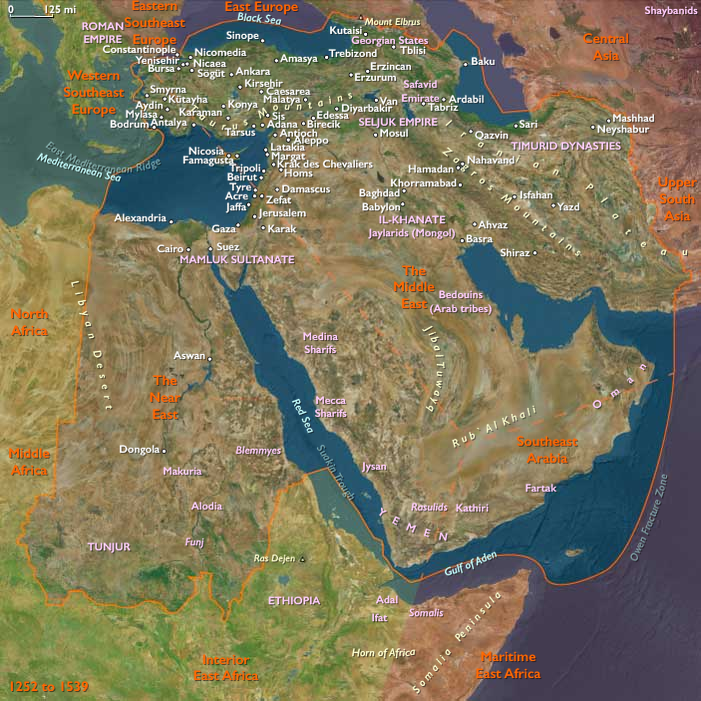
The period 1288–1299 CE witnesses significant shifts in power dynamics across Anatolia, particularly marked by the emergence of Osman I, leader of the Ottoman Turks. Following the Mongol defeat of the Seljuq army in 1293, the once-powerful Seljuq Sultanate of Rûm collapses, leaving a fragmented landscape in Anatolia. Independent Turkmen principalities, known as beyliks, arise to fill the vacuum left by Seljuq and Mongol dominance.
Osman, whose father, Ertuğrul, had established a border principality centered at Söğüt, gradually consolidates his position. He captures strategic former imperial fortresses, most notably Yenisehir, strengthening his base for further territorial expansion. This period marks the formative stages of the Ottoman Empire, which will soon dominate Anatolia and extend into southeastern Europe.
Ghazi Warriors and Frontier Dynamics
Frontier warriors known as ghazis, Turkic Muslim fighters initially engaged against Byzantine and Mongol forces, increasingly rally around Osman. These warriors are instrumental in Osman's early military successes, notably around key strongholds such as Bursa and Nicaea (modern-day İznik). The frontier culture fostered by these ghazis emphasizes religious zeal, martial prowess, and rapid territorial expansion, setting a foundation for Ottoman military and cultural ethos.
Continuing Mongol Influence and Fragmentation
Despite the rise of Osman and other local rulers, the Mongol Il-Khanate continues to exercise influence, albeit diminishing, over Persia, Iraq, and parts of Anatolia. The Mongols struggle to maintain centralized control, leading to increased autonomy among local governors and exacerbating the fragmentation of political authority throughout the region.
Intellectual and Cultural Exchange
This era continues the vibrant intellectual and cultural exchanges exemplified by earlier figures such as Gregory Bar Hebraeus. Although Bar Hebraeus himself passes away in 1286, his legacy of scholarly interaction between Christian and Muslim communities persists. Libraries and educational institutions across Syria, Armenia, and Anatolia maintain a rich tradition of intercultural dialogue and scholarship.
Crusader Decline and Defensive Strategies
The Knights Hospitaller and other Crusader states increasingly struggle against mounting pressures from local Muslim rulers and the expanding Ottoman influence. Their fortifications, particularly the strategically vital Krak des Chevaliers, remain under constant threat. This defensive posture highlights the declining power of Crusader holdings and the strategic challenges they face amidst the changing Middle Eastern geopolitical landscape.
In summary, the years 1288–1299 CE mark a critical turning point characterized by the decline of Mongol centralized control, the early rise of the Ottoman beylik under Osman I, continued scholarly and cultural exchange, and the persistent yet weakening Crusader presence in the region.
People
Groups
- Persian people
- Christians, Armenian Apostolic Orthodox
- Muslims, Sunni
- Turkmen people
- Christians, Eastern Orthodox
- Rûm, Sultanate of
- Jerusalem, Latin Kingdom of
- Italians (Latins)
- Tripoli, County of
- Teutonic Knights of Acre (House of the Hospitalers of Saint Mary of the Teutons in Jerusalem)
- Cyprus, Kingdom of
- Il-khanate
- Ottoman Emirate
Topics
Subjects
Regions
Subregions

Years: 1288 - 1299
People
Groups
- Persian people
- Christians, Armenian Apostolic Orthodox
- Muslims, Sunni
- Turkmen people
- Christians, Eastern Orthodox
- Rûm, Sultanate of
- Jerusalem, Latin Kingdom of
- Italians (Latins)
- Tripoli, County of
- Teutonic Knights of Acre (House of the Hospitalers of Saint Mary of the Teutons in Jerusalem)
- Cyprus, Kingdom of
- Il-khanate
- Ottoman Emirate
Topics
Subjects
Regions
Subregions