
The Middle East: 1276–1287 CE Mongol …
Years: 1276 - 1287
The Middle East: 1276–1287 CE
Mongol Consolidation and Fragmentation
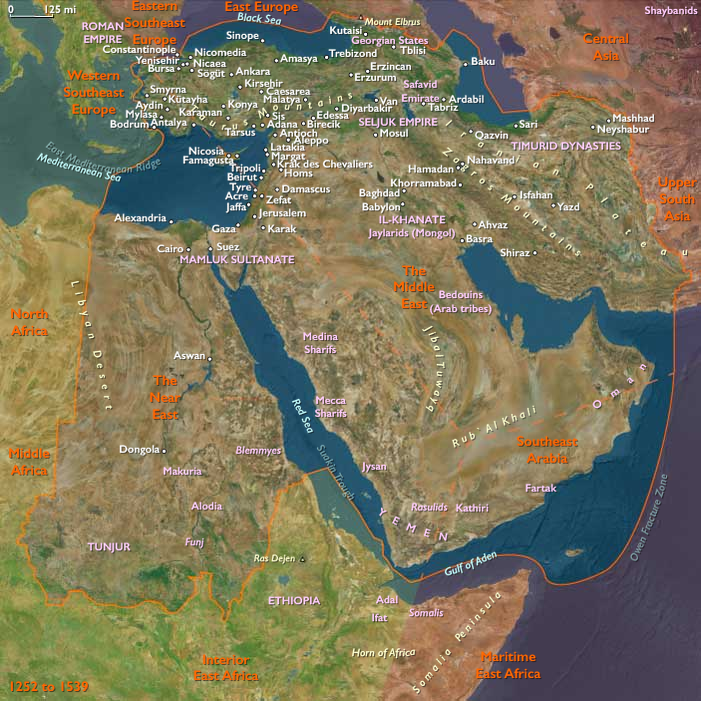
During 1276–1287 CE, the Mongol Il-Khanate further consolidates its control over the Middle East, solidifying governance structures throughout Persia, Iraq, and Anatolia. Despite their militaristic origins, Mongol rulers begin adopting aspects of local governance, significantly relying on Persian administrators and embracing Islam to enhance political legitimacy among the predominantly Muslim populations.
Cultural Exchange and Scholarship: Gregory Bar Hebraeus
A prominent figure during this period is the Syrian scholar Gregory Bar Hebraeus, noted for his extensive scholarship in science, philosophy, and literature. His numerous travels to libraries throughout Syria and Armenia foster significant intellectual exchange and dialogue between the Christian and Muslim worlds. Through his encyclopedic works, Gregory Bar Hebraeus enriches Syriac literature with Arabic cultural elements, thus significantly enhancing intercultural communication and understanding.
Continued Seljuq Fragmentation in Anatolia
The weakening of the Seljuq Sultanate of Rûm accelerates, with local Turkish beyliks increasingly asserting independence and forming distinct political entities. Anatolia becomes characterized by fragmented governance, setting the stage for the later rise of prominent powers such as the Ottoman beylik. This fragmentation creates a politically fluid environment marked by frequent alliances and rivalries among local Turkish and Mongol factions.
Crusader Fortifications and Military Dynamics
The Knights Hospitaller maintain their defensive strongholds in the Levant, particularly the Krak des Chevaliers, which remains a crucial bulwark against regional threats. However, increasing Mongol and Muslim pressures around this period challenge Crusader dominance, intensifying the strategic importance of these fortifications.
Cultural Resilience and Intellectual Continuity
Despite ongoing political instability, cultural and intellectual traditions in the region persist. The works of figures like Gregory Bar Hebraeus and Persian scholars maintain scholarly continuity, fostering intellectual growth amidst political uncertainty. This era, thus, witnesses both the persistent Mongol political presence and vibrant intercultural exchanges across diverse religious and ethnic communities.
People
Groups
- Persian people
- Turkmen people
- Rûm, Sultanate of
- Jerusalem, Latin Kingdom of
- Italians (Latins)
- Tripoli, County of
- Teutonic Knights of Acre (House of the Hospitalers of Saint Mary of the Teutons in Jerusalem)
- Cyprus, Kingdom of
- Il-khanate
Topics
Subjects
Regions
Subregions

Related Events
Showing 1 events out of 1 total
Years: 1276 - 1287
People
Groups
- Persian people
- Turkmen people
- Rûm, Sultanate of
- Jerusalem, Latin Kingdom of
- Italians (Latins)
- Tripoli, County of
- Teutonic Knights of Acre (House of the Hospitalers of Saint Mary of the Teutons in Jerusalem)
- Cyprus, Kingdom of
- Il-khanate
Topics
Subjects
Regions
Subregions