
…the Messinan Greeks have been riled by …
Years: 1168 - 1168
March
…the Messinan Greeks have been riled by the past months and a rebellion consequently breaks out in that city (on account of the criminal practices of one of Stephen's friends, Odo Quarrel).
Here, a mob commandeers some ships and sails to Reggio, there to force the release of Henry, Count of Montescaglioso, the queen's brother.
After Henry's arrival in Messina, Odo is arrested and brutally executed and all the Frenchman of the city massacred: an inglorious prelude to the more widespread Sicilian Vespers of 1282.
Stephen prepares an army (largely of Lombards from the region of Etna) and is ready to march on Messina when the young king postpones the campaign on astrological grounds.
Locations
People
Groups
Commodoties
Subjects
Regions
Subregions
Related Events
Filter results
Showing 10 events out of 48423 total
Established European states integrate the populations of subject peoples in adjacent lands: Swedes colonize southern Finland; Danes colonize the lands of the Wends, forcibly converting them to Christianity; Germans colonize Holstein, Lauenburg, and Mecklenburg; Anglo-Normans colonize Ireland.
Northeast Europe (1168–1179 CE): Royal Ascendancy, Crusading Momentum, and Baltic Resilience
Introduction
From 1168 to 1179 CE, Northeast Europe experienced a significant consolidation of royal authority, the growing momentum of crusading efforts, and ongoing resistance from the Baltic populations. This era notably marked Denmark's assertive expansion under King Valdemar I the Great, intensified missionary activities, and increasingly organized resistance among Baltic tribes against Christian encroachment.
Consolidation of Royal Power
In Denmark, the reign of Valdemar I the Great (r. 1157–1182) represented a period of pronounced royal consolidation and territorial expansion. Valdemar's leadership effectively ended decades of internal strife, establishing centralized authority through decisive victories against rival claimants. His reign notably included aggressive campaigns into pagan Baltic territories, significantly extending Danish influence and paving the way for a strengthened monarchy.
In Sweden, internal dynastic conflicts persisted between the Sverker and Erik families. Following the assassination of King Charles VII Sverkersson in 1167, political instability intensified. Nevertheless, emerging leaders continued attempts to centralize royal power, balancing internal feuds with territorial and missionary ambitions in the east.
Crusading Momentum and Expansion
The momentum of the Northern Crusades notably increased during this era. In 1168, under the leadership of King Valdemar I and Bishop Absalon of Roskilde, Danish forces decisively captured the strategic pagan stronghold at Arkona on the island of Rügen, dramatically expanding Christian influence in the southern Baltic. This event represented a major milestone in the northern expansion of Christianity, significantly emboldening crusaders' ambitions and serving as a springboard for further campaigns into the Baltic interior.
Missionary activities also continued in Finland and the eastern Baltic regions. Despite the earlier legendary First Swedish Crusade, persistent missionary incursions and military campaigns gradually reinforced Christian influence among resistant pagan populations.
Urban and Economic Development
Economic vitality and urbanization continued to flourish during this era. Visby on Gotland remained central to Baltic commerce, facilitating extensive trade exchanges with Scandinavia, northern Germany, and beyond. Danish towns, particularly Roskilde and Lund, grew notably, benefiting from increased economic activity, royal patronage, and the expanding influence of merchant guilds.
Baltic Resistance and Defensive Strategies
Baltic tribes, including the ancestors of modern Estonians, Latvians, and Lithuanians, responded to intensified Christian incursions by fortifying settlements, strengthening alliances, and launching coordinated counterattacks. The fall of Arkona in 1168 significantly alarmed these communities, prompting them to increase defensive measures and collaborative efforts to resist further crusading incursions effectively.
Ecclesiastical Influence and Cultural Expansion
The influence of ecclesiastical institutions continued to grow. The expansion of Cistercian monasteries significantly shaped regional cultural and educational life, spreading Latin literacy and ecclesiastical law. Bishop Absalon of Roskilde emerged as a prominent ecclesiastical and political figure, instrumental in promoting crusading ideology, bolstering royal authority, and advancing ecclesiastical structures throughout Denmark and newly conquered Baltic territories.
Legacy of the Era
The era 1168–1179 CE was pivotal in shaping Northeast Europe's historical trajectory. Enhanced royal authority in Denmark under Valdemar I, heightened momentum of the Northern Crusades, and resolute Baltic resistance collectively defined this transformative period. These developments laid crucial foundations for the continuing integration of Northeast Europe into broader European religious, cultural, and political spheres.
The Swedes’ colonization of southern Finland accelerates the increasing estrangement of the Estonians to the south of the Gulf of Riga from their Finnish kinsmen to the north.
East Central Europe (1168–1179 CE): Bohemia’s Royal Consolidation, Hungarian Stability under Béla III, Continued Polish Fragmentation, and the Strengthening of Austria under the Babenbergs
Between 1168 and 1179 CE, East Central Europe—including modern-day Poland, Czechia, Slovakia, Hungary, and the eastern regions of Germany and Austria east of 10°E and north of the defined southeastern boundary—experienced continued political consolidation and shifting regional dynamics. Bohemia saw royal authority strengthened under Vladislaus II; Hungary entered a prosperous era under Béla III; Poland’s fragmentation persisted, deepening regional autonomy; and Austria, newly elevated under the Babenbergs, solidified its identity and territorial influence. This era reinforced established kingdoms, intensified imperial involvement, and highlighted emerging political identities across the region.
Political and Military Developments
Bohemia under Vladislaus II: Royal Stability and Imperial Alliances
-
King Vladislaus II of Bohemia (r. 1140–1172) maintained strong royal authority with imperial support from Frederick Barbarossa, consolidating Přemyslid control and enhancing Prague’s position as a regional political center.
-
His successful governance ensured political stability and secured the Přemyslid dynasty’s long-term dominance, significantly shaping Bohemia’s medieval trajectory.
Hungarian Prosperity and Expansion under Béla III
-
In 1172, following brief succession conflicts after Géza II, Béla III (r. 1172–1196) ascended the throne, ushering in a period of considerable stability, administrative reform, and territorial expansion.
-
Béla’s reign marked increased diplomatic engagement with Byzantium and Western Europe, strengthening Hungary’s regional influence, internal governance, and economic prosperity.
Persistent Polish Fragmentation and Dynastic Rivalries
-
Poland remained deeply fragmented into autonomous Piast principalities, such as Silesia, Lesser Poland, Greater Poland, and Masovia, ruled independently by local princes. Persistent dynastic rivalries and territorial disputes limited unified royal authority, shaping Poland’s political landscape into competing regional power centers.
Strengthening of the Austrian Duchy under Henry II Jasomirgott
-
Under Duke Henry II Jasomirgott (r. 1141–1177), Austria strengthened its political identity and territorial coherence after elevation to duchy status in 1156. His rule solidified Austrian autonomy within the Holy Roman Empire, laying foundations for the Babenberg dynasty’s regional prominence.
Continued Imperial Influence under Frederick Barbarossa
-
Holy Roman Emperor Frederick Barbarossa (r. 1152–1190) maintained strong influence over regional politics, especially through alliances with Bohemia, overseeing the Austrian duchy, and managing imperial marches, profoundly shaping regional governance structures.
Economic and Technological Developments
Regional Economic Expansion and Prosperity
-
East Central Europe enjoyed continued economic growth, fueled by stable trade networks connecting Baltic, Central European, Byzantine, and Western markets. Towns expanded, and commerce thrived, notably in Hungary under Béla III and Bohemia under Vladislaus II.
Agricultural Productivity and Technological Improvements
-
Agricultural productivity continued to increase, driven by widespread adoption of advanced farming practices, heavy plow technologies, and effective land management, supporting urban expansion, population growth, and economic stability.
Cultural and Artistic Developments
Hungarian Cultural Renaissance under Béla III
-
Béla III extensively supported ecclesiastical institutions, scholarship, and artistic endeavors, including substantial architectural projects and illuminated manuscripts, reflecting Byzantine and Western European influences that enhanced Hungary’s cultural prestige.
Bohemian Cultural and Ecclesiastical Flourishing
-
Under Vladislaus II, Bohemia’s cultural landscape flourished, supported by royal patronage of monasteries, manuscript illumination, and architectural developments. Prague became an influential cultural and religious center, attracting scholars and artisans.
Cultural Continuity in Poland amid Fragmentation
-
Despite political divisions, Polish ecclesiastical institutions, particularly monasteries, maintained vibrant cultural activities and scholarly traditions, preserving religious identity and regional cultural continuity.
Settlement and Urban Development
Hungarian Urban Expansion under Béla III
-
Under Béla III, Hungarian towns, including Esztergom, Székesfehérvár, and Buda, experienced significant urban development, expanded fortifications, administrative structures, and thriving markets, reflecting strong royal authority and prosperous economy.
Bohemian Urban Prosperity and Infrastructure
-
Bohemia’s towns, especially Prague, benefited from continued Přemyslid patronage, urban infrastructure improvements, and stable governance, reinforcing their economic and administrative prominence.
Austrian Settlement Consolidation under the Babenbergs
-
The Austrian duchy saw growth and stabilization in urban centers, including Vienna, under Henry II Jasomirgott, laying foundations for Austria’s regional economic and political influence.
Social and Religious Developments
Expansion and Strengthening of Ecclesiastical Structures
-
Ecclesiastical influence deepened across the region, with robust monastic expansion, episcopal administration, and religious patronage shaping governance, education, and societal organization, particularly in Hungary under Béla III and Bohemia under Vladislaus II.
Aristocratic Influence and Dynastic Stability
-
Aristocratic power continued to influence regional governance significantly. Hungary’s strong monarchy under Béla III, Bohemia’s Přemyslid stability, and Austria’s Babenberg consolidation all exemplified the interplay of dynastic authority and aristocratic governance. In fragmented Poland, local aristocrats gained increased power amid dynastic rivalry.
Long-Term Consequences and Historical Significance
The era 1168–1179 CE profoundly shaped East Central Europe’s medieval development. Bohemia’s royal consolidation under Vladislaus II, Hungary’s stable and prosperous governance under Béla III, Austria’s strengthening under the Babenbergs, and Poland’s continued fragmentation defined distinct regional identities and governance structures. These developments reinforced economic prosperity, cultural vitality, and enduring political dynamics, significantly influencing East Central Europe’s subsequent historical trajectory.
Eastern Southeast Europe (1168–1179 CE): Alliances, Cultural Integration, and Emerging Tensions
Settlement and Migration Patterns
Consolidation of Transylvanian Communities
The integration and expansion of the Transylvanian Saxons, settlers primarily from the Low Countries and various Germanic regions, continued to strengthen Hungarian frontier security. These Saxon communities thrived, constructing fortified cities and villages such as Hermannstadt (Sibiu), enhancing regional stability, commerce, and agriculture.
Strategic Importance of the Szeklers
The Szekler communities maintained their strategic frontier positions in Transylvania, actively participating in border defense and frontier diplomacy, serving as crucial military allies and cultural intermediaries between Hungarian rulers and local populations.
Economic and Technological Developments
Venetian Trade Dominance and Byzantine Rivalry
Despite continued efforts by Emperor Manuel I Komnenos to diminish Venetian control over trade, Venice maintained significant economic influence. Manuel attempted alliances with other maritime powers, such as Genoa and Pisa, to counterbalance Venetian dominance, reflecting sustained economic rivalry and strategic maneuvering.
Advancements in Military Fortifications
Fortification projects expanded significantly throughout the region, with major cities like Constantinople strengthening their defenses against potential invasions and internal rebellions. Enhanced military logistics, fortresses, and reinforced city walls characterized this period, reflecting ongoing investment in regional security infrastructure.
Cultural and Artistic Developments
Byzantine-Western Cultural Integration
Cultural integration between Byzantium and Western Europe flourished further, particularly at the imperial court. Manuel I Komnenos continued encouraging Latin influences, attracting Western artists, scholars, and courtiers, fostering rich exchanges despite internal resistance from traditional Byzantine elites.
Intellectual and Scholarly Activity
Educational institutions actively preserved classical and theological traditions, increasingly incorporating Western scholarly methods and ideas. Enhanced intellectual exchanges between East and West enriched the cultural and educational landscape of the Byzantine Empire and its neighbors.
Social and Religious Developments
Diplomatic Alliances and Marital Strategies
Manuel I’s diplomatic strategy deepened alliances with Hungary through marital ties, as he sought to stabilize his northern frontier and counterbalance threats from the expanding Kingdom of Sicily. These alliances created interconnected royal dynasties that significantly influenced regional diplomacy and politics.
Growing Internal Tensions and Latin Influence
Internal tensions grew within the Byzantine Empire due to Manuel’s embrace of Western culture and prominent Latin presence. The Greek-Latin divide intensified further, reflecting cultural and religious friction that would lead to future conflicts and societal divisions.
Expansion of Religious Institutions
Christian institutions continued their influential expansion, deeply embedded in social and political structures. Monasteries and churches increased their roles as centers of spiritual authority and community cohesion, reinforcing cultural identity amid external pressures and internal tensions.
Long-Term Consequences and Historical Significance
The era from 1168 to 1179 CE was characterized by diplomatic sophistication, significant cultural integration, and the strengthening of frontier communities. Manuel’s alliances and embrace of Western influences shaped complex geopolitical dynamics, while growing internal tensions foreshadowed future societal divisions. These developments critically impacted Eastern Southeast Europe's trajectory, setting the stage for subsequent cultural, political, and military challenges.
Constantinople’s fleet checks initial Venetian moves in the Aegean from 1170.
A truce is concluded in 1177; a peace treaty will follow in 1183.
The Sefer ha-bahir (Hebrew: Book of Brightness), a largely symbolic commentary on the Old Testament, the basic motif of which is the mystical significance of the shapes and sounds of the Hebrew alphabet, appears in late twelfth-century Provence, ruled by the Spanish from Catalonia from 1113.
The influence of the Bahir on the development of Kabbala (esoteric Jewish mysticism) is profound and lasting.
Kabbalists themselves consider the book to be much older, falsely attributing its oldest traditions to Rabbi Nehunya ben Haqana, who flourished in the first century CE, and crediting many of the book's sayings to early Jewish scholars called tannaim (first to third century) and amoraim (third to sixth century).
The Bahir, although unsystematic, generally enigmatic, and written in a mixture of Hebrew and Aramaic, successfully introduces into Kabbala—and through Kabbala, into Judaism—an extensive mystical symbolism.
The Bahir, for example, contains the earliest-known explanation of the ten “divine emanations” that, in a mysterious way, are said to symbolize and explain the creation and continued existence of the universe.
These ten ma'amarot (sayings”), divided into three upper and seven lower manifestations, become widely known in Kabbala as sefirot (”numbers”).
The Bahir also introduces into Kabbalistic speculations the concept of the transmigration of souls (gilgul) and the notion of a cosmic, or spiritual, tree to symbolize the flow of divine creative power.
In addition, evil is said to be a principle found within God himself.
The last part of the book draws heavily on an ancient mystical text called Raza rabba (”The Great Mystery”).
Kabbalists view the Bahir as authoritative, whereas others reject it as heretical.
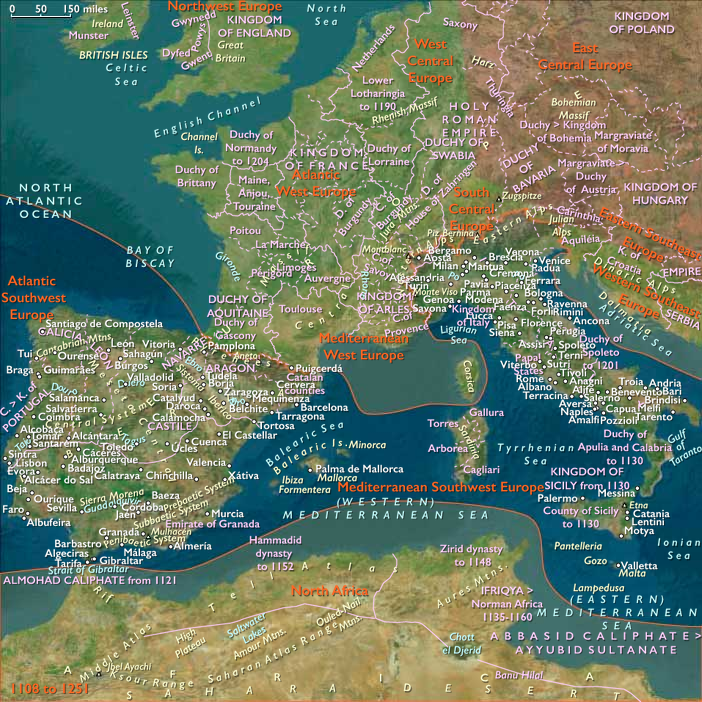
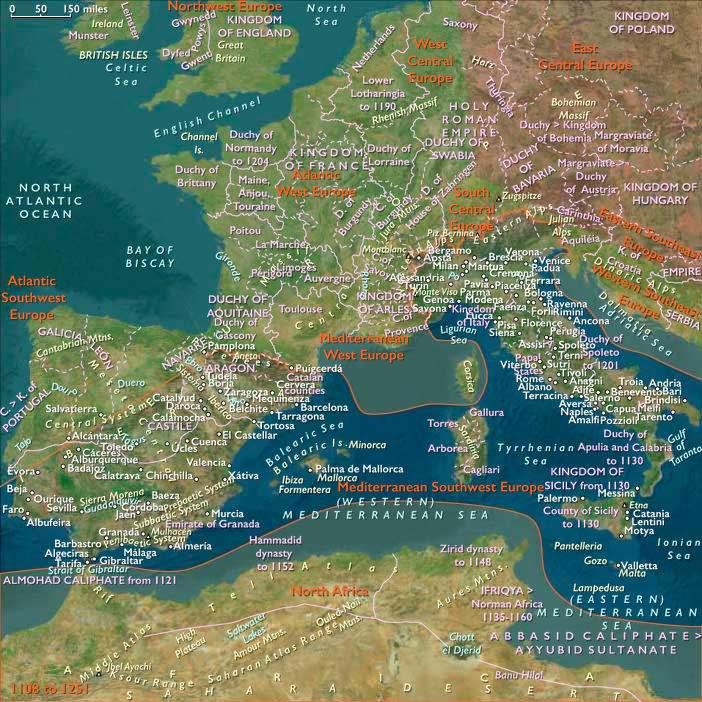
Mediterranean Southwest Europe (1168–1179 CE): Sicilian Earthquake, Almohad Conquest, and Communal Resistance in Italy
The era 1168–1179 CE in Mediterranean Southwest Europe is marked by a catastrophic natural disaster in Sicily, the rapid expansion and consolidation of the Almohad Caliphate in Iberia, and notable communal resistance in northern Italy against imperial forces.
The 1169 Sicily Earthquake and Tsunami
On February 4, 1169, southern Italy and Sicily suffer a devastating earthquake with an estimated magnitude between 6.4 and 7.3, reaching a maximum intensity of X (Intense) on the Mercalli scale. Severely damaging cities such as Catania, Lentini, and Modica, the earthquake triggers a tsunami, leading to approximately fifteen thousand fatalities and widespread destruction, profoundly impacting the region’s urban infrastructure and economy.
Almohad Conquest and Expansion in Al-Andalus
During this era, the North African Berber Almohad dynasty decisively expands its control into Iberia, overpowering the fragmented taifa kingdoms and rapidly transforming the political and religious landscape of Muslim Spain. By the late 1160s and early 1170s, major cities such as Seville, Córdoba, and Granada fall under Almohad dominance. The Almohads impose a stricter, more orthodox interpretation of Islam, resulting in intensified pressure on Christian Mozarab and Jewish communities, many of whom migrate northward toward Christian kingdoms.
Founding and Resistance of Alessandria
In northern Italy, the city of Alessandria—founded initially as Civitas Nova in 1168 CE—emerges as a stronghold of communal resistance within the Lombard League, formed to defend traditional liberties against Holy Roman Emperor Frederick Barbarossa. In 1174–1175, Alessandria successfully withstands an intense Imperial siege. According to local legend, the city's resistance is famously aided by a clever peasant named Gagliaudo, whose cunning convinces Barbarossa to abandon the siege prematurely, although malaria likely contributes significantly to the Emperor's withdrawal.
Cultural and Economic Continuity
Despite significant political and natural upheavals, Mediterranean Southwest Europe maintains its cultural and economic vitality. The Norman kingdom of Sicily continues to flourish culturally under the Hauteville dynasty, particularly through architectural innovations in the Arab-Norman style.
Legacy of the Era
The era 1168–1179 CE significantly influences Mediterranean Southwest Europe through the destructive Sicilian earthquake, the politically transformative Almohad conquest in Iberia, and the successful communal resistance exemplified by Alessandria in northern Italy. Collectively, these events profoundly shape the region’s political alignments, cultural dynamics, and societal resilience moving into subsequent periods.
Sited in the Piedmont region southeast of Turin, Alessandria stands in the territories of the marchese of Montferrat, a staunch ally of the Emperor, with a name assumed in 1168 to honor the Emperor's opponent, Pope Alexander III.
In 1174–1175 the fortress is sorely tested by Imperial siege and stands fast.
A legend (related in Umberto Eco's book Baudolino, and which recalls one concerning Bishop Herculanus’ successful defense of Perugia several centuries earlier) says it was saved by a quick-witted peasant, Gagliaudo: he fed his cow with the last grain remaining within the city, then took it outside the city walls until he reached the Imperial camp.
Here he was captured, and his cow cut open to be cooked: when the Imperials found the cow's stomach filled with grain, Gagliaudo was asked the reason to waste such a rich meal.
He answered that he was forced to feed his cow with grain because there was such a lot of it, and no room to place it within the city.
The Emperor, fearing that the siege will last too long, leaves Alessandria free (malaria is probably the real cause of his departure).
A statue of Gagliaudo can be found today on the left corner of the city cathedral.
The 1169 Sicily earthquake, which occurs on February 4, 1169, at 07:00 on the eve of the feast of St. Agatha of Sicily (in southern Italy), has an estimated magnitude of between 6.4 and 7.3 and an estimated maximum perceived intensity of X (Intense) on the Mercalli intensity scale.
Catania, Lentini and Modica are severely damaged.
It triggers a tsunami.
Overall, the earthquake is estimated to have caused the deaths of at least fifteen thousand people.
Years: 1168 - 1168
March
Locations
People
Groups
Commodoties
Subjects
Regions
Subregions