
The Messapians, an Indo-European people who inhabit …
Years: 472BCE - 472BCE
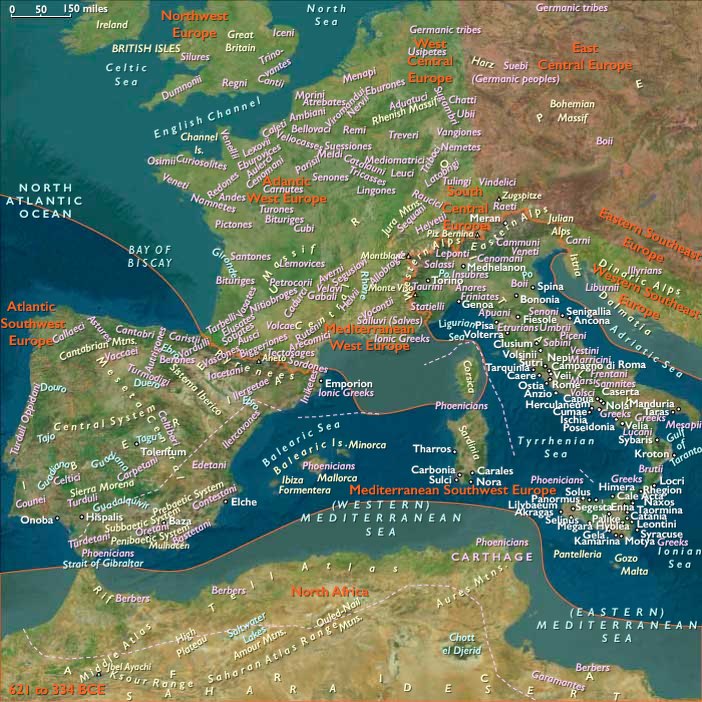
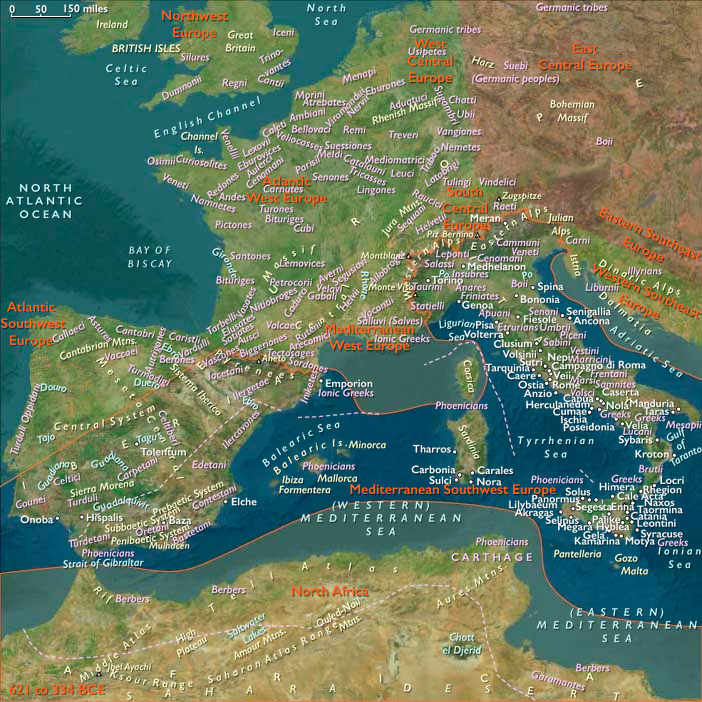
The Messapians, an Indo-European people who inhabit the heel of Italy (modern Apulia) and speak the Messapian language, had come most likely from Illyria; they are the most southerly tribe of the Iapygesm, a name given them by the Greek authors, who linked the tribe's origin to Dedalus's son Iapyges.
(Roman authors called thenm Apuli, Salentini, and Calabri.)
Their other tribes included the Daunii and the Peucetii.
The Peuceti, an Italic people of Oscan-Umbrian origin, probably settled together with the Dauni and Messapi in the eleventh century BCE, coming from Illyria over the Otranto channel.
Iapygians are kin to the Oenotrians, another tribe of Illyrian descent who had arrived at the beginning of the Iron Age from Illyria through the Otranto Channel to inhabit the region of Apulia, Basilicata and Northern Calabria.
In the early fifth century BCE, the Lucani move south into Oenotria, driving the indigenous tribes, known to the Greeks as Oenotrians, Chones, and Lauternoi, into the mountainous interior.
The settlement of the Greeks with the first stable colonies, such as Metapontum, founded on a native one (Metabon), had pushed the Oenotrians inland.
Taranto, founded in 706 BCE by Dorian immigrants as the only Spartan colony, has increased its power, becoming a commercial force and a sovereign city of Magna Graecia, ruling over the Greek colonies in southern Italy.
In its beginning, Taranto was a monarchy, probably modeled on the one ruling over Sparta; according to Herodotus (iii 136), around 492 BCE, king Aristophilides ruled over the city.
The expansion of Taranto has been limited to the coast because of the resistance of the populations of inner Apulia.
Taranto signs an alliance with Rhegion in 472 to counter the Messapii, Peuceti, and Lucanians, but the joint armies of the Tarentines and Rhegines are defeated near Kailìa (modern Ceglie Messapica) in what Herodotus claims to be the greatest slaughter of Greeks in his knowledge, with three thousand Reggians and uncountable Tarentines killed.
Locations
Groups
- Dorians
- Oenotrians
- Messapii (Iapygian tribe)
- Peucetii (Iapygian tribe)
- Greece, classical
- Italy, classical
- Magna Graecia
- Rhegium, Greek city-state of
- Taras (Dorian Greek) city-state of
- Lucani
Topics
Commodoties
Subjects
Regions
Subregions
Related Events
Showing 10 events out of 65424 total
Years: 472BCE - 472BCE
Locations
Groups
- Dorians
- Oenotrians
- Messapii (Iapygian tribe)
- Peucetii (Iapygian tribe)
- Greece, classical
- Italy, classical
- Magna Graecia
- Rhegium, Greek city-state of
- Taras (Dorian Greek) city-state of
- Lucani
Topics
Commodoties
Subjects
Regions
Subregions