
Unlike the Paleolithic, when more than one …
Years: 28557BCE - 7822BCE
Unlike the Paleolithic, when more than one human species existed, only one human species (Homo sapiens sapiens) reaches the Neolithic, a period in the development of human technology, beginning about 10,200 cal. BCE according to the ASPRO chronology in some parts of the Middle East, and later in other parts of the world.
The term Neolithic, which derives from the Greek eolithikos, from neos, “new," and lithos, "stone," literally meaning "New Stone Age," was invented by Sir John Lubbock in 1865 as a refinement of the three-age system.
Traditionally considered as the last part of the Stone Age, the Neolithic follows the terminal Holocene Epipaleolithic period, beginning with the rise of farming, which produces the "Neolithic Revolution," and ending when metal tools become widespread in the Copper Age (chalcolithic) or Bronze Age or developing directly into the Iron Age, depending on the geographical region.
The Neolithic is a measured progression of behavioral and cultural characteristics and changes, including the use of wild and domestic crops and the use of domesticated animals.
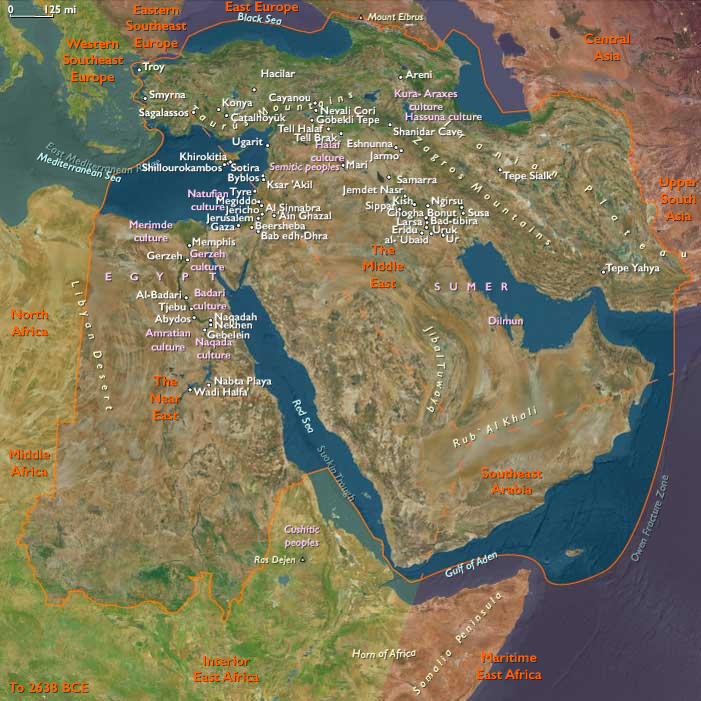
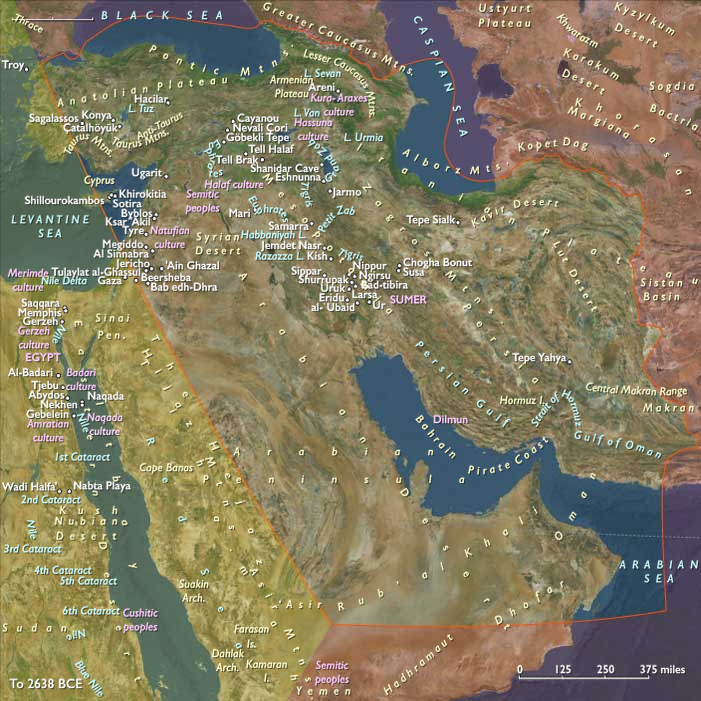
New findings put the beginning of a culture tentatively called Neolithic back to around 10,700 to 9400 BCE in Tell Qaramel in northern Syria, twenty-five kilometers north of Aleppo.
Until those findings are adopted within the archaeological community, the beginning of the Neolithic culture is considered to be in the Levant (Jericho, modern-day West Bank) about 10,200-8800 cal. BCE.
It developed directly from the Epipaleolithic Natufian culture in the region, whose people pioneered the use of wild cereals, which then evolved into true farming.
Groups
Topics
Commodoties
Subjects
Regions
Subregions

Years: 28557BCE - 7822BCE
Groups
Topics
Commodoties
Subjects
Regions
Subregions