The medical school in Pisa, stimulated by …
Years: 1543 - 1543
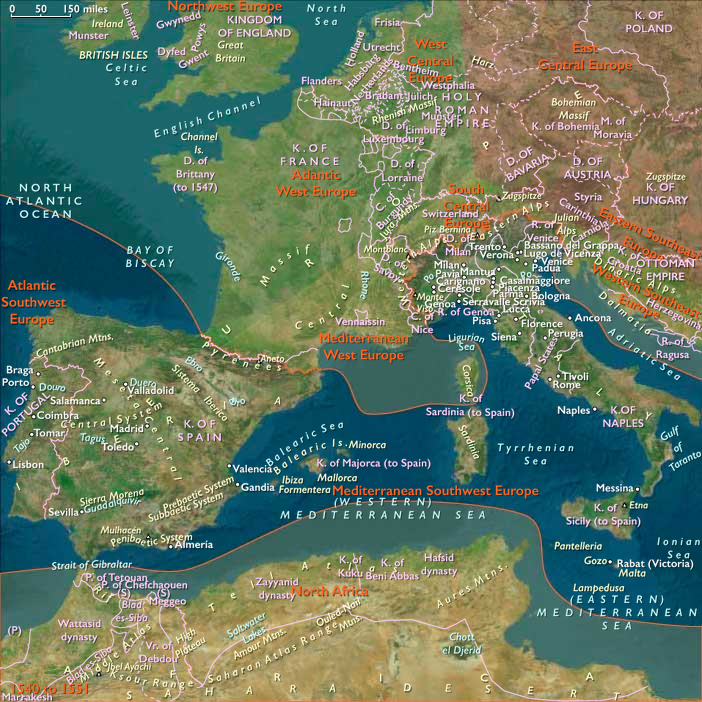
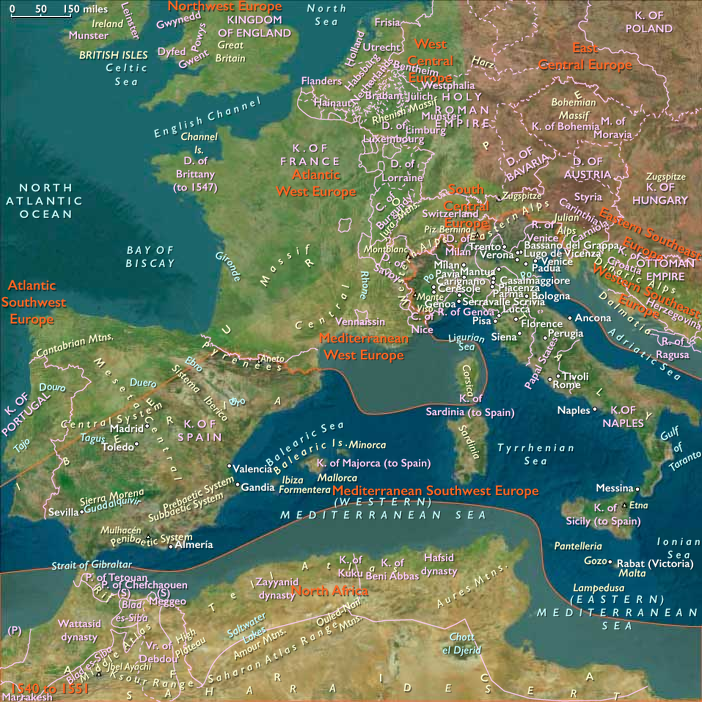
The medical school in Pisa, stimulated by the growing reliance on herbal medicine, establishes in about 1543 a botanical garden devoted mainly to medicinal species.
The garden is used for training medical students, growing plants to make medicines, and conducting research.
Locations
Groups
Topics
Subjects
Regions
Subregions
Related Events
Filter results
Showing 10 events out of 36673 total
López de Villalobos sights ten islets on the same latitude, appearing so beautiful that they name them "Los Jardines" (The Gardens), on January 6, 1543. (This was probably Eniwetok, according to historian Martin J. Noone.)
Between Eniwetok and ...
...Ulithi, during the period between January 6 and 23, the galleon San Cristobal piloted by Gines de Mafra (who had been a member of the crew of the Magellan expedition in 1519-1522) is separated from the fleet during a severe storm.
This ship ultimately reaches the island of Mazaua, the anchorage of the Magellan expedition in March-April 1521, where Magellan and his crew had been received with great "urbanity," as chronicled by Antonio Pigafetta, the Vicentine diarist who wrote the most comprehensive eyewitness account of Magellan's voyage.
This is the second visit of de Mafra to this island, which is sometimes mistakenly identified today as Limasawa in southern Leyte; the location and identity of Mazaua remains a mystery.
The men spend the next four to six months at the hospitable little isle.
De Mafra, in his account, relates he again met the "king" of Mazaua, named "Siaiu" by Pigafetta, who showed to de Mafra the items Magellan had given him as gifts, namely a "robe of red and yellow cloth, made in the Turkish fashion, and a very fine red cap," as enumerated by Pigafetta.
The Spanish fleet enters Baganga Bay (which they name Malaga) on east Mindanao on February 29.
López de Villalobos names Mindanao Caesaria Karoli after the Holy Roman Emperor, Charles V of Spain, because it looks so majestic.
The fleet stays here thirty-two days, the entire crew suffering extreme hunger.
The fleet leaves on March 31 in search of Mazaua, which had become famous for its friendly and generous reception to the Magellan fleet, but northerlies prevent them from making any headway.
After a ten-day struggle, ...
...they drop down and reach Saranggani.
The San Cristobal, to the delight and relief of everyone, appears out of nowhere around the first week of July, bringing food from Mazaua.
The San Juan and San Cristobal leave for Leyte on August 4.
A Portuguese contingent arrives on August 7, and delivers a letter from Jorge de Castro, governor of the Moluccas, demanding an explanation for the presence of the fleet in Portuguese territory.
López de Villalobos responds, in a letter dated August 9, that they are not trespassing and are perfectly within the Demarcation Line of the crown of Castile.
The San Juan leaves for Mexico on August 27, with Bernardo de la Torre as captain.
Another letter from Castro arrives in the first week of September with the same protest, and López de Villalobos writes a reply dated September 12 with the same message as his first.
He quits Sarranggani to go to Abuyog, Leyte with his remaining ships, the San Juan and the San Cristobal but again, the fleet cannot make headway because of unfavorable winds.
Spanish navigator Ruy López de Villalobos meanwhile discovers the thirty-odd Bonin, or Ogasawara, Islands, a volcanic, mountainous archipelago located about five hundred miles (eight hundred kilometers) south of Tokyo.
The so-called "Epoch of the Warring Country" referring to the decades of warfare in Japan that follow the Onin War of 1466-67 and the resultant collapse of Ashikaga power, has wrought substantive changes in the nation’s political, economical, and social structures.
New feudal lords, the “daimyo,” have arisen in the provinces, independent of imperial or shogunal authority.
Drawing their power from military strength, the daimyo define their domains as the area that can be defended from military rivals.
In an essentially feudal system, ties are fixed by vassalage, and land holdings are guaranteed in return for military service.
The daimyo concentrate their vassals in castle towns, leaving the villagers to administer themselves and pay taxes.
The castle towns develop intro market and handicraft industrial centers, and a new style of urban life begins to flourish.
This is the state of the country in 1543, when a Portuguese ship, blown off its course to China, lands in Japan; its sailors are the first Europeans to reach Japan.
The Portuguese sailors led by Fernão Mendes Pinto become the first Europeans to reach Japan when their ship is wrecked on Tanegashima, a small island to the south of Kyushu.
They gain the favor of a feudal lord, to whom they claim to have given the first firearm to enter Japan, the Portuguese arquebus. (The weapon will be rapidly reproduced and have a major impact on the ongoing Japanese civil wars; until modern times firearms will be colloquially known in Japan as "Tanega-shima," due to the belief that they were introduced by Pinto. Pinto was probably not in fact present at the first Portuguese contact with the Japanese, although he did visit Tanegashima soon after, and legend says he did marry a local woman and had a son.)
Nanban (“Southern Barbarian”), a Japanese word that originally designated people from South Asia and Southeast Asia, follows a Chinese usage in which surrounding “barbarian” people in the four directions have each their own designation.
The word will take on a new meaning in Japan when it comes to designate Europeans, first from Portugal, then Spain, and later the Netherlands and England. (The Dutch, however, will be known more commonly as Komo, meaning "Red Hair.”)
The word Nanban was thought naturally appropriate for the new visitors, since they came in by ship from the South, and their manners were considered quite unsophisticated by the Japanese.
These first Portuguese Nanban have arrived to trade, not only guns, but also soap, tobacco and other goods unknown in medieval Japan, for the excellent Japanese manufactures sold for a good price in Europe.
The Swedish king, after spreading royal propaganda to win over the population and turn them against Dacke, breaks the ceasefire in January 1543 and sends a new and larger army into the rebellious area.
Dacke, overconfident after earlier successes, meets the Royal army in a pitched battle in March.
The trained soldiers fighting on their own terms shatter the peasant army and Dacke is severely wounded.
The rebellion is all but over after this defeat, and Dacke becomes an outlaw.
While trying to escape from the king's mercenaries, Dacke is shot and killed on the border between the two nowadays southern Swedish provinces Småland and Blekinge, a border between Sweden and Denmark.
Dacke had not been executed, but his body is nvertheless dismembered and the parts sent for public display in larger communities that had supported him during the rebellion.
Gustav Vasa orders the annihilation of Dacke's entire family, and the execution of other peasant leaders, but is milder against those who have given themselves up.
The unity of the realm is thus restored.
Gustavus compels Småland’s citizens to pay severe financial retribution, but does, however, moderate his autocratic rule from this point forward, reducing his reliance on foreign mercenaries in the army in favor of soldiers of Swedish extraction (many of which will be recruited in Småland).
This lays the foundation for Sweden's military successes in later wars.
Polish writers write almost exclusively in Latin until 1543, when the moralist Mikolaj Rej, one of the best-known Polish poets and writers of the Renaissance, produces a satire on contemporary social and religious affairs in the Polish vernacular.
He is considered one of the founders of Polish literature.
Rheticus, an enthusiastic supporter of Nicolaus Copernicus and his heliocentric theory, publishes Narratio prima ("A First Account").
Following this publication, the sixty-seven-year-old Copernicus, nearly three decades after discreetly circulating his novel heliocentric theory in manuscript form, finally substantiates his arguments with his publication of De revolutionibus orbium coelestium ("On the Revolutions of the Heavenly Spheres").
Challenging the geocentric cosmology that has been accepted dogmatically since the time of Aristotle, Copernican theory is in fact in direct opposition to Aristotle and to Greco-Egyptian astronomer Ptolemy, who had enunciated the details of the geocentric system in the second century.
Ptolemy developed his system through observance of the celestial phenomena of the daily rotation of the heavens, the annual movement of the Sun through the ecliptic, and the periodic retrograde motion of the planets.
The Ptolemaic system, however, requires a complex, and ultimately arbitrary, combination of cycles upon cycles to account for these motions.
Copernicus proposes in "De revolutionibus" that a rotating Earth revolving with the other planets about a stationary central Sun can account for these same observed phenomena in a simpler way.
Copernicus, however, still follows the ancient Aristotelian doctrines of solid celestial spheres and the perfect circular motion of heavenly bodies, and remains essentially wedded to the entire Aristotelian physics of motion.
He also follows Ptolemy in representing planetary motion by means of complex combinations of cycles, although with significant innovations.
Although Copernicus realizes that his theory implies an enormous increase in the size of the universe, he declines to pronounce it infinite.
An undocumented story has Copernicus receiving a printed copy of his treatise on his deathbed; he dies at seventy on May 24, 1543.