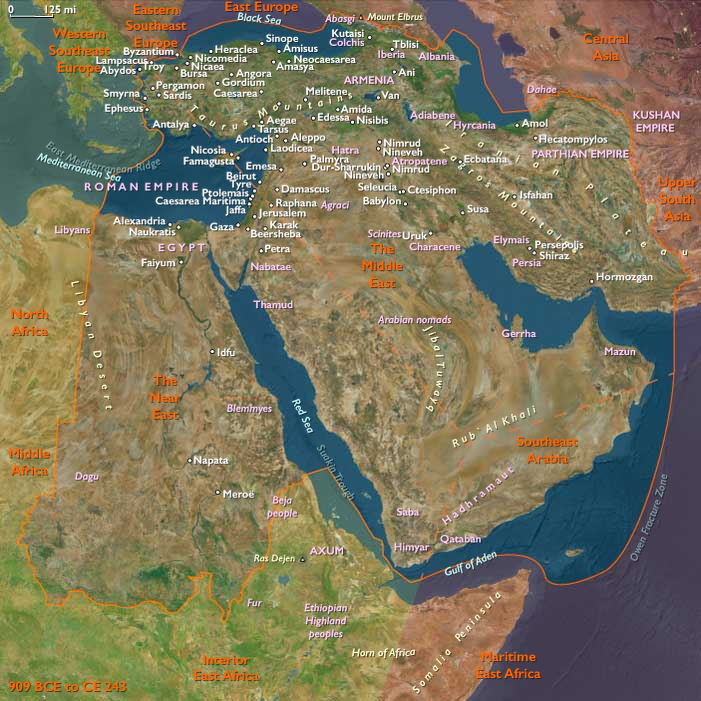
The Medes, under Astyages, have subdued the …
Years: 585BCE - 574BCE
The Medes, under Astyages, have subdued the Persians and other Iranian tribes on the plateau.
According to Herodotus, Astyages chooses Cambyses, an early member of the Achaemenid dynasty, as a son-in-law because he considers him to pose no threat to the Medean throne.
Cambyses is apparently a great-grandson of the dynasty’s founder Achaemenes, grandson of Teispes of Anshan and son of Cyrus I of Anshan.
Anshan, the original capital of Elam in the third millennium BCE, captured by Teispes, is now a minor kingdom in the declining Elamite Empire.
Cambyses’ paternal uncle had reigned as Ariaramnes of Persia and his first cousin as Arsames of Persia.
According to Herodotus, Cambyses is "a man of good family and quiet habits".
Reigning from 580 under the overlordship of Astyages, he is reportedly married to Princess Mandane of Media, a daughter to Astyages and Princess Aryenis of Lydia, and reportedly a granddaughter to both Cyaxares of Media and Alyattes II of Lydia.
Locations
People
Groups
Topics
Subjects
Regions
Subregions
Related Events
Filter results
Showing 10 events out of 65910 total
Ionian Greeks from Heraclea Pontica establish the city of Chersonesus Taurica, probably as a trading factory, (located three miles west of modern Sevastopol, Ukraine) on the Heracleotic Chersonese (or Chersonesos Micra [Small Chersonese]) in the southwestern part of Crimea, known in the sixth century BCE as Taurica.
Milesian Greeks establish the apoikia (trading post) of Odessos (present-day Varna) on the north shore of Varna Bay on the Black Sea coast towards the end of the seventh century BCE (the earliest Greek archaeological material is dated 600-575 BCE), or, according to Pseudo-Scymnus, in the time of Astyages (here, usually 572-570 BCE is suggested), within an earlier Thracian settlement.
The name Odessos is pre-Greek, arguably of Carian origin.
A member of the Pontic Pentapolis, Odessos is a mixed community—contact zone between the Ionians and the Thracians (Getae, Krobyzoi, Terizi) of the hinterland.
Excavations at nearby Thracian sites have shown uninterrupted occupation from the seventh to the fourth century and close commercial relations with the colony.
The Middle East: 585–574 BCE
Nebuchadnezzar's Babylonian Renaissance
Following the devastation of Babylon through repeated rebellions and conflicts with Assyrian rulers like Sennacherib and Ashurbanipal, Nebuchadnezzar II (r. ca. 605–562 BCE), one of the most renowned rulers of the Chaldean Dynasty, continues extensive restoration and reconstruction efforts begun by his father, Nabopolassar. Nebuchadnezzar seeks to transform Babylon into a city of unparalleled magnificence, surpassing even the grandeur of his military achievements. The city is fortified by a triple line of walls and divided by the Euphrates River, crossed by a robust bridge supported by streamlined, asphalt-covered brick piers designed to resist erosion.
Among his grand architectural projects are numerous temples dedicated to the Babylonian pantheon, the lavish royal palace finished with cedar-wood, bronze, gold, silver, and precious stones, and the legendary Hanging Gardens of Babylon, reputedly built for his Median wife, Queen Amytis, to ease her homesickness. Babylon's splendor is further adorned by the famed Ishtar Gate, part of a museum housing the trophies of Nebuchadnezzar’s conquests.
Prophetic Voices and Literary Developments
This era also witnesses significant developments in religious and literary traditions. The Hebrew prophet Jeremiah, active during this tumultuous period, preaches from Anathoth, near Jerusalem. Jeremiah advocates for moral reform, repentance, and a renewed relationship between humanity and God amid the Babylonian conquest of Judah. His deeply personal reflections, known as the "confessions of Jeremiah," appear in the first 25 chapters of the Biblical Book of Jeremiah, revealing the prophet's inner spiritual struggles. Jeremiah's prophecies and historical accounts significantly influence later biblical literature, notably the composition of the Deuteronomistic History found in the Hebrew scriptures.
Median-Lydian Rivalry and Diplomacy
In the same period, tension escalates between the Median Empire, under Cyaxares, and Lydia, under King Alyattes, triggered by territorial ambitions and personal animosity. The conflict culminates at the Battle of the Halys River (also called the Battle of the Eclipse) on May 28, 585 BCE. This encounter abruptly ends when a solar eclipse frightens both armies into believing it to be an omen from the gods. Negotiations, mediated by Babylonia and the Cilician kings, result in peace: the Halys River becomes the official boundary, and Alyattes’s daughter, Aryenis, marries Cyaxares's son, Astyages, sealing the treaty through marriage.
Astyages and the Median-Persian Dynamics
Astyages ascends the Median throne in 585 BCE upon his father Cyaxares's death. He inherits a vast empire stretching from western Iran into Anatolia, managing it alongside his two powerful brothers-in-law—Croesus of Lydia and Nebuchadnezzar of Babylon. Astyages strengthens Median control over Persia by subjugating various Iranian tribes. To further secure political alliances, Astyages arranges for his daughter, Mandane, to marry the Persian prince Cambyses I, a notable but politically unambitious figure from the minor Persian kingdom of Anshan.
This era, from 585 to 574 BCE, thus marks a period of significant political realignments, extensive cultural achievements, and religious introspection, shaping the historical trajectory of the Middle East profoundly.
Babylon had been greatly devastated during the last century of Niniveh's existence, not only at the hands of Sennacherib and Assurbanipal, but also as a result of her ever-renewed rebellions.
Nebuchadrezzar, the best known ruler of Babylon in the Chaldean Dynasty, who has reigned from about 605, has continued his father's work of reconstruction, aimed at making his capital one of the world's wonders.
Apparently taking greater pride in his constructions than his victories, Nebuchadrezzar restores old temples and erects new edifices of incredible magnificence to the many gods of the Babylonian pantheon (Diodorus of Sicily, 2.95; Herodotus, 1.183).
To complete the royal palace begun by Nabopolassar, nothing is spared, neither "cedar-wood, nor bronze, gold, silver, rare and precious stones"; an underground passage and a stone bridge connect the two parts of the city separated by the Euphrates; the city itself is rendered impregnable by the construction of a triple line of walls.
The bridge across the Euphrates is supported on asphalt covered brick piers that are streamlined to reduce the upstream resistance to flow, and the downstream turbulence that would otherwise undermine the foundations.
He establishes a museum in a rebuilt and refortified city for the trophies he has won, installing the famous Ishtar Gate, and creates fanciful adaptations of Mesopotamia’s familiar irrigated hillsides on his so-called Hanging Gardens of Babylon, built for his wife to remind her of her homeland Medis.
The prophet Jeremiah, who lived in Anathoth, on the outskirts of Jerusalem, called for moral reform to establish a personal relationship between God and humankind.
He advocated resignation in the face of political and religious crisis and denounces sin as a perversion of creation.
Jeremiah called urgently for repentance so that turning to God might lead to “a new creation.“ The autobiographical passages known as the "confessions of Jeremiah" appear in the first 25 chapters of the Biblical “Book of Jeremiah” along with a collection of prophecies against Jerusalem and Judah.
It derives its name from, and records the visions of, Jeremiah, who lived in Jerusalem in the late seventh and early sixth centuries BCE during the time of King Josiah and the fall of the Kingdom of Judah to the Babylonians.
The book is written in a complex and poetic Hebrew (apart from verse 10:11, curiously written in Biblical Aramaic).
The "confessions,” probably an original collection in their own right, reveal Jeremiah's inner struggle to surrender himself to God.
The prophet (according to chapter 36), dictates his words to "Baruch, son of Neriah," who records them on a scroll (long since vanished, and constituting only one of the sources for the “Book of Jeremiah”).
The original Judahite writings comprising the core narrative of the first “Book of Kings” probably dates from this era.
They narrate the history of Israel and Judah from Solomon's accession to the decline that began during his reign, including a detailed account of Solomon's legendary wisdom and wealth and the building of the Temple at Jerusalem.
According to Jewish tradition the author of Kings was Jeremiah, whose life overlapped the fall of Jerusalem in 586 BCE.
The most common view today accepts Martin Noth's thesis that Kings concludes a unified series of books which reflect the language and theology of the Book of Deuteronomy, and which biblical scholars therefore call the Deuteronomistic history.
Noth argued that the History was the work of a single individual living in the sixth century, but scholars today tend to treat it as made up of at least two layers, a first edition from the time of Josiah (late seventh century), promoting Josiah's religious reforms and the need for repentance, and (2) a second and final edition from the mid-sixth century.
Further levels of editing have also been proposed, including: a late eighth century edition pointing to Hezekiah of Judah as the model for kingship; an earlier eighth century version with a similar message but identifying Jehu of Israel as the ideal king; and an even earlier version promoting the House of David as the key to national well-being.

Astyages, married to Aryenis, the sister of King Croesus of Lydia, to seal the treaty between the two empires, ascends the Median throne in 585 upon the death of his father Cyarxes later in the year.
He has inherited a large empire, ruled in alliance with his two brothers-in-law, Croesus of Lydia and Nebuchadnezzar of Babylon, whose wife, Amytis, Astyages' sister, is the queen for whom Nebuchadnezzar is said to have built the Hanging Gardens of Babylon.
Media’s King Cyaxares and Lydia’s King Alyattes war from 590, instigated by a Median attempt to take over Urartu.
Herodotus (Histories, 1.73-74) states that there were two reasons for the war; the two sides clashing interests in Anatolia, but also there was a motive of revenge.
Some Scythian hunters employed by the Medes who once returned empty-handed were insulted by Cyaxares.
In revenge the hunters slaughtered one of his sons and served him to the Medes.
The hunters then fled to Sardis, the capital of the Lydians.
When Cyaxares asked for the Scythians to be returned to him, Alyattes refused to hand them over; in response, the Medes invaded.
The two armies oppose each other at the Halys River (Turkish: Kızılırmak, "Red River") , the boundary between Asia Minor and the rest of Asia, and also the boundary between Pontos and Paphlagonia.
As the site of the Battle of Halys or Battle of the Eclipse on May 28, 585 BCE, between the Medes and the Lydians, it is the border between Lydia to the west and Media to the east.
Since renamed as the Battle of the Eclipse, this final battle of the five-year war between Lydia and Media ends abruptly due to a total solar eclipse; the eclipse was perceived as an omen, indicating that the gods wanted the fighting to stop.
A truce is hastily arranged.
The war ends end through negotiations by the ruler of Babylonia and the Syenneses, kings of Cilicia.
As part of the terms of the agreement, Alyattes's daughter Aryenis is married to Cyaxares's son Astyages, and the river Halys is declared to be the border of the two warring nations.
Since the exact dates of eclipses can be calculated, the Battle of the Eclipse is the earliest historical event of which the date is known with such precision.
Near East (585–574 BCE): Babylonian Captivity and Shifts in Settlement Patterns
Judah under Babylonian Rule
Following the devastating Babylonian conquest, Judah no longer exists as an independent kingdom but becomes a mere province of the expansive Babylonian Empire. King Nebuchadnezzar II enforces another mass deportation of Judah’s population to Babylonia in 582 BCE, significantly intensifying the demographic shift initiated by earlier deportations. Only the poorest inhabitants—estimated at about twenty thousand—remain in Judah, struggling to sustain themselves in a ravaged landscape. This mass deportation, profoundly impacting Hebrew identity, religious practice, and community structure, inaugurates the epoch traditionally known in Jewish history as the Babylonian Captivity.
Demographic Changes in Hebron and Edomite Settlement
Concurrent with the broader depopulation of Judah, cities such as Hebron, historically significant and densely inhabited, experience severe demographic declines. Following the destruction of the First Temple and subsequent exile of Judahite inhabitants, Hebron is largely emptied of its traditional population. The conventional historical narrative, though notably lacking clear archaeological corroboration, suggests that displaced Edomites, fleeing pressures from Arab incursions, begin settling in areas vacated by the Judahites. This presumed Edomite migration reshapes the ethnic and cultural landscape of Hebron and surrounding regions, laying foundations for future demographic and cultural transformations in southern Palestine.
Legacy of the Era
The era of 585–574 BCE firmly entrenches Judah’s identity as a dispersed community, with the cultural and religious legacy of the Hebrew people evolving distinctly under conditions of exile. This period fundamentally alters the region's population dynamics, as older urban and agrarian structures are disrupted or abandoned. The displacement and subsequent reshaping of communities—epitomized by the contentious historical understanding of Hebron’s Edomite settlement—underscore the ongoing complexity of cultural interactions and migrations in the Near East during this transformative era.
Judah, having lost its status as a kingdom, has become a Babylonian province.
Nebuchadnezzar imposes upon Judah a further deportation of its citizens to Babylonia in 582, leaving only the poorest, who number some twenty thousand.
Thus begins the so-called Babylonian Captivity of Jewish tradition.
Most of the Judahite inhabitants of Hebron had been exiled after the destruction of the First Temple.
The conventional view, unsupported by archaeology, is that Edomites, escaping from Arab pressure, now took their place.
The growing crisis in Athens has forced most Athenians into debt; many have been sold into slavery to foreign lands.
The Athenian oligarchs, facing a serious economic crisis and the possibility of a revolt by the common people against their unpopular rule, give Solon, a well-intentioned liberal aristocrat who had had already held office as archon about 594 BCE, unique powers as “diallaktes,” or mediator, granting him absolute authority to remedy the grave ills afflicting Athens.
His first concern is to relieve the immediate distress caused by debt.
He redeems all the forfeited land and frees all the enslaved citizens, probably by fiat.
Solon in one of his poems describes this measure, known popularly as the “shaking off of burdens”: “These things the black earth … could best witness for the judgment of posterity; from whose surface I plucked up the marking-stones [probably signs of the farmers' indebtedness] planted all about, so that she who was enslaved is now free.
And I brought back to Athens … many who had been sold, justly or unjustly, or who had fled under the constraint of debt, wandering far afield and no longer speaking the Attic tongue; and I freed those who suffered shameful slavery here and trembled at their masters' whims.”
Solon also prohibits for the future all loans secured on the borrower's person, but refuses to go to the length demanded by the poor, which is to redistribute the land.
Instead, he passes measures designed to increase the general prosperity and to provide alternative occupations for those unable to live by farming: e.g., trades and professions are encouraged; the export of produce other than olive oil is forbidden (so much grain has been exported that not enough remains to feed the population of Attica); the circulation of coined money (invented in Solon's lifetime) is stimulated by the minting of a native Athenian coinage on a more suitable standard than that of the coins of neighbors, which had been used hitherto; and new weights and measures are introduced.