
The Rise and Fall of Grimoald and …
Years: 652 - 663
The Rise and Fall of Grimoald and the Deposition of Sigebert III’s Dynasty (656–657 CE)
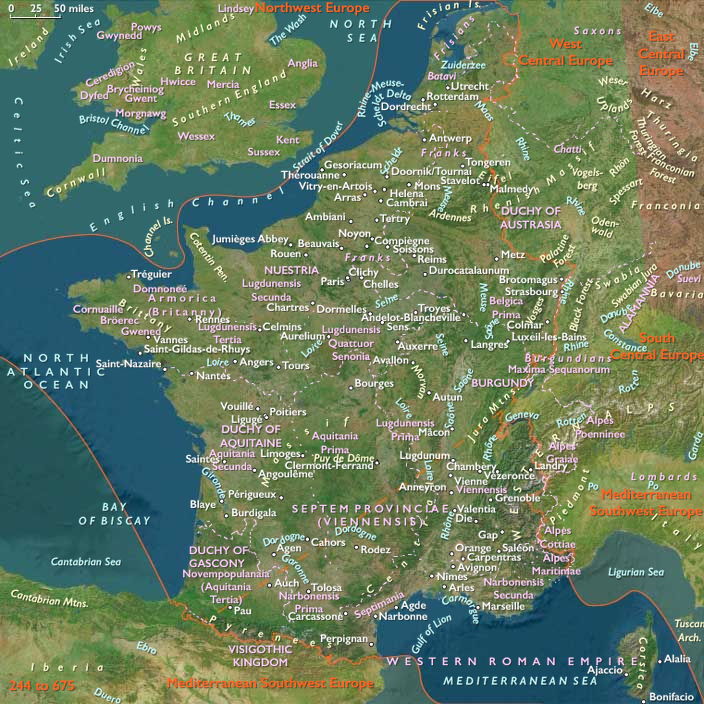
Under Sigebert III of Austrasia, the Mayor of the Palace becomes the most powerful political figure, overshadowing the king. Grimoald, the son of Pepin I of Landen, solidifies his authority by persuading Sigebert to adopt his son, Childebert, as heir. However, upon Sigebert’s death at age twenty-five, Grimoald, fearing for his position, exiles Sigebert’s biological son, Dagobert II, to Ireland, attempting to install his own family as rulers of Austrasia.
This bold political move leads to his downfall, as Clovis II of Neustria retaliates, captures Grimoald, and executes him by 656 or 657, reunifying the Frankish kingdom under Neustrian control.
1. The Growing Power of the Mayors of the Palace Under Sigebert III
- Sigebert III is often regarded as the first "roi fainéant" ("do-nothing king"), as real power rests not with him, but with Grimoald.
- Grimoald, as Mayor of the Palace, takes full advantage of the king’s weak rule, consolidating his own influence over the Austrasian court.
- Despite Sigebert’s lack of political success, he is remembered for his religious patronage, founding monasteries, hospitals, and churches.
2. Grimoald’s Attempt to Overthrow the Merovingians
- Grimoald convinces Sigebert III to adopt his son Childebert, effectively making him the heir to the Austrasian throne.
- However, when Sigebert fathers his own son, Dagobert II, Grimoald sees this as a threat to his dynastic ambitions.
- Upon Sigebert’s death, Grimoald exiles young Dagobert to Ireland, securing the throne for his own son and effectively usurping the Merovingian dynasty in Austrasia.
3. The Fall of Grimoald: Clovis II’s Reunification of Francia (656–657 CE)
- Clovis II of Neustria, viewing Grimoald’s actions as a direct challenge to Merovingian authority, retaliates.
- He captures Grimoald, possibly through military intervention or treachery.
- By 656 or 657, Grimoald is executed, marking the failure of the attempted usurpation and the reunification of the Frankish kingdom under Clovis II.
The Liber historiæ Francorum records that Clovis had Grimoald captured and executed and treats Clovis’s reign hostilely, while showing disdain for Clovis’s son, Chlothar III, indicating continued resentment toward Neustrian dominance over Austrasia.
4. The Long-Term Impact of Grimoald’s Downfall
- The failed coup accelerates the decline of the Merovingian dynasty, as power continues shifting to the Mayors of the Palace.
- Dagobert II, though exiled, would later return, though he never truly recovers Austrasia from aristocratic control.
- Clovis II’s reunification of Francia is temporary, as regional divisions will soon re-emerge.
- Grimoald’s downfall delays but does not prevent the rise of the Mayors of the Palace, as the Carolingians will later succeed where he failed.
Conclusion: A Failed Usurpation That Foretells the Future
Grimoald’s attempt to seize the throne of Austrasia by exiling Dagobert II and installing his own son as king ultimately fails, leading to his capture and execution by Clovis II. However, his actions foreshadow the eventual replacement of the Merovingian kings by the Carolingians, proving that the Mayors of the Palace were now the true power behind the throne.
Locations
People
Groups
- Franks
- Austrasia, Frankish Kingdom of
- Neustria and Burgundy, Frankish Kingdom of
- Thuringia, (Frankish) Duchy of
Topics
Subjects
Regions
Subregions
Years: 652 - 663
Locations
People
Groups
- Franks
- Austrasia, Frankish Kingdom of
- Neustria and Burgundy, Frankish Kingdom of
- Thuringia, (Frankish) Duchy of
Topics
Subjects
Regions
Subregions