The Mayan site of Piedras Negras, overlooking …
Years: 735 - 735
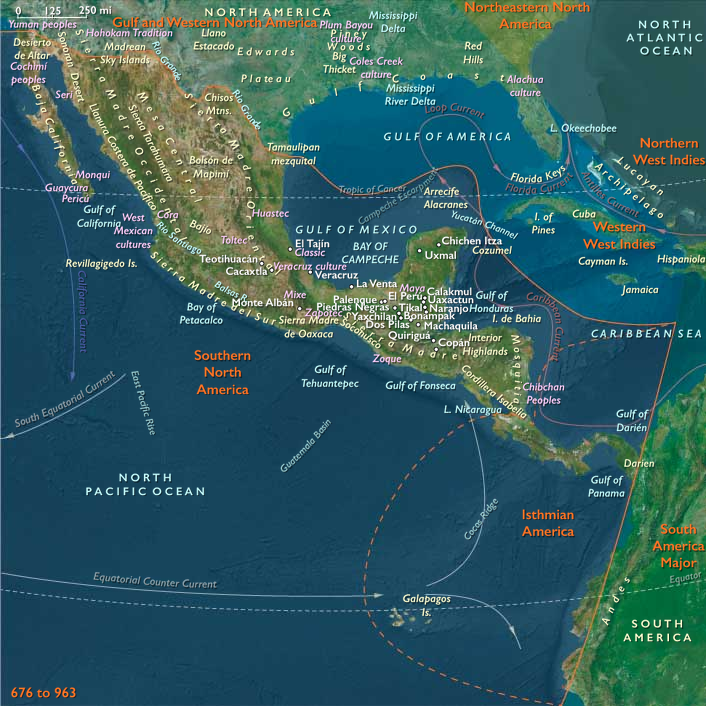
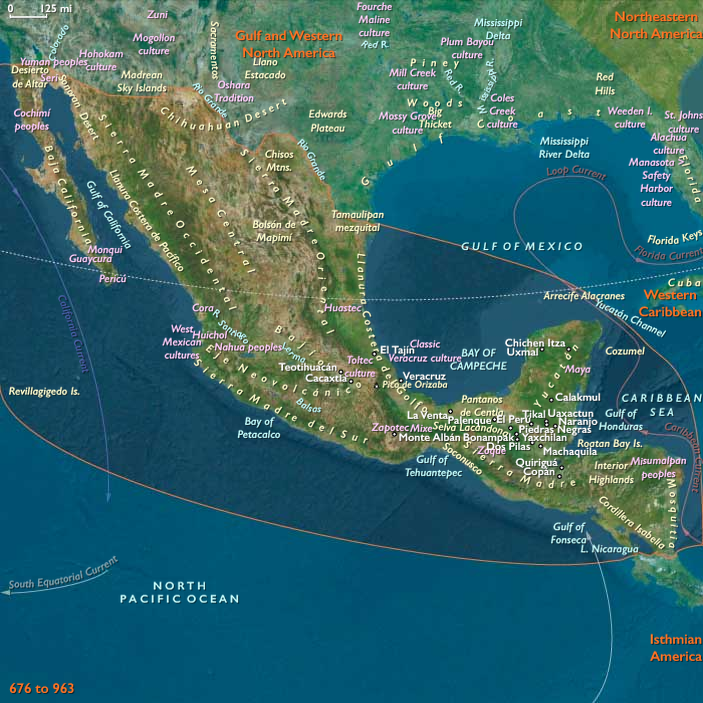
The Mayan site of Piedras Negras, overlooking the Central Usumacinta River in the region of present Guatemala, engages in a series of wars with Yaxchilan, an upstream power.
On both Dos Pilas Stela 16 and Aguateca Stele 2, which date to 735, the Dos Pilas monarch identified as Ruler 3 is depicted standing over a Seibal king.
The accompanying text notes a shell/star, or war event, followed by the dressing of the defeated king for sacrifice.
Locations
Groups
Topics
Commodoties
Subjects
Regions
Subregions
Related Events
Filter results
Showing 10 events out of 55502 total
China’s Tang dynasty, under Emperor Xuanzong, controls a pan-Asian empire stretching from Korea to the borders of Persia.
During the glorious and tolerant period of the Tang dynasty at its zenith, Chinese Buddhism reaches its greatest heights and Islam, Manichaeanism, Judaism, Zoroastrianism and Nestorian Christianity all enter China.
The Tang capital, Changan, supports one million residents within its walls and another one million in its suburbs.
In 730, Xuanzong has four palace walls in the northeast sector of the capital city torn down and reassembled to construct a new Taoist abbey, the grounds of which were formerly a large garden for the governmental Bureau of Agriculture.
By the year 735, 149,685,400 kg (165,000 short tons) of grain are shipped annually along China’s Grand Canal.
The world’s first printed book sees production under the Tang dynasty.
In literature, the greatest glory of the Tang period is its poetry.
By the eighth century, poets had broken away from the artificial diction and matter of the court poetry of the southern dynasties and achieved a new directness and naturalism.
The reign of Xuanzong—known as Ming-huang, the Brilliant Emperor—is the time of the great figures of Li Po, Wang Wei, and Tu Fu.
The rebellion of An Lu-shan and Tu Fu's bitter experiences in it bring a new note of social awareness to his later poetry.
Li Bo (Li Po or Li Pai, also known by his courtesy name, Taibo), born in 701 in Central Asia, had grown up in present Sichuan (Szechwan); displaying an early taste for knight-errantry as well as poetry, he had left home about the age of twenty to roam the mountains, eventually moving into southern and central China, where he establishes various friendships.
Although not pursuing a conventional official career, Li Bo aspires to high military service.
He serves as court poet to the pleasure-loving emperor T'ang Xuandong, but the experience leaves him disappointed, and he returns to the life of a wanderer.

The game of go is introduced into Japan, where professionals play it at the royal court in Nara in 735.
Japanese court officials, a few decades prior to the outbreak of smallpox in 735, had adopted the Chinese policy of reporting disease outbreaks among the general population.
This recording practice will greatly facilitate the identification of smallpox as the disease that afflicts Japan during the years 735-737.
Increased contact between Japan and the Asian mainland had led to more frequent and serious outbreaks of infectious diseases.
The smallpox epidemic of 735-737 is recorded as having taken hold around August 735 in the city of Dazaifu, Fukuoka in northern Kyushu, where the infection had ostensibly been carried by a Japanese fisherman who had contracted the illness after being stranded on the Korean peninsula.
The disease spreads rapidly throughout northern Kyushu this year, and will persist into the next.
The Japanese population will suffer a thirty percent reduction in the smallpox epidemic from 735 to 737.
Hisham has been able to stem the Umayyad decline temporarily.
As the empire is reaching the limits of expansion, frontier defenses, manned by Syrian troops, are organized to meet the challenge of Turks in Central Asia and Berbers in North Africa.
In the aftermath of the Battle of the Defile and other similar disasters, the need to reinforce the buckling frontiers is stretching the military and financial resources of the Caliphate.
This is especially the case with the powerful Syrian army (the ahl al-Sham), the main pillar of the Umayyad regime, which is parceled out to distant provinces.
Eventually, this weakening of the Syrian army will be the major factor in the fall of the Umayyad dynasty during the civil wars of the 740s and the Abbasid Revolution that follows them.
Like his late brother al-Walid I, Hisham is a great patron of the arts, and he has again encouraged arts in the empire.
He has also encouraged the growth of education by building more schools, and perhaps most importantly, by overseeing the translation of numerous literary and scientific masterpieces into Arabic.
He has returned to a stricter interpretation of the Sharia as Umar had, and enforced it, even upon his own family.
His ability to stand up to the Umayyad clan may be an important factor in his success, and may point to why his brother Yazid had been ineffective.
The Aftermath of Tours and the Frankish Control of Aquitaine (735)
Despite their defeat at the Battle of Tours (732), the Moors continue to raid Aquitaine periodically, testing Frankish defenses. However, under the leadership of Duke Odo of Aquitaine, Frankish and Aquitanian forces successfully prevent any serious incursions, keeping the Umayyad forces from re-establishing a foothold north of the Pyrenees.
Rebellion in Aquitaine and Charles Martel’s Response (735)
Upon Odo’s death in 735, his sons rebel against Austrasian rule, seeking to restore Aquitaine’s independence from Frankish overlordship. Their defiance threatens Charles Martel’s authority over the region, prompting him to march south to the Bordeaux area to reassert control.
Confronted by Charles’s superior military strength, Odo’s sons are forced to submit and pay homage to the Frankish ruler. Though they retain some measure of local rule, Aquitaine remains firmly within the Frankish sphere of influence, ensuring its continued integration into Charles Martel’s growing empire.
With this intervention, Charles secures his hold over Aquitaine, demonstrating once again his ability to crush rebellion and maintain Frankish supremacy across the realm.
Bede, an erudite English Benedictine scholar, composes a summary of the works of Roman naturalists and writes around forty treatises on practically every area of knowledge, including grammar, orthography, metrics, figures of speech, chronology, theology, and history.
He had in 731 completed his most important work, the reliable and perceptive “Ecclesiastical History of the English People.”
On his deathbed in 735, Bede reputedly dictates a translation of the Gospel of St. John into English.
Mount Tambora, a stratovolcano on Sumbawa island, Indonesia, estimated to have erupted within a few hundred years of 3910 BCE and in 3050 BCE, erupts again within one for years between about 590 and about 890.
These three events share similar eruptive characteristics: central vent eruption and explosive eruption with pyroclastic flows.
The Abbasids, rivals of the Umayyads, are members of the Hashim clan, but the word "Hashimiyya" seems to refer specifically to Abu Hashim, a grandson of Ali and son of Muhammad ibn al-Hanafiyya.
Hashimiyya missions beginning around 719 had begun to seek adherents in Khorasan, their campaign framed as one of proselytism (dawah).
They seek support for a "member of the family" of Muhammad, without making explicit mention of the Abbasids.
These missions meet with success both among Arabs and non-Arabs (mawali), although the latter may have played a particularly important role in the growth of the movement.
Abu Muslim around 746 assumes leadership of the Hashimiyya in Khorasan.
He successfully initiates an open revolt in 747, organized under the sign of the black flag, against Umayyad rule.
He soon establishes control of Khorasan, expelling its Umayyad governor, and dispatches an army westwards.