
The Maurya king Asoka may have established …
Years: 153BCE - 142BCE
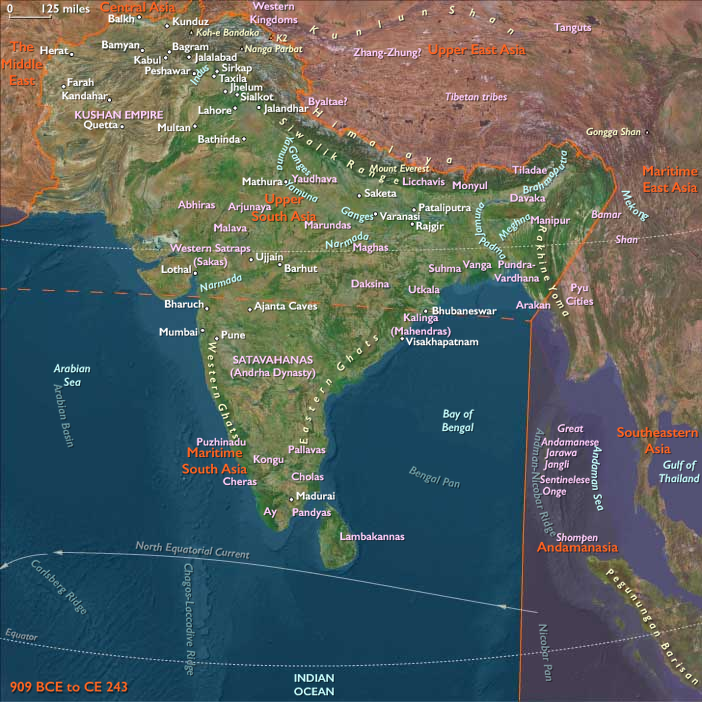
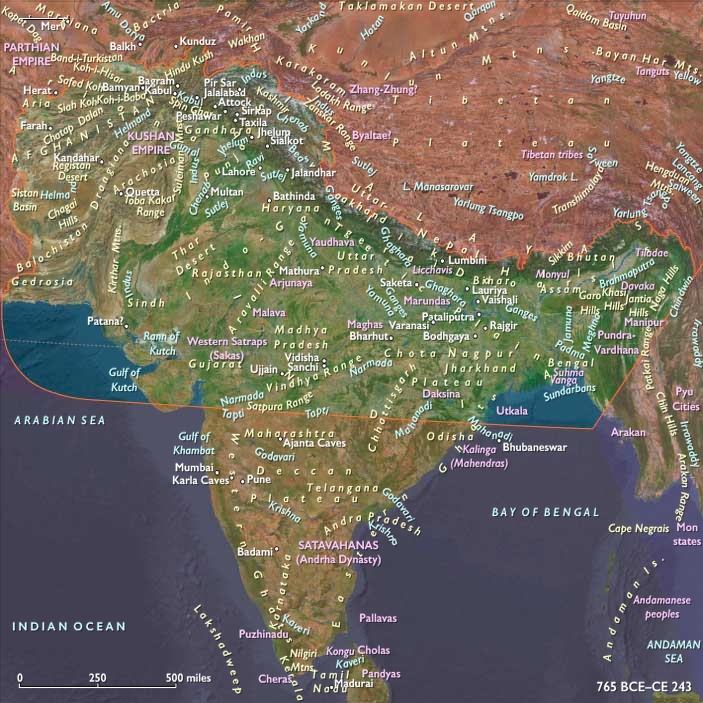
The Maurya king Asoka may have established the principal stupa of Bharhut, a village in present Madya Pradesh state in north central India, in the third century BCE, but many friezes and other works of art are apparently added during the Sunga period in the second century BCE.
Carved from a fine-grained reddish stone, the rail and gates imitate the form and construction of wooden post-and-rail fences and portals.
Each railing segment is constructed of three rails tenoned into uprights; each of the original four gates is carved to depict a cluster of four poles.
These are tied to create a pier at each side of the opening and support the elaborate structure of a triple lintel.
The elaborately carved faces of rails, uprights, and gates feature a rich variety of Buddhist symbols, floral motifs, heads of rajahs, and narrative references to important incidents in the Buddha's history.
In conformity with the early aniconic phase of Buddhist art, the Buddha is only represented through symbols, such as the Dharma wheel, the Bodhi tree, an empty seat, footprints, or the triratana symbol.
The stupa (now dismantled and reassembled at Kolkata Museum) contains numerous birth stories of the Buddha's previous lives, or Jataka tales.
Many of them are in the shape of large, round medallions.
An unusual feature of Bharhut panels is inclusion of text in the narrative panels, often identifying the individuals.
The style is generally flat (no sculptures in the round), and all characters are depicted wearing the Indian dhoti, except for one foreigner, thought to be an Indo-Greek king, with Buddhist symbolism.
Locations
Groups
Topics
Subjects
Regions
Subregions
Related Events
Showing 5 events out of 5 total
Years: 153BCE - 142BCE
Locations
Groups
Topics
Subjects
Regions
Subregions