
The Marinids are an offshoot of the …
Years: 1250 - 1250
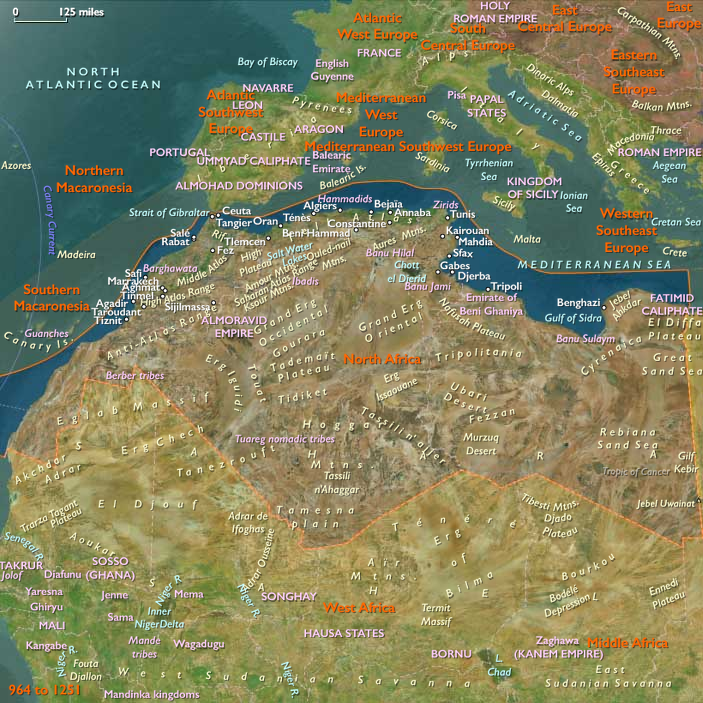
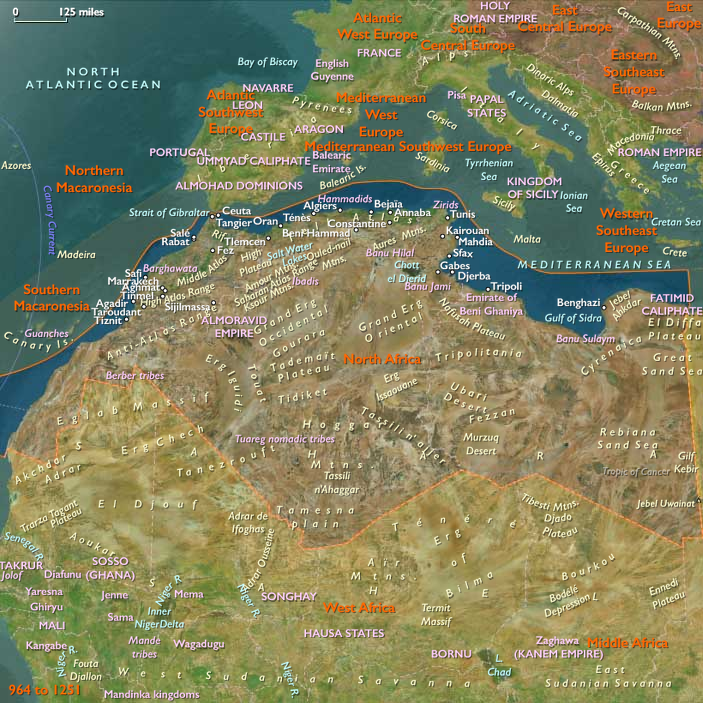
The Marinids are an offshoot of the Wassin, a nomadic Zenata Berber tribe originating from Ifriqiya that had migrated to the West following the Banu Hilal invasion in the eleventh century.
As early as 1145, the Marinids had engaged in several battles with the Almohads, the ruling dynasty at the time, who had regularly defeated them until 1169.
In that year, the Marinids had begun a dedicated pursuit to take Morocco from the Almohads.
Following their expulsion from the south, the Marinids move northwards under the command of Abu Yahya ibn Abd al-Haqq and take Fes in 1244, making it their capital.
This date marks the beginning of the Marinid dynasty.
Locations
Groups
- Berber people (also called Amazigh people or Imazighen, "free men", singular Amazigh)
- Muslims, Sunni
- Zenata (Berber tribal confederacy)
- Almohad Caliphate
- Marinid Dynasty (Sultanate of Morocco)
Subjects
Regions
Subregions
Related Events
Filter results
Showing 10 events out of 46660 total
The Saimyō-ji, constructed around 1250 in Kora, exemplifies a progressive Japanese style of temple, the “Wayo,” which develops further the Heian style.
Construction begins in 1250 on the Great Church of Stockholm, a city established shortly before as a defense outpost on one of the twenty of so channel islands astride a navigable waterway between Lake Malaren and the Baltic Sea.
The expedition to Finland seems to have cost Birger the Swedish crown as an unexpected side effect.
As King Eric died in 1250 and Birger was still absent from Sweden, the rebellious Swedish lords selected Birger's underaged son Valdemar as the new king instead of the powerful jarl himself.
Sources from 1249 onward generally regard Finland as a part of Sweden.
Diocese of Finland is first listed among the Swedish dioceses in 1253.
The first reliable mention in Russian chronicles of Finns being a part of Swedish forces is from 1256.
However, very little is known about the situation in Finland during the following decades.
Reason for this is partly the fact that Finland was now ruled from Turku and most of the documentation remained there.
As the Novgorod forces burned the city in 1318 during the Swedish-Novgorodian Wars, very little remained about what had happened in the previous century.
Baldwin, who had been with Louis IX at Damietta, had been happy to be able to get money from the French king in exchange for relics.
The extremity of his financial straits had reduced him soon afterwards to handing over his only son, Philip, to Venetian merchants as a pledge for loans of money.
The Latin Empire, progressively weakened by feudal divisions and internal power rivalries, by 1250 controls only a small strip of land surrounding Constantinople on each side of the Bosporus.
Villehardouin had built a castle (Grand Maigne) at the tip of Cape Taínaron (Cape Matapan) on the hill of Mezythra (French "Mistra") in March 1242 to protect nearby Lakedaimonia, the settlement at Sparta.
The Lakedaimonians soon evacuate to Mistra, three miles (four point eight kilometers) from Sparta, to pacify the Maina region.
The Emergence of the Motet (c. 1250): The Climax of Early Polyphony
By 1250, the term "motet" (from the French mot, meaning "word") came into use to describe a new form of polyphonic composition that had evolved from the 12th-century clausula. The motet became the pinnacle of early Western polyphony, blending liturgical and secular elements, often featuring multiple texts in different languages sung simultaneously.
Origins: The Clausula and the Evolution into the Motet
-
The Clausula as a Precursor
- A clausula was a short, polyphonic passage inserted into an organum, typically based on a fragment of Gregorian chant (the cantus firmus).
- In a clausula, the tenor voice (from tenere, "to hold") sang the chant fragment in a regular rhythm, while one or two other voices elaborated on it with freer melodic lines.
-
Adding New Texts: The Birth of the Motet
- When a new Latin or French text (mots) was added to one of the upper voices of a clausula, it became a motetus, giving rise to the motet as a distinct form.
- The term motet soon came to designate the entire composition, marking the transition to an independent polyphonic genre.
The Thirteenth-Century Motet: A Mix of Sacred and Secular
- Unlike earlier strictly liturgical polyphony, the 13th-century motet was used for both sacred and secular purposes.
- Many motets featured two or even three different texts sung simultaneously, often in different languages:
- A few words of Latin liturgical text in the tenor voice.
- A French poetic, comic, or even ribald text in one of the upper voices.
- This created a striking musical and textual contrast, making the motet a complex, layered form of musical expression.
Significance and Influence of the Early Motet
- The motet was the first truly independent polyphonic form, influencing later medieval and Renaissance music.
- It became a centerpiece of both religious and courtly life, blending sacred tradition with secular innovation.
- Its development led to greater rhythmic complexity and textural layering, anticipating later forms such as the Renaissance madrigal and Baroque counterpoint.
The thirteenth-century motet was a revolutionary musical development, showcasing the evolution of polyphony from simple chant embellishments to complex, multi-texted compositions, making it one of the most significant innovations in medieval Western music.
Simon de Montfort’s Governorship of Gascony (1248–1250) and the Inquiry into His Rule
In 1248, Simon de Montfort was appointed Governor of Gascony by King Henry III of England, tasked with restoring order in the unsettled duchy. Gascony, still a Plantagenet possession, was rife with noble rivalries, lawlessness, and factional struggles between the seigneurs (local lords) and the powerful urban communes.
Montfort’s Harsh Administration
- As governor, Simon enforced strict discipline, seeking to curb both noble abuses and disorder in the towns.
- His severe methods—which included harsh justice and heavy-handed suppression of noble revolts—led to widespread resentment.
- The Gascon nobility and communes accused him of tyrannical governance and sent complaints to Henry III, claiming he had exceeded his authority.
The Inquiry into Montfort’s Rule (1250)
- In 1250, Henry III, responding to mounting pressure, launched a formal investigation into Montfort’s administration.
- The inquiry was intended to assess his alleged abuses of power and determine whether his governance had been just or excessive.
- Montfort, known for his strong-willed personality, defended himself vigorously.
Reconciliation with Henry III
- Despite the complaints against him, Montfort remained a valuable military and political ally to Henry III.
- The inquiry ultimately did not lead to Montfort’s disgrace, and he was soon reconciled with the king.
- This restored his position at court, though tensions between him and Henry III’s administration would resurface later, leading to his leadership of the baronial opposition in the Second Barons' War (1264–1267).
Impact of Montfort’s Rule in Gascony
- While his governorship alienated many local factions, it demonstrated his ability to impose strong leadership in a volatile region.
- His strict administration reflected the challenges of governing Plantagenet-controlled territories in France, where noble autonomy often clashed with royal authority.
- The tensions in Gascony foreshadowed the broader struggles Montfort would later lead in England, particularly his advocacy for baronial rights against royal overreach.
The inquiry into Simon de Montfort’s administration in 1250 reflected the ongoing challenges of English rule in Gascony, but his quick reconciliation with Henry III showed that, for now, he remained a key figure in the king’s service. However, his opposition to unchecked royal power would later define his political legacy in England.
Vincent of Beauvais and the Speculum Majus (1244–1250): The Medieval Encyclopedia of Universal Knowledge
Between 1244 and 1250, Vincent of Beauvais, a French Dominican friar and encyclopedist, compiled the Speculum Majus (The Greater Mirror), one of the most important encyclopedias of the Middle Ages. This monumental work sought to gather, organize, and preserve all available knowledge in the fields of history, philosophy, theology, science, and the arts.
Structure of the Speculum Majus
The encyclopedia is divided into three major sections, each referred to as a “mirror” (speculum), reflecting different aspects of human knowledge:
- Speculum Naturale (Mirror of Nature) – Covers the natural sciences, including astronomy, medicine, zoology, botany, and physics. It draws heavily from Aristotelian and Arabic sources, integrating the works of Avicenna and Alhazen.
- Speculum Doctrinale (Mirror of Doctrine) – Focuses on philosophy, theology, ethics, logic, grammar, and rhetoric. This section includes a glossary, making it one of the earliest medieval linguistic reference works.
- Speculum Historiale (Mirror of History) – A vast historical chronicle, compiling accounts from biblical, classical, and medieval history, including Augustine, Orosius, and medieval chronicles.
A fourth section, the Speculum Morale (Mirror of Morality), was later added, but its authorship is disputed and may have been compiled by a later editor, rather than Vincent himself.
Importance and Legacy of the Speculum Majus
- It became the most widely used encyclopedia of the Middle Ages, influencing scholars, clergy, and rulers.
- The work synthesized classical, Christian, and Arabic knowledge, making it an intellectual bridge between ancient and medieval thought.
- It was commissioned by King Louis IX (Saint Louis), reflecting its royal and ecclesiastical significance.
- The Speculum Majus served as a model for later encyclopedic works, influencing thinkers like Roger Bacon and Albertus Magnus.
Completed by 1250, Vincent of Beauvais’ Speculum Majus remains a defining achievement of medieval scholarship, reflecting the intellectual ambitions of the 13th century and serving as a testament to the era’s quest for universal knowledge.
The "Annunciation" Sculpture Group at Reims Cathedral (c. 1250): A Departure from Classical Naturalism
Created around 1250 for the west-central portal of Reims Cathedral, the Annunciation sculpture group represents a reaction against the classicizing tendencies seen in the earlier Visitation group, located to its left. While Visitation exemplifies a refined, Roman-inspired realism, the Annunciation reflects a more restrained, stylized Gothic aesthetic, influenced by sculptural trends from Amiens Cathedral.
Stylistic Differences Between "Annunciation" and "Visitation"
-
The Virgin of the Annunciation: A Shift to Structural Definition
- Unlike the expressively posed, swaying Virgin of the Visitation, the Virgin of the Annunciation exhibits a clearer volumetric solidity.
- Her form is more contained and austere, signaling a shift away from the naturalism of earlier Gothic classicism.
-
The Angel Gabriel: A Spiritualized Figure with Geometric Drapery
- Gabriel’s smiling face conveys delicate spirituality, a hallmark of High Gothic emotional expressiveness.
- His mantle features large, angular V-folds, giving his figure architectural weight and structure.
- His undergarment forms long, tubular folds that break sharply at his feet, emphasizing geometric clarity over fluid drapery.
Influences and Significance
- The sculptor of the Annunciation group was influenced by Amiens Cathedral, particularly in the greater emphasis on solidity and stylization rather than classical realism.
- The contrast between the two groups (Annunciation vs. Visitation) highlights a stylistic shift in Gothic sculpture from early naturalism back to a more abstract and spiritual representation.
- This marks an evolution in High Gothic sculpture, as later figures at Reims and elsewhere would continue to explore both classicizing and highly stylized approaches.
The Annunciation group at Reims Cathedral (c. 1250) illustrates the stylistic diversity within Gothic sculpture, balancing expressiveness and idealization, and reinforcing the cathedral’s reputation as one of the finest sculptural ensembles of medieval France.
Albertus Magnus first describes a method of manufacturing arsenic in about 1250: the mineral arsenopyrite is heated and decomposes with the liberation of arsenic gas; the gas can then be condensed on a cold surface.
Years: 1250 - 1250
Locations
Groups
- Berber people (also called Amazigh people or Imazighen, "free men", singular Amazigh)
- Muslims, Sunni
- Zenata (Berber tribal confederacy)
- Almohad Caliphate
- Marinid Dynasty (Sultanate of Morocco)
