
The March of Tuscany, a northern Italian …
Years: 1115 - 1115
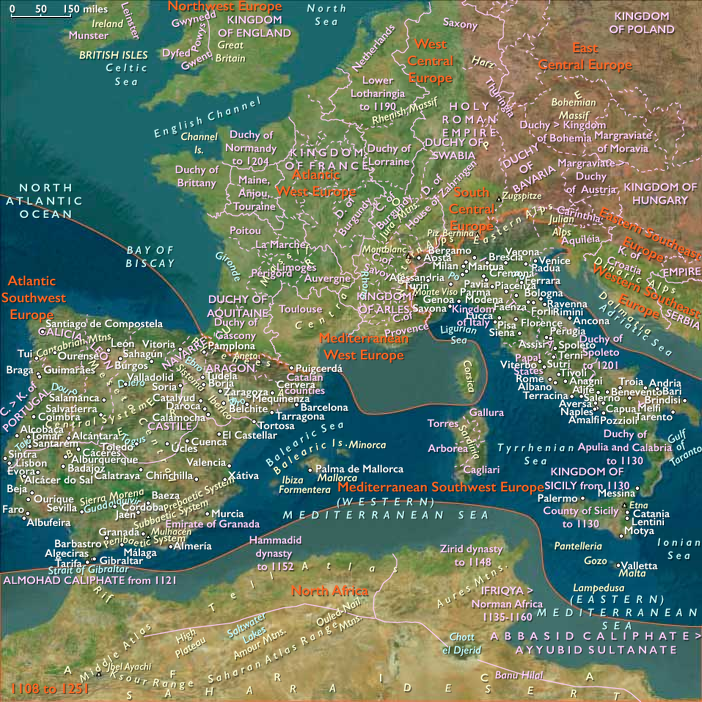
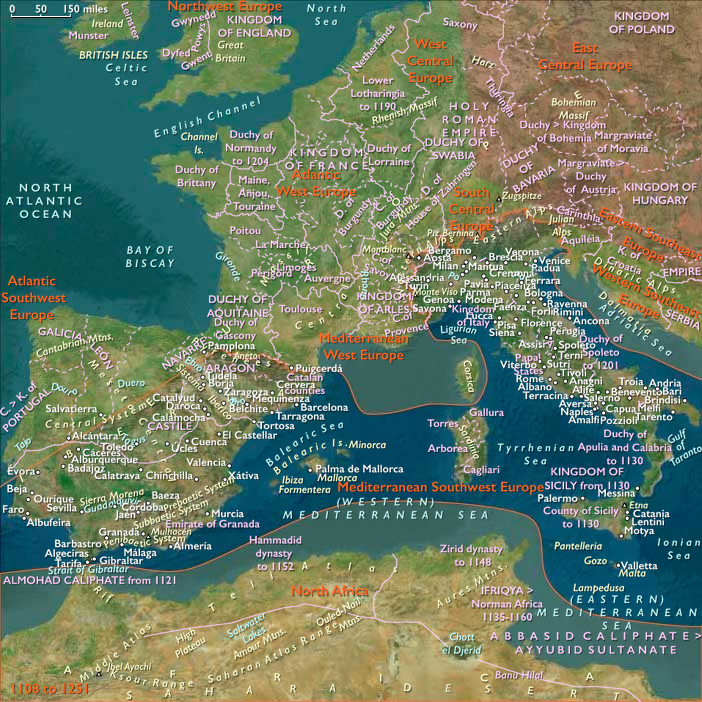
The March of Tuscany, a northern Italian polity dating to the early ninth century, had in 1027 been granted to the House of Canossa.
Boniface III, who had used the title dux et marchio (duke and margrave), had been an ally of the Holy Roman Emperors, but his power was so great that he had threatened that of the emperors in Italy.
He had united the Canossa inheritance, which was largely in the Emilia, to Tuscany and had passed it on to his daughter Matilda, called la Gran Contessa or the Great Countess.
Beside her vast Emilian allods, Tuscany, held in feudal tenure, is her greatest possession and she has wielded it to the benefit of the Papacy in the Investiture Controversy.
After Matilda's death in 1115, no further margraves will be appointed and the era of the feudal princes has passed in northern Italy, to be replaced by the dominance of the city-states, maritime republics and communes.
Florence, which now becomes governed by an autonomous commune, begins to evolve as a commercial power.
Locations
People
Groups
- Tuscany, Margravate of
- German, or Ottonian (Roman) Empire
- Italy, Kingdom of (Holy Roman Empire)
- Italians (Latins)
- Florence, Republic of
Topics
Subjects
Regions
Subregions
Related Events
Showing 10 events out of 49450 total
Years: 1115 - 1115
Locations
People
Groups
- Tuscany, Margravate of
- German, or Ottonian (Roman) Empire
- Italy, Kingdom of (Holy Roman Empire)
- Italians (Latins)
- Florence, Republic of
Topics
Subjects
Regions
Subregions