
The Maori still own most of the …
Years: 1860 - 1860
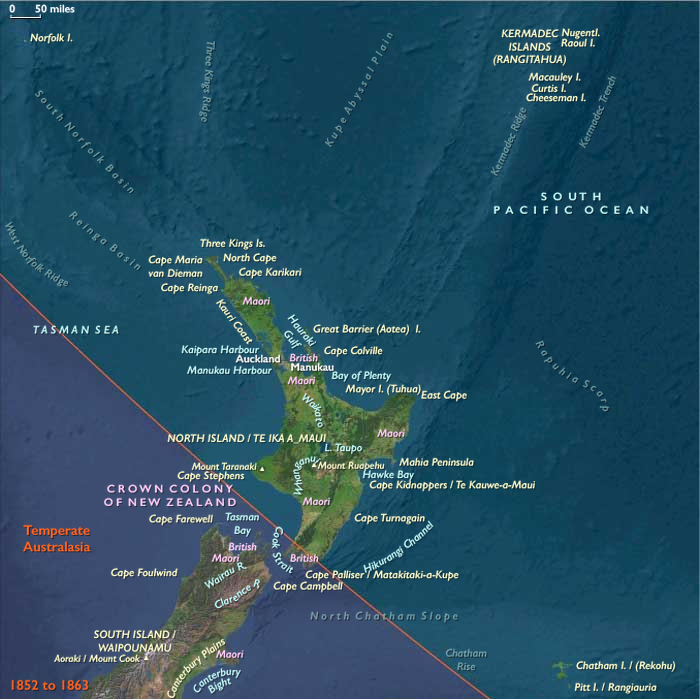
The Maori still own most of the land of the North Island, but a large increase in the number of immigrants in the 1850s has led to demands for greatly increased land purchase by the government.
Many Maori are determined not to sell, but Pokikake Te Teira, a minor chief of the Te Atiawa iwi, offers to sell some six hundred acres of land known as the Pekapeka block at Waitara to the British.
However, the sale is vetoed by the paramount chief of the tribe, Wiremu Kingi.
Despite knowing this, the Governor of the Colony, Thomas Gore Browne, accepts the purchase and tried to occupy the land.
The real issue is sovereignty.
The Treaty of Waitangi had given the Māori Chiefs and the British Government equal sovereignty over the land of New Zealand, and by 1860 it is tacitly recognized that British Law prevails in the settlements and Māori Custom elsewhere.
The British had accepted this situation for twenty years but are finding it increasingly irksome.
The European settlers now outnumber the Māori whose population is declining due to disease and low birth rates.
They are convinced that the British system represents the best that civilization has to offer and see it as both their duty and their right to impose it on other peoples.
On March 5, 1860 Governor Browne orders Colonel Gold, commanding the 65th Regiment, the militia and the Taranaki Rifle Volunteers to occupy the disputed block of land at Waitara.
In response, Wiremu Kingi hastens to the block and with about eighty men hastily built a Pā, or defensive strong point, on a nearby headland and refused to evacuate it, beginning the first of two Taranaki War, in which only the extremist wing of the King Movement participates.
At the time of the conflict the main European settlement is at New Plymouth and much of the fighting takes place within twenty-five kilometers of the town.
The war consists essentially of a series of generally successful sieges of Maori pas (fortified villages) by British troops and militia employing a sap trench procedure.
The British are defeated during an attack (June 1860) on Puketakauere pa when the Maori execute a surprise counterattack; but the Maori are defeated at Orongomai in October and Mahoetahi in November.
Locations
Groups
Topics
Commodoties
Subjects
Regions
Subregions
Related Events
Showing 10 events out of 15018 total
Years: 1860 - 1860
Locations
Groups
Topics
Commodoties
Subjects
Regions
Subregions