The major Greek settlement of Anatolia's west …
Years: 1053BCE - 910BCE
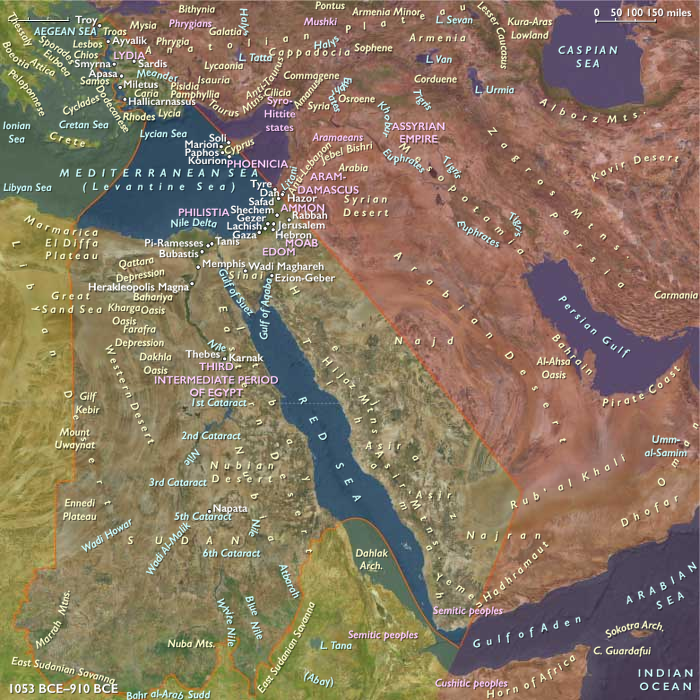
The major Greek settlement of Anatolia's west coast belongs to the Dark Age.
In contrast to the colonization, at best sporadic, of the Mycenaean period, this movement has all the characteristics of a migration.
Aeolis, also called Aeolia, is a group of ancient cities on the west coast of Anatolia, which are founded at the end of the second millennium BCE by Greeks speaking the Aeolic dialect native to Thessaly and Boeotia.
Migrations during 1130-1000 BCE result in the earliest settlements, located on the mainland between Troas and Ionia—where Greek settlement at Smyrna (by Aeolians, according to Herodotus; the Ionians will seize the city in the mid-seventh century BCE) is first clearly attested by the presence of pottery dating from about 1000 BCE.
Locations
Groups
Topics
Commodoties
Subjects
Regions
Subregions
Related Events
Filter results
Showing 10 events out of 18 total
Historians have debated Catherine's sincerity as an enlightened monarch, but few have doubted that she believed in government activism aimed at developing the empire's resources and making its administration more effective.
Initially, Catherine attempts to rationalize government procedures through law.
In 1767 she creates the Legislative Commission, drawn from nobles, townsmen, and others, to codify Russia's laws.
Although the commission does not formulate a new law code, Catherine's Instruction to the Commission introduces some Russians to Western political and legal thinking.
The true power behind the Polish throne is the Russian ambassador Nicholas Repnin and the Russian army, with King Stanislaus Augustus Poniatowski being a former favorite of the Russian Empress.
In order to further Russian goals, Repnin had encouraged the formation of two Protestant konfederacjas of Słuck and Toruń and later, Catholic (Radom Confederation, led by Karol Stanisław "Panie Kochanku" Radziwiłł).
The first act of the Radom Confederation had been to send a delegation to Saint Petersburg, petitioning Catherine to guarantee the liberties of the Republic, and allow the proper legislation to be settled by the Russian ambassador at Warsaw.
With Russian troops sent to "protect" the various pro-Russian factions and this carte blanche in his pocket, Repnin had proceeded to treat the deputies of the Sejm as if they were already servants of the Russian empress.
The opposition was headed by four bishops: Bishop of Lviv Wacław Hieronim Sierakowski (1699–1784), Bishop of Chełm Feliks Turski (1729–1800), Bishop of Cracow Kajetan Sołtyk (1715–1788), and Bishop of Kiev Józef Andrzej Załuski (1702–1774).
To break the opposition, Repnin, in the very Polish capital, had ordered the arrest of four vocal opponents of his policies, namely bishops Józef Andrzej Załuski and Kajetan Sołtyk and hetman Wacław Rzewuski with his son Seweryn.
All of them members of Senate of Poland, they had been arrested by Russian troops on October 13, 1767[9] and imprisoned in Kaluga, where they will remain for for five years.
Through the Polish nobles that Repnin bribed (like Gabriel Podoski, Primate of Poland) or threatened by the presence of over ten thousand Russian soldiers in Warsaw and even in the very chambers of the parliament, Repnin, despite some misgivings about the methods he was ordered to employ, had de facto dictated the terms of that Sejm.
The intimidated Sejm, which had met in October 1767 and adjourned until February 1768, has appointed a commission (the so-called Delegated Sejm) which drafts a Polish–Russian treaty, approved in a "silent session" (without debate) on February 27, 1768.
The legislation undoes some of the reforms of 1764 under King Poniatowski and pushesd through legislation that ensures that the political system of the Commonwealth will be ineffective and easily controlled by its foreign neighbors.
The liberum veto, wolna elekcja (free election), neminem captivabimus, rights to form the confederation and rokosz—in other words, all the important privileges of the Golden Liberty, which makes the Commonwealth so ungovernable—are guaranteed as unalterable parts in the Cardinal Laws.
The Sejm, however, also passes some more beneficial reforms.
Russia, which has used the pretext of increased religious freedoms for the Protestant and Orthodox Christians to destabilize the Commonwealth in the first place, now had to push those reforms through the Sejm to save face.
Thus the legislation of the Sejm grants those religious minorities the same status as that of the previously dominant Roman Catholics, and some privileges of the Catholic clergy are limited.
In addition, the penalty for killing a peasant is increased from a fine to death, liberum veto is abolished on sejmiks (local parliaments), and a mint is created.
All these reforms are guaranteed by the Russian Empress, Catherine II.
The Perpetual Treaty of 1768 between Poland and Russia is highly contradictory to the well-being of Poland and leads to massive revolts by nobility, church, and peasants.
The resulting reaction among Poland's Roman Catholic leadership to the laws granting privileges to the Protestants, as well as the deep resentment of Russia's meddling in the Commonwealth's domestic affairs, leads to the War of the Bar Confederation (1768–1772), directed against Poniatowski and Russia, which will end with Russian victory and the First Partition of Poland.

There is strife between the Polish nobility and the king, Stanislaus August Poniatowski.
The king, a former favorite of the Russian Empress, is dependent on Russian military backing.
An association of Polish nobles (szlachta) form the Bar Confederation at the fortress of Bar in Podolia in 1768 to defend the internal and external independence of the Polish-Lithuanian Commonwealth against aggression by the Russian Empire and against the King and Polish reformers who are attempting to limit the power of the Commonwealth's magnates.
The founders of the Bar Confederation include the magnates Adam Krasiński, the Bishop of Kamenets, Casimir Pułaski, and Michał Krasiński. (Some historians consider the Bar Confederation the first Polish uprising.)
It is easy for Repnin to suppress the revolts but he can barely keep up as they spread across the country, and Polish revolts will dog Russia throughout the war and make it impossible for Catherine II to keep control of Poland.
A detachment of Cossacks in Russian service, not content to see the Polish enemy flee over the border, enters Balta (on Ottoman territory) during the pursuit of a Polish Bar Confederation force.
The Ottoman Empire accuses the troops of having conducted the slaughter of its subjects in the town of Balta, a charge denied by the Russian authorities.
Ottoman sultan Mustafa III receives reports that the town of Balta had been massacred by Russian paid Cossacks.
Russia denies the accusations.
However, the Cossacks had certainly razed Balta and killed whomever they found.
With both the confederates of Poland and the French embassy pushing the sultan, along with many pro-war advisors, Mustafa on October 6 imprisons Aleksei Mikhailovich Obreskov, and the entire Russian embassy's staff, marking the Ottoman’s declaration of war on Russia.
The Turks, ill-prepared for war, form an alliance with the Polish opposition forces of the Bar Confederation, while Russia is supported by Great Britain, which offers naval advisers to the Imperial Russian Navy.
Many noble factions have risen against the sultan’s power and will proceed to break away from the Ottoman Empire.
In addition to this decentralization of the Empire the Ottomans are also faced with the revival of a unified Persia, which has risen to oppose the Turks in Iraq.
Upon the outbreak of the Russo-Turkish War the Ottomans seem to have the upper hand in the face of Russia's lethargy and the threat of financial ruin as a consequence of Russia's involvement in the Seven Years' War.
The Turkish Navy capitalizes on Russia's naval inferiority, despite employing British officers to resolve this weakness, to dominate the Black Sea, giving it the advantage of shorter supply lines.
The Ottomans are also able to levy troops from their vassal state, the Crimean Khanate, to fight the Russians, but their effectiveness is undermined by constant Russian destabilization of the area.
In the years preceding the war the Ottoman Empire had enjoyed the longest period of peace with Europe in its history (1747–1768).
Despite peace with Europe during this period the Ottoman Empire had faced internal division, rebellion and corruption compounded by the re-emergence of a unified Persian leadership, under Nader Shah.
One clear advantage for the Ottoman Empire is its superior numbers as the Ottoman army is three times the size of its Russian counterpart; however, the new Grand Vizier Mehmed Emin Pasha will prove himself to be incompetent militarily.
For a long time the Ottoman military has been considered to be more technologically advanced than Europe, however, the period of peace that preceded the war meant that the Ottomans fell behind in this regard.
Russia masses her army along the borders with Poland and the Ottoman Empire, which makes it difficult for Ottomans troops to make inroads into Russian territory.
Catherine II, after her victories in the Russo-Turkish War, is depicted in portraits dressed in the military uniforms of Great Britain, which had at first been a willing ally to Russia because of the trade between the two countries.
Great Britain needs bar iron to fuel its nascent Industrial Revolution as well as other products, such as sailcloth, hemp, and timber, for the construction and maintenance of its Navy, all of which Russia can provide.
When the tide of the conflict turns in Russia's favor, Britain sees fit to limit its support, seeing Russia as a rising competitor in far eastern trade rather than merely a counterbalance to France’s Navy in the Mediterranean.
The withdrawal of British support leaves Russia in a superior position in the Black Sea but unable to do anything more than cut down its own supply lines and disrupt Turkish trade in the area.
On February 22, 1771, the Bar Confederates defend Lanckorona and its castle from the Russian army led by Alexander Suvorov.
The Russians are forced to retreat after a surprising victory for the Polish army given that it is significantly outnumbered by the Russian side.
It takes place on May 23, 1771, near Lanckorona when a Polish formation of thirteen hundred men with eighteen cannons is suddenly attacked by four thousand Russians commanded again by general Alexander Suvorov.
The second battle is lost as the new commander on the Polish side, French envoy lieutenant-colonel Charles François Dumouriez, is caught off guard in an early morning attack by the Russian forces and is unable to assemble his men.
Many historians will argue that it was sabotage on the part of Dumouriez as he was privately outspoken against the Polish nation and its democratic aspirations.
Dumouriez was noted as calling Poles an "Asiatic nation".
Antoine-Charles du Houx and Baron de Vioménil replace Dumouriez in the Bar Confederation army.