
André Beauneveu: Royal Sculptor and Artist of …
Years: 1366 - 1366
André Beauneveu: Royal Sculptor and Artist of Fourteenth-Century France
André Beauneveu, a sculptor, painter, and architect from Valenciennes, was one of the most highly esteemed artists of the French royal family in the second half of the fourteenth century. Despite the scarcity of biographical records, his impressive commissions and lasting artistic influence attest to his renown in both France and England.
Early Career and Work in England (Before 1364)
- Beauneveu worked under the patronage of Philippa of Hainault, the Queen of England and wife of Edward III.
- The earliest documentary reference to "Master Andrew the Painter" (presumed to be Beauneveu) appears in 1359, when he worked for Duchess Yolande de Bar, decorating a chapel in her castle at Nieppe (now destroyed).
Royal Patronage in France Under Charles V (1364–1366)
- By 1364, Beauneveu had moved to Paris, becoming part of King Charles V’s artistic workshop.
- The king referred to him as “our esteemed Andreu Bauneveu, our sculptor,” signaling his prominence at the royal court.
- In 1365, Charles V commissioned Beauneveu to create four monumental tomb sculptures for the royal crypt at Saint-Denis, the dynastic burial site of French kings.
The Saint-Denis Royal Tomb Project
- Charles V aimed to legitimize and reinforce the authority of the new Valois dynasty by creating spectacular tombs for himself and his immediate ancestors, placing them in the Capetian necropolis at Saint-Denis.
- Beauneveu designed the tombs in the latest artistic style, featuring:
- Brilliant white marble gisants (recumbent effigies of the deceased).
- Polished black marble slabs, creating a striking contrast.
- These effigies, particularly that of Charles V, were crafted in the representacion au vif style (representation from life), displaying highly personalized and lifelike features, distinguishing them from earlier, more stylized medieval tomb sculptures.
Completion by Other Artists and Legacy
- Beauneveu was paid 4,700 gold francs for his work, demonstrating his high status and the importance of the project.
- Records of payments to Beauneveu cease in 1366, suggesting that he left the project, which was then completed by Jean de Liège and other sculptors.
- Although the tombs were destroyed in 1793 during the French Revolution, their form is preserved in late seventeenth-century drawings commissioned by Roger de Gaignières.
- The surviving gisants (effigies) of Charles V and his family are still at Saint-Denis, though now mounted on plain bases.
Beauneveu’s Influence and Later Recognition
- His work set a new standard for royal tomb sculpture, influencing future commissions, including the Burgundian necropolis at Champmol a decade later.
- His realistic approach to portraiture and refined use of marble established him as one of the most innovative artists of the period.
André Beauneveu’s masterful sculptures at Saint-Denis and his prominent role in Charles V’s court cemented his reputation as one of the leading artists of fourteenth-century France, bridging the artistic traditions of France, England, and the Low Countries.
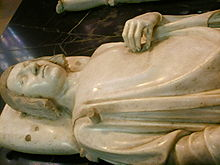
Beauneveu's effigy of King Charles V in the Abbey Church of St Denis. c.1366 (Photo taken February 25, 2007 by Sailko)
Locations
People
Groups
Topics
Commodoties
Subjects
Regions
Subregions
Related Events
Showing 10 events out of 43935 total
Years: 1366 - 1366
Beauneveu's effigy of King Charles V in the Abbey Church of St Denis. c.1366 (Photo taken February 25, 2007 by Sailko)
Locations
People
Groups
Topics
Commodoties
Subjects
Regions
Subregions