
Pierre Dugué de Boisbriand leads an expedition …
Years: 1719 - 1719
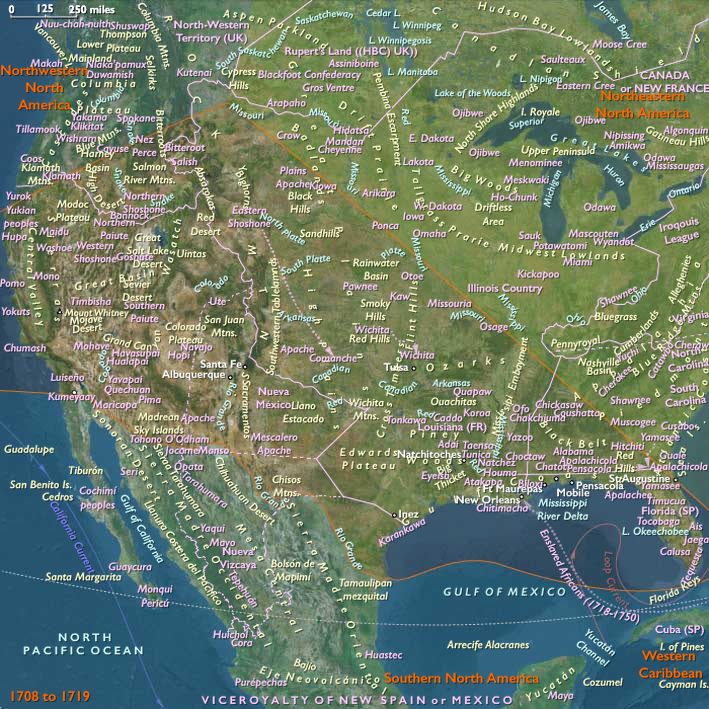
Pierre Dugué de Boisbriand leads an expedition to the area south of present-day St. Louis in 1719.
Eighteen miles north of the Jesuit mission at Kaskaskia, he establishes an outpost that he names Fort de Chartres.
The fort will become the center of military and civilian activity in the area known as Upper Louisiana and the Illinois Country.
The French government had granted a trade monopoly to John Law and his Company of the West on January 1, 1718.
Hoping to make a fortune mining precious metals, the company has built Fort de Chartres to protect its interests.
Dugué, a cousin and fellow officer of brothers (Jean-Baptiste Le Moyne de Bienville and Pierre Le Moyne d'Iberville), with whom he served on expeditions during French colonization in North America, is the son of Michel-Sidrac Dugué de Boisbriand and Marie Moyen Des Granges.
As a French military officer, Dugué holds a succession of posts from 1699 to 1726 at France's settlements on the Gulf Coast and on the Mississippi River in present-day Illinois.
He serves at various times as commander of outposts at Mobile, Natchez, Louisiana, and the area known as the Illinois Country during his military career.
Eighteen miles north of the Jesuit mission at Kaskaskia, he establishes an outpost that he names Fort de Chartres.
The fort will become the center of military and civilian activity in the area known as Upper Louisiana and the Illinois Country.
The French government had granted a trade monopoly to John Law and his Company of the West on January 1, 1718.
Hoping to make a fortune mining precious metals, the company has built Fort de Chartres to protect its interests.
Dugué, a cousin and fellow officer of brothers (Jean-Baptiste Le Moyne de Bienville and Pierre Le Moyne d'Iberville), with whom he served on expeditions during French colonization in North America, is the son of Michel-Sidrac Dugué de Boisbriand and Marie Moyen Des Granges.
As a French military officer, Dugué holds a succession of posts from 1699 to 1726 at France's settlements on the Gulf Coast and on the Mississippi River in present-day Illinois.
He serves at various times as commander of outposts at Mobile, Natchez, Louisiana, and the area known as the Illinois Country during his military career.
Locations
People
Groups
- French people (Latins)
- New France (French Colony)
- Jesuits, or Order of the Society of Jesus
- France, (Bourbon) Kingdom of
- Illinois Country
- Louisiana (New France)
- Mississippi Company, the
Topics
Commodoties
Subjects
Regions
Subregions
Related Events
Showing 10 events out of 28184 total
Years: 1719 - 1719
Locations
People
Groups
- French people (Latins)
- New France (French Colony)
- Jesuits, or Order of the Society of Jesus
- France, (Bourbon) Kingdom of
- Illinois Country
- Louisiana (New France)
- Mississippi Company, the
Topics
Commodoties
Subjects
Regions
Subregions