
The magnificent paintings of the Ajanta caves …
Years: 472 - 483
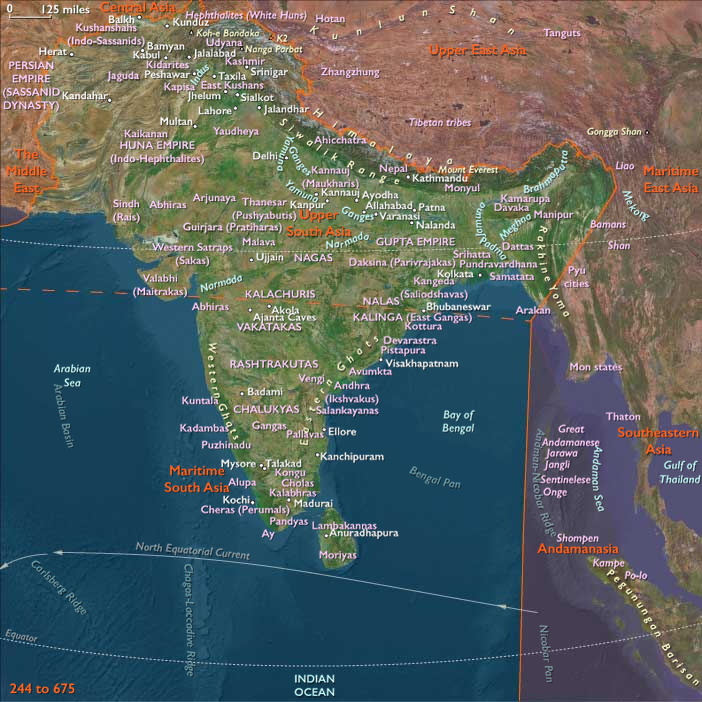
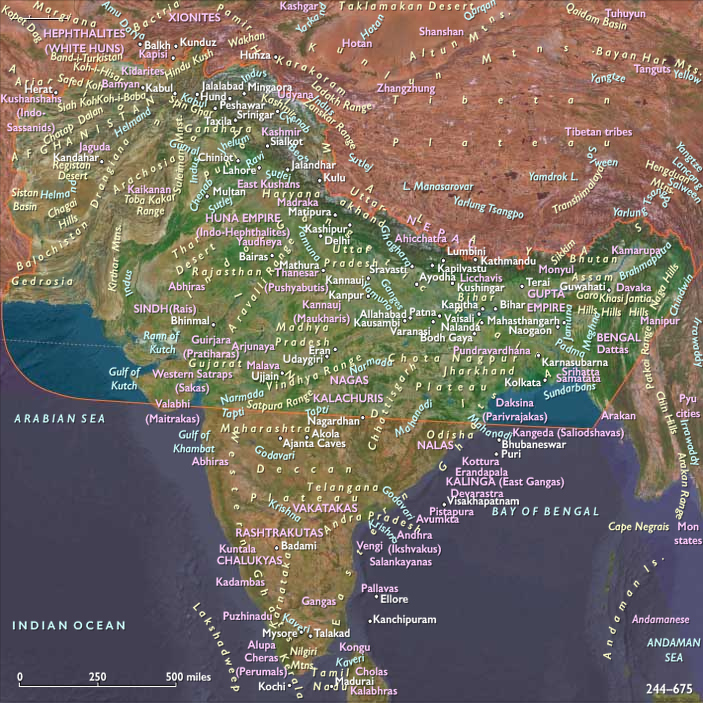
The magnificent paintings of the Ajanta caves in India’s north Deccan, thirty rock-cut Buddhist cave monuments that date from the second century BCE, cut into the volcanic rock and elaborately painted, were long thought to epitomize Gupta patronage.
However, according to art historian and longtime researcher Walter M. Spink, the first phase was the construction of sanctuaries (known as chaytia-grihas) built in the canyons of the Waghora River during the period 100 BCE to 100 CE, probably under the patronage of the Satavahana dynasty, in power from 230 BCE to about 220 CE. (Spink, Walter M. (2007). Ajanta: History and Development Volume 5: Cave by Cave. Leiden: Brill)
The caves 9, 10, 12 and 15A were constructed during this period.
Murals preserved from this time belong to the oldest monuments of painted art in India.
Scholars disagree about the date of the Ajanta Caves' second period.
For a time it was thought that the work was done over a long period from the fourth to the seventh century CE, but recently Spink declared that most of the work took place over short time period, from 460 to 480 CE, during the reign of Emperor Harishena of the Vakataka dynasty.
The rock cut architectural cell-XVI inscription of Ajanta states that he conquered Avanti (Malwa) in the north, Kosala (Chhattisgarh), Kalinga and Andhra in the east, Lata (Central and Southern Gujarat) and Trikuta (Nasik district) in the west and Kuntala (Southern Maharashtra) in the south.
Some twenty cave temples were simultaneously created, for the most part viharas: monasteries with a sanctuary in the structure's rear center.
Each of cave temples seem to be patronized by influential authority, with numerous of the best available artists involved in the work with fruitful rivalry between the neighboring construction sites.
The caves form the largest corpus of early Indian wall-painting; other survivals from the area of modern India are very few, although they are related to fifth century paintings at Sigiriya in Sri Lanka.
The elaborate architectural carving in many caves is also very rare, and the style of the many figure sculptures is a highly local one, found only at a couple of nearby contemporary sites, although the Ajanta tradition can be related to the later Hindu Ellora Caves and other sites.
According to Spink, the Ajanta Caves appear to have been abandoned shortly after the fall of Harishena, around 480 CE.
Since then, these temples have been abandoned and gradually forgotten.
During the intervening centuries, the jungle grows back and the caves are hidden, unvisited and undisturbed.
Locations
Groups
Topics
Commodoties
Subjects
Regions
Subregions
Related Events
Showing 10 events out of 58557 total
Years: 472 - 483
Locations
Groups
Topics
Commodoties
Subjects
Regions
Subregions