
The lower reaches of the Elbe River, …
Years: 9 - 9
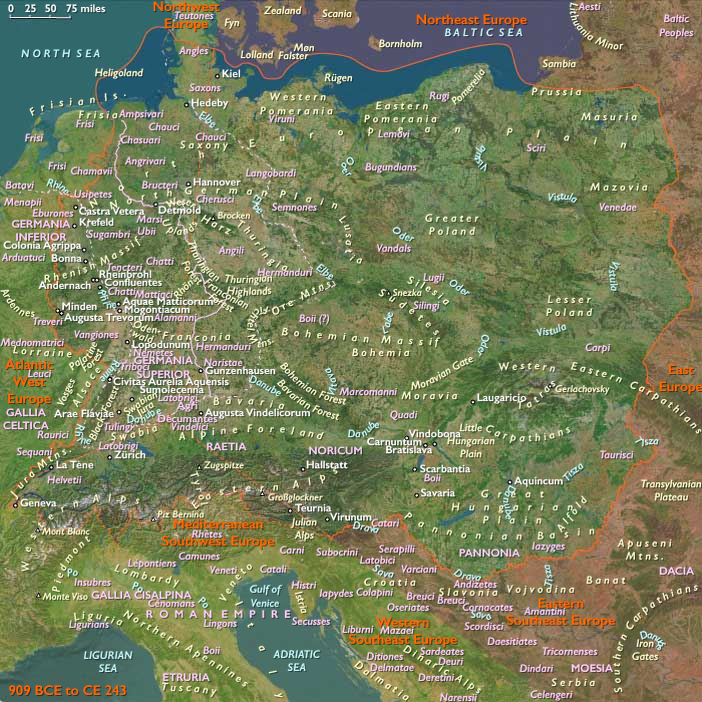
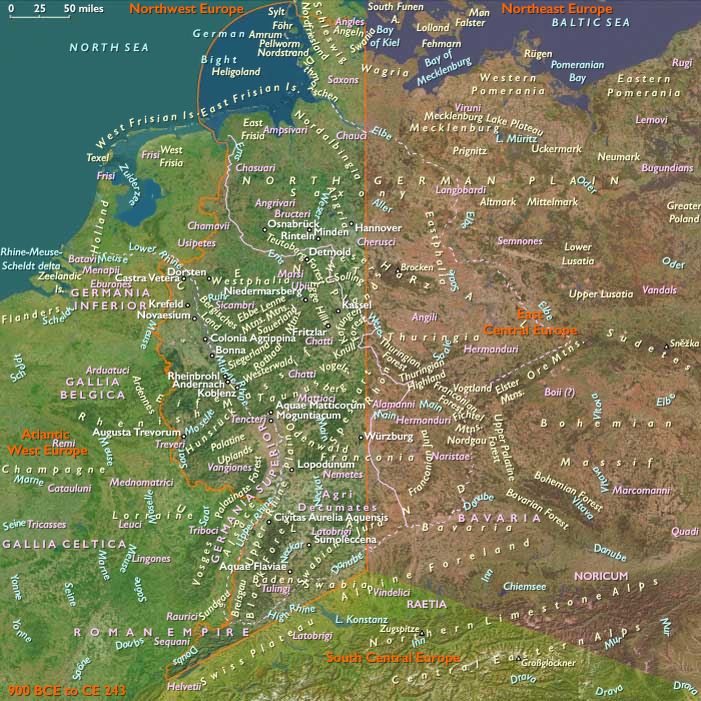
The lower reaches of the Elbe River, known to the Romans as the Albis, marks the limit of the Romans' farthest advance in Germany in CE 9.
Angered by the governance of the arrogant and tactless Varus, Arminius deceitfully persuades Varus to lead his entire force—composed of the Seventeenth, Eighteeth and Nineteenth legions, plus three cavalry detachments and six cohorts of auxiliaries—into the Teutoburger Wald (Teutoburg Forest) in the late summer of 9, with Arminius as head of a rear guard.
Lying in wait is an allied coalition force of Cherusci, Marsi, Chatti, Bructeri, Chauci and Sicambri.
Once the supply wagons mire (at a point supposedly near present Detmold, Germany) and the legions break formation, Germanic guerillas, the home advantage lying with their more loosely organized forces in the heavy woods, attack the unsuspecting Romans; the German recruits desert, and the rear guard falls on the legions from behind.
Varus desperately attempts to march west to safety, but the tribesmen annihilate his cavalry by the second day; by the end of the third, twenty thousand Roman soldiers are dead.
Varus, humiliated, takes his own life.
The Roman advance into Germany is thus halted at the Rhine, not the Elbe.
Locations
People
Groups
- Sicambri (Germanic tribe)
- Chatti (Germanic tribe)
- Bructeri (Germanic tribe)
- Cherusci (Germanic tribe)
- Marsi (Germanic tribe)
- Chauci (Germanic tribe)
- Roman Empire (Rome): Julio-Claudian dynasty
Topics
- Classical antiquity
- Pre-Roman Iron Age of Northern Europe
- Roman Age Optimum
- Pax Romana
- Roman Northern Frontier Wars of 24 BCE-CE 16
- Teutoburg Forest, Battle of the
Commodoties
Subjects
Regions
Subregions
Related Events
Showing 10 events out of 62028 total
Years: 9 - 9
Locations
People
Groups
- Sicambri (Germanic tribe)
- Chatti (Germanic tribe)
- Bructeri (Germanic tribe)
- Cherusci (Germanic tribe)
- Marsi (Germanic tribe)
- Chauci (Germanic tribe)
- Roman Empire (Rome): Julio-Claudian dynasty
Topics
- Classical antiquity
- Pre-Roman Iron Age of Northern Europe
- Roman Age Optimum
- Pax Romana
- Roman Northern Frontier Wars of 24 BCE-CE 16
- Teutoburg Forest, Battle of the
Commodoties
Subjects
Regions
Subregions