
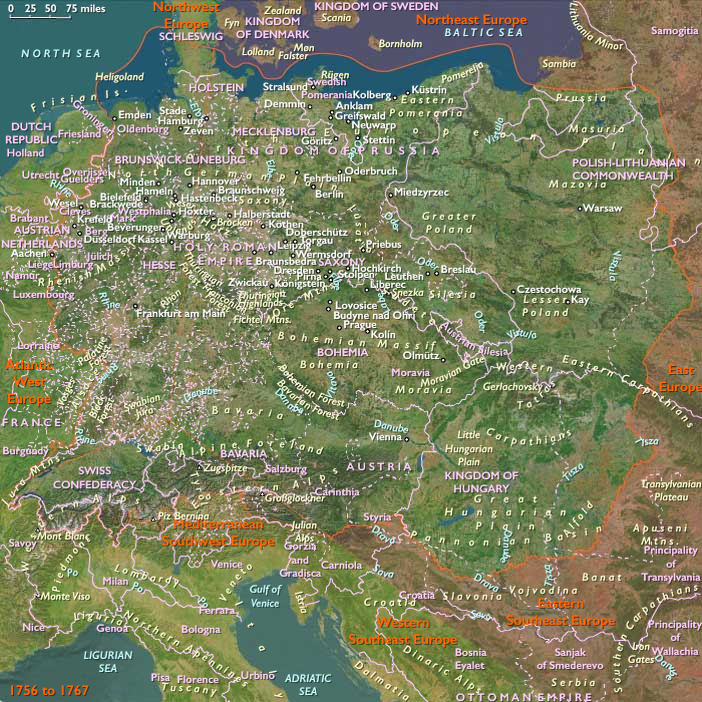
The Russians occupy Frankfurt on the Oder …
Years: 1759 - 1759
August
By the following week, Daun's reinforcements join forces with Saltykov at Kunersdorf.
Locations
People
- Carl Heinrich von Wedel
- Count Leopold Joseph von Daun
- Ernst Gideon Laudon
- Frederick the Great
- Maria Theresa
- Pyotr Saltykov
Groups
Topics
Subjects
Regions
Subregions
Related Events
Filter results
Showing 10 events out of 26500 total
Unalaska and Amaknak Islands contain twenty-four settlements with more than a thousand Aleut inhabitants in 1759, when the first Russian group under Stepan Gavrilovich Glotov comes and starts trading for three years on Umnak and Unalaska.
The Burmese have successfully reestablished their authority by early 1759.
A Chinese army from Ili (Kulja) invades Turkistan and consolidates their authority by settling Chinese emigrants in the vicinity of a Manchu garrison.
The Chinese have thoughts of pushing their conquests towards Transoxiana and Samarkand, the chiefs of which have sent to ask assistance of the Afghan king Ahmed Shah Abdali.
This monarch had dispatched an ambassador to Beijing to demand the restitution of the Muslim states of Central Asia, but the representative had not been well received, and Ahmed Shah is too closely aligned with the Sikhs to attempt to enforce his demands by arms.
Some of these rumors included that Peter had taken a mistress (Elizabeth Vorontsova), while Catherine will be said to carry on liaisons with Sergei Saltykov, Grigory Grigoryevich Orlov (1734–1783), Alexander Vasilchikov, Grigory Potemkin, Stanisław August Poniatowski, and others.
She has become friends with Princess Ekaterina Vorontsova-Dashkova, the sister of her husband's mistress, who has introduced her to several powerful political groups that oppose her husband.
Peter III's temperament has become quite unbearable for those who resided in the palace.
He announces trying drills in the morning to male servants, who later join Catherine in her room to sing and dance until late hours.
Catherine becomes pregnant with her second child, Anna, who only lives to four months, in 1759.
Due to various rumors of Catherine's promiscuity, Peter is led to believe he is not the child's biological father and is known to have proclaimed, "Go to the devil!" when Catherine angrily dismissed his accusation.
She thus spends much of this time alone in her own private boudoir to hide away from Peter's abrasive personality.
As both buildings and vegetation dry out, the fire hazard grows.
In addition, the water supply is on the verge of running dry (except near Mälaren), which means that any fire will be harder to fight.
The drought may also have contributed to fires in the towns of Skövde and (in south-eastern Norway) Halden the same year.
At around 4:15 PM on July 19, the fire breaks out in the Besvärsbackan (literally: Trouble Hill) area.
High (and increasing) winds spread the fire quickly in all directions, but especially to the west and southwest.
About an hour and a half later, the Maria Magdalena Church catches fire.
Panic spreading among the people makes the situation worse.
Attempts to fight the fire are hampered by a lack of available water, and the lines bringing water from Mälaren (one of the few bodies of water not shrunk by the drought) grow longer as the fire advances away from the sea.
Given the inferior equipment available at the time and the difficulties in transporting water, it is probably not possible the extinguish the fire itself.
As the fire crosses the major street (Hornsgatan) in the area, firefighting efforts turn towards the construction of firebreaks well in advance of the fire's spread.
Using some open areas on either side of Hornsgatan, the firebreaks are able to halt the fire's advance, and it burns itself out early on the morning of July 20 (Friday).
The Maria Magdalena Church is severely damaged.
The tower has collapsed, and the interior is burned out.
However, the people demands that the church be restored, and it will be reopened four years later, at the Pentecost of 1763.
After the fire, the city government requires all constructions to consist of brick and stone.
With these regulations in place, the Great Fire of 1759 will be the last on such a scale to strike Stockholm.
Most houses in Northern Europe are made of wood, and are often built very close to adjoining structures.
Open fires are used for cooking, heating, and light.
When a fire breaks out, firefighting mainly dependson bucket or pail teams, in addition to fire axes and equipment to tear downs houses for firebreaks.
Like most major cities at this time, Stockholm does not have any professional firefighters.
As cities have expanded in the seventeenth and eighteenth centuries, fires have become more threatening, as with the Great Fire of London, the Great Fire of Copenhagen in 1728, and the Great Fire of Bergen in 1702.
The increased fire threat also applies to Sweden.
Throughout the seventeenth century, Sweden had experienced over thirty devastating fires that had destroyed many cities and villages.
In addition, the Russians had burned down more than twenty cities or towns between 1714 and 1721, during the Great Northern War.
In 1751, the year before Karlstad burned for the third time since 1616, a violent fire (Klarabranden) had destroyed at least a hundred buildings in Stockholm.
The fire had originated in Norrmalm during a whole gale and grew into a firestorm.
Some copper plates, glowing with heat from the fire, blew above Riddarfjärden (an arm of the sea Mälaren), at least four hundred meters, and, in turn, had set fire to buildings on Södermalm, as well.
In India, they repulse French forces besieging Madras.
In Europe, British troops partake in a decisive Allied victory at the Battle of Minden.
The destruction of the French invasion barges and the victory of the Royal Navy over the French Navy at the Battle of Lagos and the decisive Battle of Quiberon Bay end any realistic prospect of a French invasion, and confirm Britain's reputation as the world's foremost naval power.
In North America, the British capture Fort Ticonderoga (Carillon), drive the French out of the Ohio Country, capture Quebec City as a result of the Battle of the Plains of Abraham, and capture Guadeloupe in the West Indies.
The succession of victories leads Horace Walpole to remark; "Our bells are worn threadbare with ringing for victories".
Several of the triumphs will assume an iconic place in the mindset of the British public, reinforced by representations in art and music, such as the popular song Heart of Oak and the later painting The Death of General Wolfe.
Frank McLynn will identiiy 1759 as the year that prefigures the rise of the British Empire in eclipsing France as the dominant global superpower.
Much of the credit for the annus mirabilis is given to William Pitt the Elder, the minister who directs military strategy as part of his duties as Secretary of State for the Southern Department, rather than to the Prime Minister, the Duke of Newcastle.
More recent historians, however, will portray the British Cabinet as a more collective leadership than had previously been thought.
The Russian advance in May liberates Swedish Pomerania, but lack of money and supplies means the Swedish commander can only start campaigning that August.
His goal is to besiege Stettin and in preparation for this Lantingshausen allows Axel von Fersen to take four thousand men to capture Usedom and Wollin—this objective is met after the Battle of Frisches Haff ensures Swedish naval supremacy in September—while Lantingshausen takes the main body of the army to advance deep into Prussian Pomerania, where he then remains still for a long while.
However, due to a lack of cooperation from his allies, he is unable to besiege Stettin and in late autumn withdraws into Swedish Pomerania.
At the Battle of Kay, or Paltzig, the Russian Count Saltykov with forty-seven thousand Russians defeats twenty-six thousand Prussians commanded by General Carl Heinrich von Wedel.
Though the Hanoverians defeat an army of sixty thousand French at Minden, Austrian general Daun forces the surrender of an entire Prussian corps of thirteen thousand in the Battle of Maxen.
Frederick himself loses half his army in the Battle of Kunersdorf (now Kunowice, Poland), the worst defeat in his military career and one that drives him to the brink of abdication and thoughts of suicide.
The disaster results partly from his misjudgment of the Russians, who had already demonstrated their strength at Zorndorf and at Gross-Jägersdorf (now Motornoye, Russia), and partly from good cooperation between the Russian and Austrian forces.
This initial event is estimated at 6.6 on the surface wave magnitude scale and given a rating of VIII (Severe) to IX (Violent) on the Mercalli intensity scale.
This is followed by a more significant earthquake (7.4 and IX) on November 25 that destroys all the villages in the Beqaa Valley.
The areas that experience damage are roughly the same for both the thirteenth and eighteenth-century earthquakes, with the cities of Nablus, Acre, Tyre, Tripoli and Hama being affected.
The village of Ras Baalbek and the city of Damascus are both damaged and the shock is felt as far as Egypt
Years: 1759 - 1759
August
Locations
People
- Carl Heinrich von Wedel
- Count Leopold Joseph von Daun
- Ernst Gideon Laudon
- Frederick the Great
- Maria Theresa
- Pyotr Saltykov
