The Lombards under Zotto, Duke of Benevento, …
Years: 581 - 581
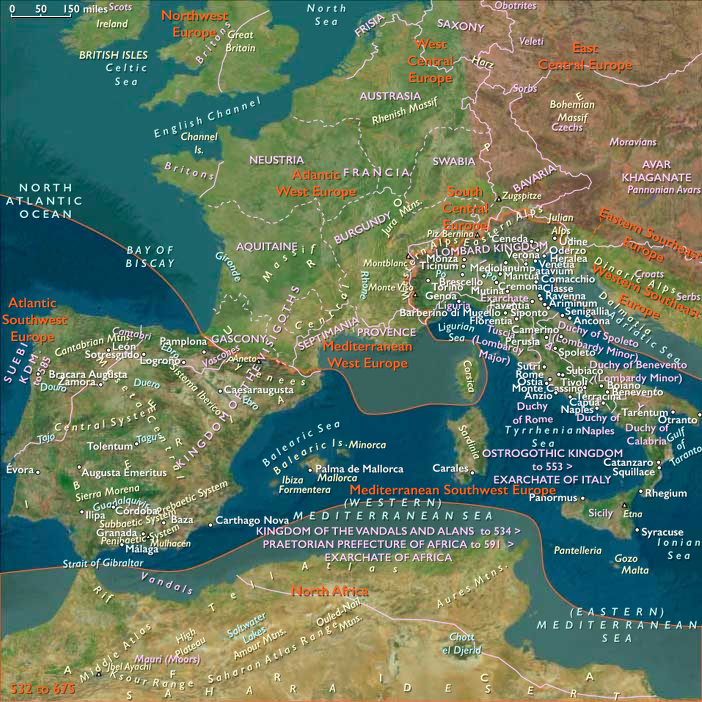
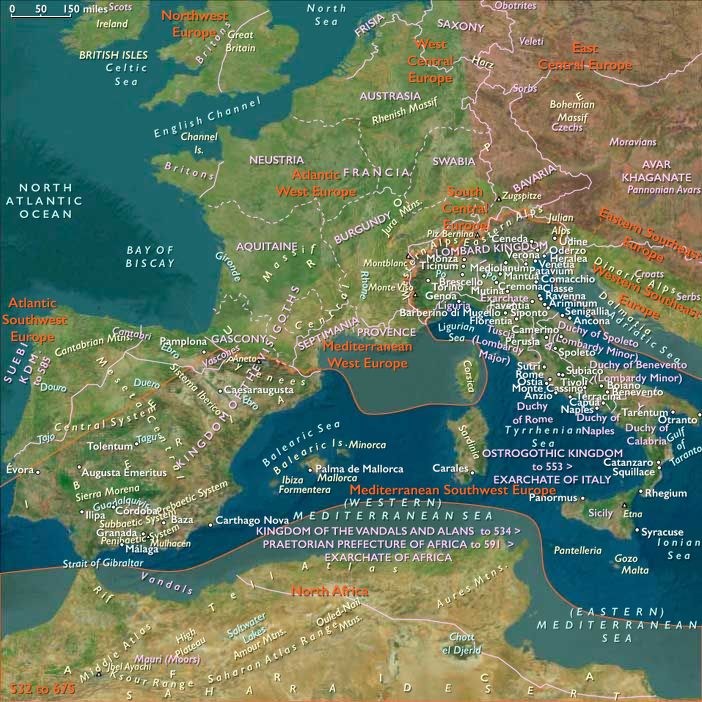
The Lombards under Zotto, Duke of Benevento, sack the abbey of Monte Cassino near Naples.
The Benedictine monks who survive flee to Rome, but later return to the site and rebuild the monastery.
Locations
People
Groups
- Lombards (West Germanic tribe)
- East, or Oriens, Praetorian prefecture of
- Christianity, Chalcedonian
- Italy, Praetorian prefecture of
- Benedictines, or Order of St. Benedict
- Rome, Duchy of
- Lombards (Italy), Kingdom of the
- Benevento, Lombard Duchy of
Topics
Commodoties
Subjects
Regions
Subregions
Related Events
Filter results
Showing 10 events out of 57330 total
Yang Jian conquers the Northern Zhou (Chou) and Zhen (Ch'en) dynasties, uniting China for the first time in almost four centuries.
He executes the last ruler Jing Di, age eight, along with fifty-eight royal relatives at Chang'an.
He proclaims himself emperor the first emperor of China’s Sui Dynasty, ruling from his capital at Daxian (Ta-hsing) (later Chang'an; Ch'ang-an).
The Sui Period sees order reestablished in China.
Sui Wen Di directs several large construction projects, such as the repair of the Great Wall and a canal system linking the fertile central region with the northern plain.
The Sui dynasty reintroduces civil service examinations according to the Confucianist philosophy.
There are four claimants to the Göktürk throne in 581 at the death of the fourth khagan, Taspar Qaghan.
Prince Anlou is Taspar's son, Talopien (Apa) and Shetu (Ishbara) are Taspar's nephews, while Tienchueh (Tardu) is Taspar's cousin.
Taspar before dying had announced his preference for Talopien to succeed him instead of his son Anluo, although he had no right to determine the succession.
During the kurultay after Taspar's death, Shetu, who is also a claimant, sees that he has no chance and supports Anluo on the grounds that Talopien's mother was not of noble birth.
He threatens the kurultay that in case of Talopien's election he will revolt.
Anluo quickly renounces the title on behalf of Taspar's "Niwar Qaghan" Shetu, who becomes khan with the regnal name Ishbara.
Ishbara is the central khagan, residing in the holy forest Ötüken in central Mongolia, but the other claimants are not satisfied.
The second khagan is Tienchueh, now called Tardush Khagan, who has chosen the Tienshan mountains in western China as his seat, and becomes the de facto ruler of all western territories.
The third khagan is Anluo, who controls the region around the Tuul River in Mongolia.
Töremen, now called Apa Khagan, is sovereign in the northern territories.
Western elements of the Göktürks have crossed the Cimmerian Bosporus into the Crimea, besieging, without success, Chersonesos Taurica in 581; their cavalry will continue to roam the steppes of Crimea until 590.
Mundhir, together with his family at the capital, is treated well by Tiberius, who allows the Ghassanid king a comfortable residence and a subsidy, but denies him an audience.
Irfan Shahîd believes that this generous treatment, as well as the fact that he was not brought to trial for his supposed treason, indicate that Tiberius too did not believe the charges, but ordered the arrest chiefly to placate the strong anti-Monophysite faction in the imperial capital.
Maurice writes an encyclopedic work on the science of war (the "Strategikon"), which exercise a major influence on the military system.
Mundhir goes in the summer of 580 or 581 to Circesium on the river Euphrates, where he joins the imperial forces under the new magister militum per Orientem, Maurice, for a campaign deep into Persian territory.
The combined force moves south along the river, accompanied by a fleet of ships.
The allied army storms the fortress of Anatha and moves on until it reaches the region of Beth Aramaye in central Mesopotamia, near the Persian capital of Ctesiphon, but there they find the bridge over the Euphrates destroyed by the Persians.
With any possibility of a march to Ctesiphon gone, they are forced to retreat, especially since at the same time …
…the Persian commander Adarmahan has taken advantage of the imperial army's absence and is raiding freely in Osroene, where he sacks the provincial capital Edessa.
The retreat is arduous for the exhausted army, and Maurice and Mundhir exchange recriminations for the expedition's failure.
Mundhir and Maurice cooperate, however, in forcing Adarmahan to withdraw, and defeat him at Callinicum.
Mundhir learns upon returning to his lands that a combined Persian-Lakhmid force is preparing another attack against the Ghassanid realm.
Immediately he sets out to meet them, engages their army and comprehensively defeats it, before going on to capture the enemy camp.
It is to be his last victory.
Despite his successes, Mundhir is accused by Maurice of treason during the preceding campaign.
Maurice claims that Mundhir had revealed the imperial plan to the Persians, who then proceeded to destroy the bridge over the Euphrates.
The chronicler John of Ephesus explicitly calls this assertion a lie, as the Byzantine intentions must have been plain to the Persian commanders.
Both Maurice and Mundhir write letters to Emperor Tiberius, who tries to reconcile them.
Finally, Maurice himself visits Constantinople, where he is able to persuade Tiberius of Mundhir's guilt.
The charge of treason is almost universally dismissed by modern historians; Irfan Shahîd says that it probably had more to do with Maurice's dislike of the veteran and militarily successful Arab ruler.
This is further compounded by the Empire's habitual distrust of the "barbarian" and supposedly innately traitorous Arabs, as well as by Mundhir's staunchly Monophysite faith.
Tiberius orders Mundhir's arrest, and a trap is laid for the Ghassanid king: summoned to Constantinople to answer charges of treason, Mundhir chooses his friend, the curator Magnus, a prominent aristocratic figure and close ally to emperors Justin II and Tiberius II, as his advocate.
Magnus owns property in Evaria (present Huwwarin) and finances many of its construction projects.
Here he has built a church as well as a wall surrounding it, and now calls on Mundhir to join him and the patriarch of Antioch Gregory in the dedication ceremony.
Mundhir arrives with only a small escort and is arrested by imperial troops stationed in secret at the location.
He is transported to Constantinople, joined along the way by his wife and three of his children.
Mundhir's arrest provokes a revolt led by his four sons, especially the eldest, al-Nu'man, a man described by John of Ephesus as even more capable and warlike than his father.
Following Magnus's departure from Huwwarin, al-Nu'man's troops raid and thoroughly plunder the city, slaying a number of its residents.

The Epidemics of the Sixth Century and the First Western Description of Smallpox (581 CE)
The sixth century was marked by multiple waves of devastating epidemics, but much of the historical record is lost, likely due to the scarcity of written sources from the Early Middle Ages. However, some details survive, particularly through Gregory of Tours, who provides the first incontrovertible description of smallpox in Western Europe in 581 CE.
1. The Lack of Written Records on Early Medieval Epidemics
- The Early Middle Ages saw a decline in literacy and historical record-keeping, particularly outside of Byzantium and the Church.
- While some monastic chronicles and Byzantine sources describe plague outbreaks, details about other infectious diseases remain largely unrecorded or lost.
- Epidemics would have been common due to:
- Poor sanitation
- Malnutrition (exacerbated by climate disruptions)
- High population densities in monastic and urban centers
2. Gregory of Tours’ Eyewitness Account of Smallpox (581 CE)
- The first clear Western description of smallpox appears in Gregory of Tours' Historia Francorum (History of the Franks).
- Gregory documents a disease outbreak in Gaul (France), describing symptoms that match smallpox’s characteristic pustules and high mortality rates.
- This confirms the presence of smallpox in Western Europe, indicating its establishment as an endemic disease.
3. The Impact of Epidemics on Rural Populations
- Repeated waves of disease wipe out large portions of the rural population, leaving fewer workers for agriculture.
- This contributes to the gradual economic transformation of the early medieval world, reinforcing:
- The decline of large Roman estates
- The transition to feudalism, as landowners depend more on self-sufficient local labor
4. Smallpox in Europe: A Reservoir for Global Spread
- The establishment of smallpox in Western Europe in the sixth century is historically significant.
- Over time, Europe becomes the primary reservoir for smallpox, from which it will later spread to:
- The Middle East and Asia through trade routes.
- The Americas during European exploration and colonization in the 15th–17th centuries, leading to devastating epidemics among indigenous populations.
Conclusion: A Turning Point in Global Disease History
Gregory of Tours’ 581 CE account of smallpox marks a key moment in medical history, as it is the earliest confirmed Western reference to the disease. The establishment of smallpox in Europe not only affects early medieval societies but also sets the stage for future global pandemics, shaping the course of world history through trade, conquest, and colonization.
Palace Coup in Austrasia and the Alliance with Chilperic I (581 CE)
In 581 CE, a palace coup in Austrasia brings new advisors to power in the court of Childebert II, the young king of Austrasia. These advisors break the existing peace treaty with King Guntram of Burgundy and instead forge a new alliance with Chilperic I of Neustria, dramatically altering the balance of power in the Frankish kingdoms.
1. The Breaking of the Peace Treaty with Guntram
- King Guntram of Burgundy, the half-brother of Chilperic I, had previously acted as a protector of Childebert II, securing peace between Austrasia and Burgundy.
- However, following a coup within Childebert’s court, his new advisors reject Guntram’s influence and renounce the treaty.
- This shift leaves Guntram isolated and marks a significant change in Frankish politics, as Austrasia and Neustria had previously been bitter enemies.
2. The New Alliance Between Childebert II and Chilperic I
- Instead of maintaining ties with Guntram, Childebert’s new government aligns with Chilperic I, forming an unexpected Neustrian-Austrasian alliance.
- Under the terms of the treaty:
- Childebert II, at age eleven, is formally recognized as Chilperic’s heir.
- This agreement signals a temporary reconciliation between Neustria and Austrasia, though tensions remain.
3. Political Implications of the Alliance
- This move is highly controversial, as Chilperic had long been at war with Childebert’s mother, Brunhild, and had orchestrated the assassination of Childebert’s father, Sigebert I, in 575.
- It strengthens Chilperic’s position, as he now has an official claim to Austrasia if Childebert were to die without heirs.
- The deal undermines Guntram’s influence, as he had positioned himself as Childebert’s protector and ally.
- It also shifts the power dynamics of the Frankish realm, with Chilperic gaining the upper hand over Guntram.
4. The Fragility of the Alliance
- While this agreement appears to secure Chilperic’s dynastic ambitions, it remains tenuous due to the long-standing rivalries between Neustria and Austrasia.
- Many of Childebert’s nobles resent Chilperic’s influence, leading to future political instability.
- This treaty does not last, as the assassination of Chilperic in 584 CE and continued intrigues between Brunhild and Fredegund ensure that the Frankish civil war continues for decades.
Conclusion: A Short-Lived Power Shift
The palace coup in Austrasia (581 CE) and the resulting alliance with Chilperic I mark a significant political realignment in the Merovingian civil wars. However, this fragile agreement is short-lived, as power struggles between the Merovingian factions continue, eventually culminating in further assassinations, betrayals, and dynastic feuds that shape the course of Frankish history.
Years: 581 - 581
Locations
People
Groups
- Lombards (West Germanic tribe)
- East, or Oriens, Praetorian prefecture of
- Christianity, Chalcedonian
- Italy, Praetorian prefecture of
- Benedictines, or Order of St. Benedict
- Rome, Duchy of
- Lombards (Italy), Kingdom of the
- Benevento, Lombard Duchy of