The Lombards take Taranto from the Empire …
Years: 675 - 675
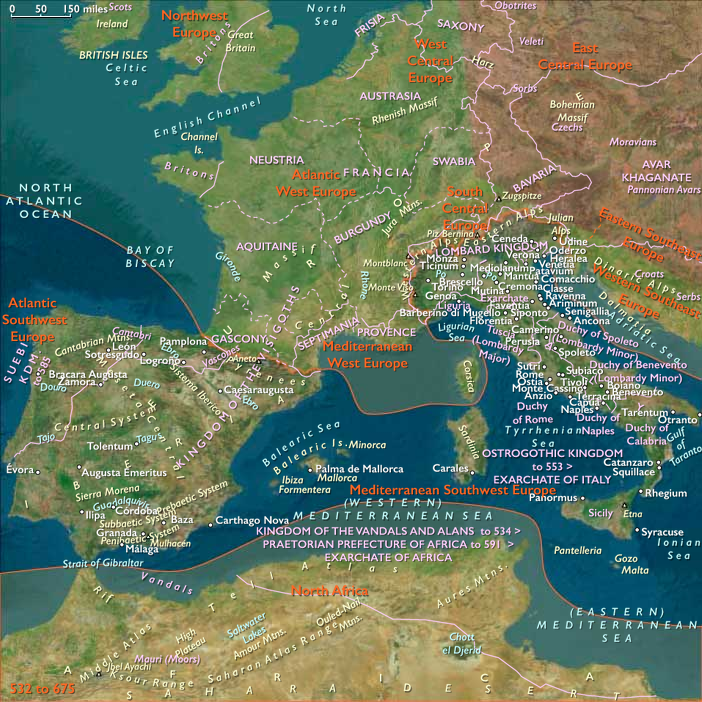
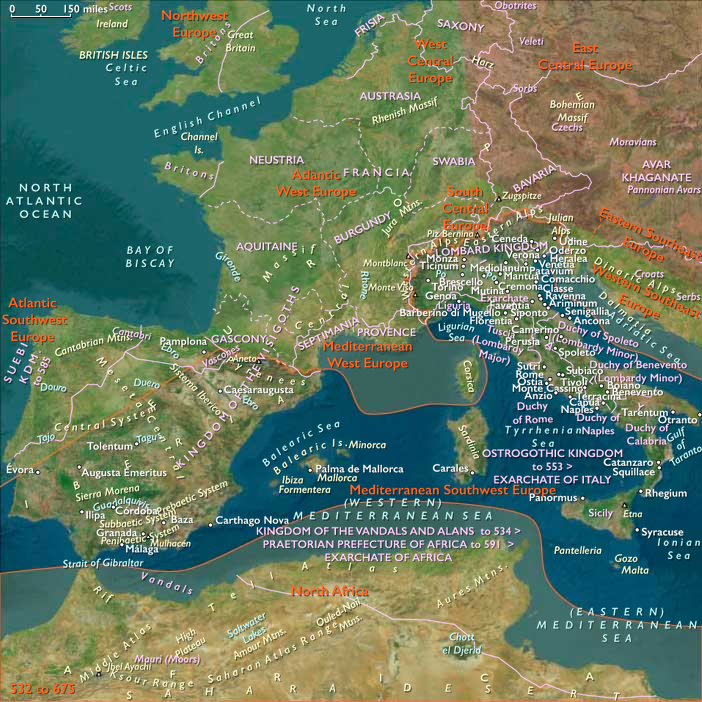
The Lombards take Taranto from the Empire in 675.
Locations
People
Groups
- Lombards (West Germanic tribe)
- Greeks, Medieval (Byzantines)
- Rome, Duchy of
- Lombards (Italy), Kingdom of the
- Ravenna, Exarchate of
- Roman Empire, Eastern: Heraclian dynasty
Topics
Commodoties
Subjects
Regions
Subregions
Related Events
Filter results
Showing 10 events out of 56213 total
A revolt within the Avar Empire, precipitated by the creation in the second half of the seventh century of the Bulgarian state in the southeastern Balkans, results in the expulsion of about nine thousand dissidents.
The Muslims besiege Constantinople in 674 and 675, but are again thwarted by the defenders’ use of Greek fire.
Asparukh, one of the sons of Kubrat, is followed by thirty thousand to fifty thousand Bulgars.
He reaches the Danube and, while the imperial capital, Constantinople, is besieged by Muawiyah I, Caliph of the Arabs (674–678), he and his people settle in the Danube delta, probably on the now disappeared Peuce Island.
The Bulgars have meanwhile assumed the role on the Balkan frontier abdicated by the Avars after 626.
The Danubian region, nominally controlled in the seventh century by the Roman Empire, is inhabited by Vlachs (ancestors of the modern Romanians) and very largely by recently arrived Slavs.
The immigration of the first Bulgars into the Balkans overlaps that of the Slavs in the seventh century.
A pagan people of mixed Turkic stock (the word Bulgar derives from an Old Turkic word meaning "one of mixed nationality"), the Bulgars are warriors who had migrated from a region between the Urals and the Volga to the steppes north of the Caspian Sea.
Constantine cannot prevent the Bulgars from crossing, under their khan Asparukh, southward across the Danube, where they conquer or expel the Slavic tribes living north of the Balkan Mountains.
Here, on the plain between the Danube and the Balkan Mountains, the Bulgars establish the kernel of the so-called first Bulgarian empire—the state from which the modern nation of Bulgaria derives its name.
Perctarit had been king of the Lombards from 661 to 662.
The son and successor of Aripert, he had shared power with his brother Godepert.
Perctarit was a Catholic, Godepert an Arian; the former ruled from Milan, the latter from Pavia.
Godepert had requested the aid of Duke Grimoald of Benevento in a war with Perctarit, but the Beneventan had had him assassinated and taken over the kingdom, forcing Perctarit to flee to the court of the Avar khagan Kakar.
However, his wife, Rodelinde and their son Cunipert had been captured by Grimoald and sent to Benevento.
Perctarit had returned soon after to conspire against Grimoald, but fled again to Gaul.
Under Grimoald, the Lombards had successfully fought the Franks and the Romans in Italy.
When duke Lupus of Friuli refused to swear allegiance to Benevento, the king had had the Avar khagan attack him in 663 but after the Avars refuses to leave, Grimoald had had to wage war to force them out.
After Grimoald confirmed a treaty with the Franks, Perctarit had prepared to flee to England, but news of Grimoald's death in 672 had reached him first.
Returned from exile and retaking his realm, which had been ruled on behalf of Grimoald's son Garibald, Perctarit had made Catholicism the official religion, but did not recognize papal authority.
He has forced Lombard’s Jews to adopt Christianity or be killed; many survive by outwardly accepting Christianity.
The Edictum Rothari of 64 gives the gastalds—Lombard officials in charge of some portion of the royal demesne (a gastaldia or castaldia) with civil, martial, and judicial powers—the civil authority in the cities and the reeves the like authority in the countryside.
Territories are delimited under the Lombard dominion by giudicati or "judgments" among the several gastaldi.
Another subdivision of the Bulgars disappears into service under the Lombards, who settle them in the Molise region of southern Italy in the deserted area of Bovianum (modern Boiano, or Bojano), the ancient Samnite capital, which becomes a seat of a gastaldate.
Wulfhere, with an effective hegemony over all the Anglo-Saxon kingdoms except for Northumbria, had by the early 670s become the most powerful king in southern Britain.
Wulfhere according to Stephen of Ripon, had in 674 "stirred up all the southern nations against [Northumbria]", but he was defeated by Oswiu's son Ecgfrith who had forced him to surrender Lindsey, and to pay tribute.
Wulfhere survived the defeat but dies in 675, possibly of disease; his brother Æthelred succeeds him as king of Mercia.
We begin in the easternmost subregions and move westwardly around the globe, crossing the equator as many as six times to explore ever shorter time periods as we continue to circle the planet. The maps of the regions and subregions change to reflect the appropriate time period.
Narrow results by searching for a word or selecting from one or more of a dozen filters.
Punuk Culture (676–819 CE)
Large Villages, Whale Hunting, and the Maturation of the Thule Tradition
By the late 7th century CE, the Punuk culture emerged across the islands of the Bering Strait and the Chukchi Peninsula, representing a clear development out of earlier Old Bering Sea (OBS) and Okvik traditions. While these earlier phases were renowned for their artistry in ivory and compact, semi-subterranean settlements, the Punuk stage marked a decisive shift toward larger villages, intensified whale hunting, and new forms of social organization.
Archaeological evidence shows Punuk settlements clustering along the major Strait islands (St. Lawrence, Diomedes, Punuk group) and extending onto the Siberian and Alaskan coasts. Unlike the smaller OBS dwellings, Punuk houses were larger, square or rectangular subterranean structures, carefully engineered for insulation. Their walls and roofs were supported by massive whale jawbones, reinforced with driftwood, and covered with sod and skins. With only low entrances visible above ground, these houses retained warmth through long winters, reflecting architectural ingenuity in the unforgiving Arctic climate.
The artifact styles of the Punuk stage also distinguish it from earlier OBS forms. Harpoon heads and hunting implements became standardized in shape, reflecting a culture increasingly oriented toward whale hunting rather than smaller marine mammals. The artistry of ivory carving continued, but with a shift toward simpler, more functional motifs compared to the exuberant curvilinear designs of the OBS. This suggests that social emphasis was moving from symbolic display toward practical efficiency in large-scale hunts and cooperative subsistence.
Whale hunting became the hallmark of Punuk life. The remains of bowhead and gray whales in settlement middens attest to organized, communal hunts that required coordination, large boats, and substantial labor. This reliance on whales not only increased food security but also facilitated larger and denser settlements, as whale harvests could support bigger populations.
In cultural terms, the Punuk horizon signals the consolidation of the Thule trajectory in the Bering Strait. Communities were no longer small, mobile bands but village societies with durable architecture, cooperative whale hunts, and broader exchange networks stretching across the Strait. This stability allowed the Punuk tradition to flourish and paved the way for the full-fledged Thule migrations eastward into Arctic Canada and Greenland in the centuries to come.
Polynesia (676–819 CE): Chiefly Horizons, Sacred Genealogies, and the Oceanic Web
Geographic & Environmental Context
By the late 7th and early 9th centuries CE, Polynesia had fully matured as a cultural world—its islands scattered across a vast triangle stretching from Hawai‘i (North Polynesia) to Tonga and Samoa (West Polynesia) and to the far-flung eastern arc of Mangareva, Pitcairn, and Rapa Nui (East Polynesia).
The region comprised a spectrum of environments: high volcanic islands such as Tongatapu, Upolu, Tahiti, and Hawai‘i with fertile soils and perennial streams; mid-ocean atolls such as Tokelau, Tuvalu, and the Cooks dependent on rainwater and lagoon productivity; and the dry, isolated islands of the far southeast where ingenious field systems emerged. Despite their remoteness, these island worlds were joined by voyaging canoes, kinship alliances, and ritual exchanges that carried ideas, crops, and people across thousands of kilometers.
Climate & Environmental Shifts
The late Holocene climatic stability persisted across the Pacific. Trade winds blew reliably, seas were calm enough for open-ocean voyages, and ENSO variability remained modest. High islands enjoyed dependable rainfall that sustained breadfruit, banana, and taro agriculture, while atolls relied on coconuts, fish, and preserved breadfruit. Only in the eastern outliers did dryness and wind pose serious challenges—factors that spurred early Polynesian innovation in rock-mulch gardening and rain-fed irrigation.
Societies & Political Developments
West Polynesia: Hierarchies and Monumental Foundations
In Tonga, Samoa, and the Cook and Society Islands, population growth and inter-island competition gave rise to stratified chiefdoms. The Tu‘i Tonga dynasty began to consolidate authority, erecting massive earthen and stone mounds (langi) that anchored sacred kingship. Samoa maintained a federated chiefly system—matai councils of lineage heads balancing consensus and prestige. Across the region, authority blended divine ancestry with pragmatic leadership, expressed in ceremonies of kava drinking, tattooing, and oratory. Monumental platforms and marae sanctuaries symbolized unity between ancestors, land, and sea.
North Polynesia: Consolidation and Cultural Refinement
In Hawai‘i and the northern chain, societies became more territorial and structured, their valleys divided among chiefly lines (ali‘i). Irrigated taro terraces expanded in O‘ahu and Maui’s windward valleys; fishponds (loko i‘a) were engineered to capture tides and breed mullet. Ritualized chiefly exchanges—feasting, dancing, and tribute distribution—strengthened social cohesion. While navigation routes between Hawai‘i and the central Pacific likely thinned, local voyaging remained vigorous among the northern islands.
East Polynesia: Frontier Communities and Ancestral Memory
Far to the southeast, settlers in Mangareva, Pitcairn, and Rapa Nui lived in isolation, maintaining small but resilient societies. Chiefs presided over kin-based villages cultivating taro, yam, and sweet potato in terraces and rock gardens. Ahu shrines and standing stones emerged as ancestral foci—the embryonic stage of the moai tradition that would later define Rapa Nui. Canoes connected these islands intermittently, sustaining exchange in stone tools, shell ornaments, and genealogical lore. Here, voyaging became both a practical necessity and a sacred remembrance.
Economy & Exchange Networks
Across Polynesia, horticulture and arboriculture formed the economic base—taro, yam, breadfruit, banana, and coconut supplemented by pigs, chickens, and dogs introduced generations earlier.
-
West Polynesia exported shell valuables and basalt adzes through Tonga–Samoa–Fiji circuits.
-
North Polynesia relied on local specialization: irrigated taro inland, salt and fish from coasts.
-
East Polynesia used inter-island reciprocity to mitigate ecological limits.
Voyaging remained integral: double-hulled canoes carried goods, spouses, and genealogies; their movement stitched the region into a maritime commonwealth of mutual awareness, even as local identities deepened.
Technology & Material Culture
The lashed-lug canoe with mat sails epitomized Polynesian mastery of wood, fiber, and hydrodynamics. Stone adzes, coral files, and shell scrapers refined woodworking and house construction. Fine tapa cloth, dyed red, black, or yellow, became a medium of tribute and ceremony. Ornaments in whale ivory, shell, and bone displayed chiefly status. In the east, basalt and coral tools from Mangareva and Pitcairn circulated in small but steady exchange spheres.
Cultural & Symbolic Expressions
Polynesian cosmology centered on genealogy (whakapapa, gafa)—the sacred chain linking gods, chiefs, and commoners. Myths of Tangaloa, Tane, and Pele described creation through navigation and transformation.
Ritual life unfolded in marae and heiau—open-air temples marked by coral or basalt pavements where offerings and kava libations honored gods and ancestors. Song, dance, and tattooing codified memory, rank, and identity. Across the ocean, shared motifs—spiral designs, triangular tattoos, red sacred coloration—testify to a living network of cultural dialogue.
Environmental Adaptation & Resilience
-
Tonga and Samoa: irrigated taro and arboriculture balanced protein from lagoons.
-
Hawai‘i: fishpond systems, diversified valley agriculture, and ritual resource management sustained dense populations.
-
Rapa Nui: stone-mulch gardens and windbreaks stabilized soils.
-
Atolls: preserved breadfruit paste, coconut water, and dried fish underpinned food security.
Polynesians treated ecology as a sacred partnership—land (fenua, ʻāina) and sea (moana) were both kin and deity.
Movement & Interaction Corridors
West Polynesia remained the political and ritual center, radiating influence outward through marriage alliances, kava rites, and trade. Central Polynesian canoes ventured along the Tonga–Samoa–Cook–Tahiti axis, while smaller craft maintained contact across the Tuvalu–Tokelau–Pukapuka chain. The far east and north were increasingly autonomous, but oral traditions preserved the idea of a connected “sea of islands,” navigable through shared stars and genealogies.
Transition (After 819 CE)
By the early 9th century, Polynesia had reached a cultural equilibrium:
-
West Polynesia anchored a network of monumental chiefdoms under the rising Tu‘i Tonga.
-
North Polynesia fostered intricate irrigation, aquaculture, and lineage-based leadership.
-
East Polynesia, though remote, developed distinct ancestral monuments that anticipated later innovation.
This was an age of stability and synthesis—when Polynesian societies balanced expansion and rootedness, hierarchy and reciprocity, and the sacred ocean continued to bind their far-flung worlds into one cultural continuum.

Years: 675 - 675
Locations
People
Groups
- Lombards (West Germanic tribe)
- Greeks, Medieval (Byzantines)
- Rome, Duchy of
- Lombards (Italy), Kingdom of the
- Ravenna, Exarchate of
- Roman Empire, Eastern: Heraclian dynasty