
The Livonian Crusade refers to the German …
Years: 1204 - 1215
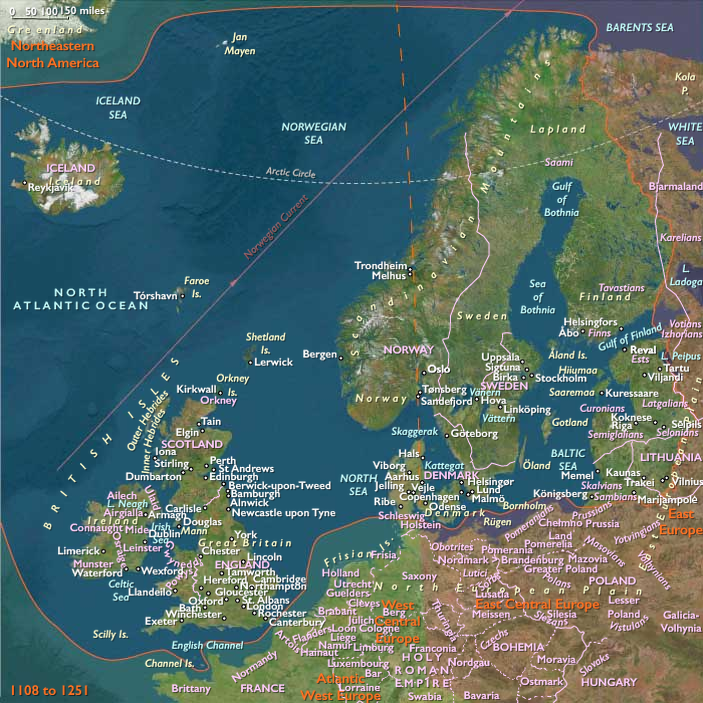
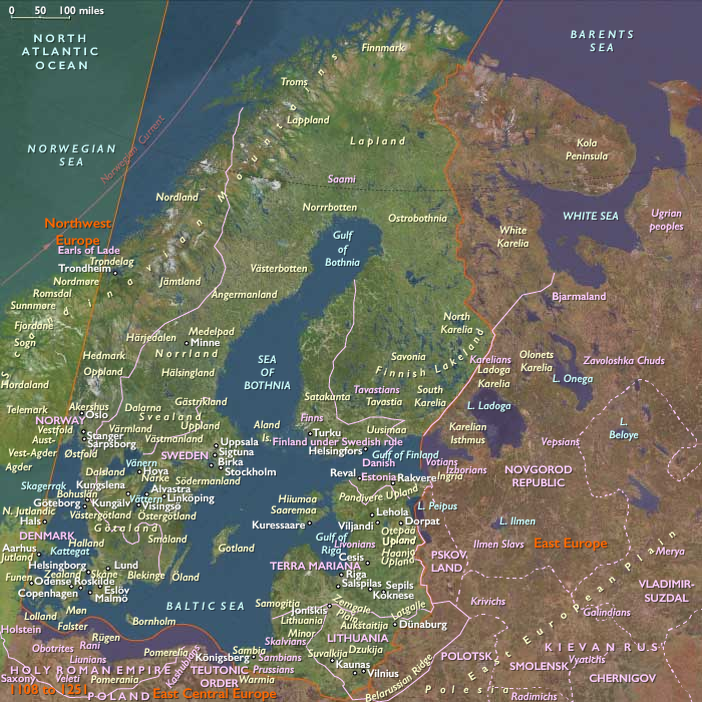
The Livonian Crusade refers to the German and Danish conquest and colonization of medieval Livonia, the territory constituting modern Latvia and Estonia, during the Northern Crusades.
The lands on the eastern shores of the Baltic Sea are the last corners of Europe to be Christianized.
Groups
- Polytheism (“paganism”)
- Latvians, or Letts (Eastern Balts)
- Estonians
- Germans
- Livs
- Estonia, independent
- Denmark, Kingdom of
- Papal States (Republic of St. Peter)
- Danes (Scandinavians)
- Christians, Roman Catholic
- Knights of the Sword (Order of the Livonian Brothers of the Sword, or Livonian Knights)
Topics
- Crusades, The
- Ostsiedlung (German: Settlement in the East), a.k.a. German eastward expansion
- Northern Crusades, or Baltic Crusades
- Livonian Crusade
Commodoties
Subjects
Regions
Subregions
Related Events
Filter results
Showing 10 events out of 47639 total
Genghis Khan and his allies during his political rise in 1206 create a Mongol Empire that shares its western borders with the Tanguts' Western Xia Dynasty.
To its east and south is the Jin Dynasty, founded by the Manchurian Jurchens, who rule northern China as well as being the traditional overlords of the Mongolian tribes for centuries.
Genghis Khan organizes his people, army, and his state to first prepare for war with Western Xia, or Xi Xia, which is close to the Mongolian lands.
He correctly believes that the more powerful Jin Dynasty's young ruler will not come to the aid of Xi Xia.
The Mongol forces in the ensuing war of attrition with the Tanguts ravage the countryside so thoroughly that the Xi Xia rulers seek peace terms and acknowledge Mongol suzerainty, freeing Genghis Khan to move against the Jin and plan for further expansion to the west.Despite initial difficulties in capturing its well-defended cities, Genghis Khan by 1209 forces the surrender of Western Xia.
Northeast Europe (1204–1215 CE): Livonian Crusade, Conquest, and Baltic Defiance
Introduction
Between 1204 and 1215 CE, Northeast Europe entered a transformative period marked by the formal intensification of the Livonian Crusade, significant territorial conquests, and resolute Baltic resistance. This era dramatically reshaped the region through coordinated Danish and German military actions, further Swedish expansion, and the determined defense by local Baltic tribes.
The Livonian Crusade and Military Colonization
The Livonian Crusade, constituting the German and Danish conquest and colonization of medieval Livonia (modern-day Latvia and Estonia), accelerated during this period. Prompted by Pope Celestine III's call in 1193, these campaigns represented the final major wave of forced Christianization in Europe, targeting pagan peoples along the Baltic's eastern shores—among Europe's last non-Christian communities.
Danish King Valdemar II "the Victorious" (r. 1202–1241) significantly advanced Danish interests by establishing control over key Estonian territories. Simultaneously, the German Livonian Brothers of the Sword solidified their presence by establishing and fortifying strategic outposts, notably the city of Riga (founded in 1201), which quickly became a critical military and trading hub.
Danish and German Territorial Gains
Under Valdemar II, Denmark expanded aggressively into Estonia, successfully subjugating significant areas of northern Estonia, laying the groundwork for long-term Danish control. German crusaders, working closely with the Danes, targeted southern regions, systematically subduing and converting local populations such as the Livs and Latgallians, establishing enduring crusader states that dramatically reshaped local political structures.
Swedish Colonization and Baltic Estrangement
Swedish expansion into southern Finland continued robustly, furthering colonization and Christian missionary efforts. This growth in Swedish presence accelerated the cultural and political estrangement of Estonians south of the Gulf of Finland from their Finnish kinsmen to the north, setting distinct trajectories for these culturally related yet increasingly separated communities.
Baltic Resistance and Enduring Defiance
The Baltic peoples, particularly the Estonians, Latvians, Lithuanians, and Curonians, vigorously resisted the crusaders' advances. Tribes fortified strategic locations, formed defensive alliances, and launched effective counterattacks. Their resistance delayed and complicated crusader expansion, exemplifying persistent defiance against foreign domination.
Economic and Urban Development
The era witnessed significant economic development and urban expansion. Riga, newly founded by German crusaders, rapidly became a pivotal economic center in the Baltic region. Simultaneously, traditional trading hubs like Visby on Gotland further consolidated their position as influential commercial and maritime centers, linking Scandinavia, German territories, and the broader Baltic region.
Ecclesiastical Influence and Cultural Integration
Christian ecclesiastical institutions, led by powerful bishops and supported by monastic orders, rapidly expanded their influence. They oversaw the systematic conversion of local populations, integrating them into Latin Christendom. Riga became an influential ecclesiastical hub, significantly facilitating cultural and religious transformation throughout Livonia.
Legacy of the Era
The years 1204–1215 CE profoundly reshaped Northeast Europe through the intensification of the Livonian Crusade, dramatic military conquests, and steadfast Baltic resistance. This era firmly established Christian rule and cultural dominance in the region, laying crucial foundations for subsequent political, social, and religious dynamics that would persist for centuries.
East Central Europe (1204–1215 CE): Andrew II’s Hungarian Ascendancy, Bohemian Royal Consolidation under Ottokar I, Polish Regional Power under Henry the Bearded, and Austria’s Stability under Leopold VI
Between 1204 and 1215 CE, East Central Europe—including modern-day Poland, Czechia, Slovakia, Hungary, and eastern regions of Germany and Austria east of 10°E and north of the defined southeastern boundary—experienced significant political realignments, territorial consolidation, and cultural developments. Hungary entered a vibrant era under King Andrew II, Bohemia solidified Přemyslid royal authority under Ottokar I, Poland’s fragmentation continued but saw growing regional strength under Henry the Bearded in Silesia, and Austria prospered under Leopold VI of the Babenberg dynasty. These developments significantly influenced regional stability, economic expansion, and cultural flourishing.
Political and Military Developments
Hungarian Stability and Expansion under Andrew II
-
In 1205, following King Emeric’s death, his brother Andrew II (r. 1205–1235) ascended Hungary’s throne, ushering in a politically active and culturally vibrant reign. Andrew pursued ambitious foreign and domestic policies, seeking greater political influence across East Central Europe and actively engaging in Crusades.
-
His governance significantly strengthened Hungary’s regional standing, despite occasional internal disputes and aristocratic challenges.
Bohemian Royal Authority Strengthened under Ottokar I
-
King Ottokar I Přemysl (r. 1197–1230) reinforced royal authority, stabilizing Bohemia after previous dynastic conflicts. His strong leadership earned recognition of hereditary royal status from the Holy Roman Empire in the Golden Bull of Sicily (1212), enhancing Přemyslid autonomy and political prestige.
-
Ottokar’s reign marked significant administrative reform, territorial consolidation, and increased Bohemian political influence within imperial affairs.
Polish Fragmentation and Silesian Power under Henry the Bearded
-
Poland’s political fragmentation persisted with principalities operating autonomously. The most prominent was Silesia under Duke Henry I the Bearded (r. 1201–1238), who consolidated power, enhanced economic prosperity, and fostered diplomatic alliances.
-
Henry’s leadership elevated Silesia as the strongest of Poland’s regional duchies, significantly influencing broader Polish and Central European politics.
Austrian Stability and Prosperity under Leopold VI
-
Duke Leopold VI of Austria (r. 1198–1230) ensured political stability, territorial security, and economic prosperity within Austria. His rule strengthened urban centers, fortified regional influence, and reinforced Austria’s prominence in the Holy Roman Empire.
-
Leopold VI actively supported crusading efforts, fostering diplomatic relations across Europe and enhancing Austria’s international prestige.
Imperial Authority under Otto IV and Frederick II
-
The period featured contested imperial succession between Otto IV (r. 1198–1215) and Frederick II (r. 1212–1250), affecting regional politics. East Central European rulers navigated shifting imperial alliances, notably Bohemia under Ottokar I, whose support for Frederick II strengthened his position and royal autonomy.
Economic and Technological Developments
Prosperous Regional Economies and Expanded Trade
-
Economic prosperity continued through robust trade networks connecting Baltic, Western Europe, and Mediterranean markets. Major urban centers—Prague, Vienna, Esztergom, Kraków, and Wrocław—thrived commercially, becoming vital hubs of regional trade.
Agricultural Innovations and Population Growth
-
Agricultural productivity increased due to widespread adoption of advanced techniques, such as improved plows, crop rotation, and land management practices, supporting significant urbanization and population expansion.
Cultural and Artistic Developments
Hungarian Cultural and Artistic Flourishing under Andrew II
-
Andrew II patronized extensive ecclesiastical foundations, artistic endeavors, and intellectual developments, greatly enhancing Hungarian cultural life. Manuscript production, ecclesiastical architecture, and scholarly activities flourished, influenced by Western European and Byzantine traditions.
Bohemian Intellectual and Cultural Revival under Ottokar I
-
Bohemia’s cultural prominence significantly increased, particularly in Prague, driven by royal patronage of monastic scholarship, manuscript illumination, and architectural projects. Prague became an influential cultural and intellectual center within Central Europe.
Silesian Cultural and Economic Vitality under Henry the Bearded
-
Duke Henry the Bearded fostered cultural and economic vitality in Silesia, promoting monasteries, urban development, and artistic patronage. His support solidified Silesia’s role as a prominent cultural and commercial region within fragmented Poland.
Settlement and Urban Development
Urban Expansion in Hungary under Andrew II
-
Hungarian urban centers, notably Esztergom and Buda, expanded significantly, benefiting from improved fortifications, administrative organization, and flourishing commerce. This urban development reflected Andrew’s effective governance and economic policies.
Bohemian Town Consolidation and Growth
-
Under Ottokar I, Prague and other Bohemian urban centers experienced notable growth, infrastructure improvements, and commercial expansion. Prague’s prominence as a regional economic and administrative center was significantly enhanced.
Austrian Urban Prosperity and Infrastructure Development
-
Austria’s towns, particularly Vienna, experienced considerable prosperity under Leopold VI, supported by infrastructure enhancements, fortified settlements, and growing regional trade connections, reinforcing Austria’s economic strength and political influence.
Social and Religious Developments
Expansion and Strengthening of Ecclesiastical Structures
-
Ecclesiastical institutions expanded significantly, shaping regional governance, education, and cultural identities. Monasteries and bishoprics played critical roles in societal cohesion, intellectual development, and cultural continuity across East Central Europe.
Dynastic and Aristocratic Governance Structures
-
Aristocratic authority and dynastic leadership remained pivotal. Hungarian royal strength under Andrew II, Přemyslid consolidation in Bohemia, Austrian stability under Leopold VI, and Silesian prominence under Henry the Bearded emphasized the critical role of nobility and dynastic influence in regional governance.
Long-Term Consequences and Historical Significance
The era 1204–1215 CE represented a decisive period of regional consolidation and political realignment in East Central Europe. Andrew II’s reign solidified Hungarian regional prominence, Ottokar I secured lasting Přemyslid royal authority and autonomy in Bohemia, Henry the Bearded elevated Silesia within fragmented Poland, and Austria prospered under Leopold VI’s strong rule. These developments significantly shaped regional political identities, economic patterns, and cultural traditions, profoundly influencing East Central Europe’s medieval trajectory and future historical developments.
The Fourth Crusade and the Sack of Constantinople (1204 CE): A Crusade Gone Astray
The Fourth Crusade (1202–1204) was originally intended to recapture Jerusalem by launching an invasion through Egypt, which had become the center of Ayyubid power after Saladin’s conquests. However, due to financial difficulties, Venetian manipulation, and internal rivalries, the Crusade was diverted and resulted in the shocking conquest of Constantinople, the capital of the Eastern Orthodox Byzantine Empire, in April 1204.
The Diversion to Constantinople
- The Crusaders had agreed to transport their forces by Venetian ships, but they lacked the funds to pay the Republic of Venice for their passage.
- The Venetians, led by Doge Enrico Dandolo, proposed that the Crusaders first attack the Christian city of Zara (Zadar), a rebellious Venetian vassal, in 1202 as payment.
- After sacking Zara, the Crusaders were approached by Alexios IV Angelos, the exiled Byzantine prince, who promised money and military support if the Crusaders helped restore him to the Byzantine throne.
- In 1203, the Crusaders installed Alexios IV as co-emperor, but he struggled to fulfill his promises, leading to a Byzantine backlash and his overthrow.
- The Crusaders, now angry and unpaid, turned against Constantinople itself.
The Sack of Constantinople (April 1204)
- On April 12, 1204, the Crusaders breached Constantinople’s walls and looted the city.
- Churches, palaces, and homes were ransacked, and priceless relics and artworks were either stolen or destroyed.
- The Hagia Sophia, the great cathedral of Eastern Christianity, was desecrated, with Crusaders looting its treasures and placing a prostitute on the patriarch’s throne.
- Thousands of Byzantine civilians were slaughtered, and the city was set ablaze, leading to irreparable damage to one of the greatest cities of Christendom.
- The treasures of Constantinople, including the Horses of Saint Mark, were taken back to Venice and Western Europe.
Consequences of the Sack
-
The Final Blow to the Great Schism (1054)
- The destruction of Constantinople by fellow Christians marked the point of no return in the East-West Schism between the Orthodox and Catholic Churches.
- The Byzantines never forgave the Latin West, creating a permanent rift between the two Christian traditions.
-
The Establishment of the Latin Empire (1204–1261)
- The Crusaders dismantled the Byzantine Empire, establishing the Latin Empire of Constantinople, which lasted until 1261, when the Byzantines reclaimed the city.
- The Greek world was fractured, with remnants of the Byzantine aristocracy fleeing to Nicaea, Epirus, and Trebizond, from where they would eventually reconquer the city.
-
Venice and Western Europe Profited Immensely
- Venice, in particular, benefited greatly, taking control of key trade routes and territories in the Aegean and Eastern Mediterranean.
- Many Western feudal lords gained new fiefs, ruling over Greek-speaking Orthodox Christians.
A Crusade of Betrayal
The Fourth Crusade, originally meant to retake Jerusalem, instead became a catastrophic betrayal of Christendom itself, ending in one of the most infamous sacks in history.
The fall of Constantinople in 1204 is widely regarded as one of the darkest episodes of the Crusades, strengthening divisions between East and West and leaving the Byzantine Empire permanently weakened until its final fall to the Ottoman Turks in 1453.
The Latin crusaders consolidate their new empire of Constantinople, which they call Romania, while Theodore Lascaris consolidates the remnants of Greek imperial power and erects a new empire centered upon Nicaea in Asia Minor, with Ionian and Balkan holdings.
Eastern Southeast Europe (1204–1215 CE): Aftermath of the Fourth Crusade, Fragmentation, and New Powers
Settlement and Migration Patterns
Crusader States and Latin Rule
The aftermath of the Fourth Crusade in 1204 significantly reshaped Eastern Southeast Europe's political landscape. Crusaders established the Latin Empire of Constantinople, drastically altering settlement patterns as Latin nobles and knights assumed control of formerly Byzantine territories. Regions around Constantinople saw significant settlement by Western Europeans, resulting in cultural and demographic shifts.
Bulgarian Territorial Consolidation
Under Tsar Kaloyan, the Second Bulgarian Empire capitalized on Byzantine collapse, significantly expanding its territory and consolidating control over much of the Balkan Peninsula. Bulgarian settlements and influence increased markedly, notably in areas previously under Byzantine rule.
Serbian Expansion and Consolidation
Serbian territorial gains under Stefan Nemanja and subsequently his son, Stefan the First-Crowned, continued. The Serbian state grew more cohesive, establishing stronger administrative and urban centers, reinforcing Serbian settlements across the region.
Economic and Technological Developments
Decline of Byzantine Economic Dominance
The economic impact of Constantinople's fall to the crusaders was profound. Byzantine commercial influence dramatically diminished, replaced by Latin-controlled trade networks dominated by Venetian and Genoese merchants. These Western powers seized control of key trade routes and maritime commerce.
Development of Local Economies
Regional economic autonomy increased as the fragmented political environment necessitated localized trade and production. Towns and cities, particularly within Bulgaria and Serbia, experienced economic growth through local trade, agriculture, and artisanal production.
Military Fortifications and Innovations
Defensive structures were reinforced and newly constructed across the region. Crusader states and emergent Balkan kingdoms heavily invested in fortifications, enhancing their capacity to defend against both external invasions and internal rebellions.
Cultural and Artistic Developments
Western Influence in Art and Architecture
Latin rule introduced considerable Western European cultural elements, particularly noticeable in religious and military architecture. Gothic and Romanesque styles increasingly blended with traditional Byzantine aesthetics, resulting in unique hybrid forms in the region.
Preservation and Adaptation of Byzantine Culture
Despite the political upheaval, Byzantine cultural traditions persisted, adapting to new political realities. Orthodox religious art, manuscript illumination, and classical learning continued, often merging subtly with Latin influences.
Social and Religious Developments
Establishment of Latin Ecclesiastical Structures
The Latin Empire introduced Roman Catholic ecclesiastical institutions to regions historically dominated by Eastern Orthodoxy. Latin patriarchs and bishops replaced or competed with their Orthodox counterparts, creating deep religious tensions and conflicts.
Bulgarian Church Autonomy
The Bulgarian Church reasserted autonomy under Tsar Kaloyan, who secured recognition from Pope Innocent III, briefly aligning with Rome against the Latin Empire. This strategic alignment enhanced Bulgaria’s political and religious independence, although it remained fundamentally Orthodox in practice.
Serbian Ecclesiastical Strengthening
Serbian rulers strengthened the Serbian Orthodox Church, aligning closely with Eastern Orthodox traditions. The growing power of the Serbian Church supported national identity and provided social cohesion amidst regional fragmentation.
Political Fragmentation and Regional Rivalries
Latin Empire’s Instability
The Latin Empire of Constantinople struggled to consolidate power, facing constant resistance from Byzantine successor states such as the Empire of Nicaea, Despotate of Epirus, and the Empire of Trebizond. Internal divisions and external pressures from Bulgaria and Serbia further weakened its authority.
Rise of Bulgarian and Serbian Dominance
The period saw the definitive emergence of Bulgaria and Serbia as dominant regional powers, each capitalizing on Byzantine collapse to expand their territories and strengthen administrative systems. Their growing influence reshaped regional politics, setting the stage for future conflicts and alliances.
Long-Term Consequences and Historical Significance
The era from 1204 to 1215 CE dramatically altered Eastern Southeast Europe, characterized by political fragmentation, the emergence of new regional powers, economic reorientation toward localized production, and significant cultural exchanges between Latin and Byzantine traditions. These developments profoundly influenced the region's subsequent historical trajectory, laying foundations for lasting divisions, regional identities, and the complex interplay of religious and political forces.
Aside from Nicaea, the Greek imperium lives on in the Empire of Trebizond, based on the former empire’s Crimean and southern Black Sea holdings; the Despotate of Epirus in northwestern Greece; in the area around Monemvasia in the eastern Peloponnese; and in the mountain fastness of the Taïyetos in Achaia and Arcadia.
The leaders of Epirus and Trebizond vie with Theodore for the right to the imperial title.
Muhammad of Ghur is assassinated while returning in 1206 to Afghanistan.
Qutb-ud-Din remains in India and declares himself sultan of Delhi, the first of the Mamluk (Slave) dynasty.
Concurrent with the exploits of Muhammad of Ghur, an obscure adventurer, Ikhtiyar-ud-Din Muhammad Bakhtiyar Khalji of the Ghurid army, conquers Nadia, the capital of the Sena kings of Bengal, in 1202.
Within two years, Bakhtiyar had embarked upon a campaign to conquer Tibet in order to plunder the treasure of its Buddhist monasteries as well as to gain control of Bengal's traditional trade route leading to Southeast Asian gold and silver mines.
After the attempt ends in disaster, Bakhtiyar manages to return to Bengal with a few hundred men and dies there in 1206.
The Tamil poet Kampbar, another devotional writer of the Bhakti Hindu revival, composes the colorful epic “Ramavataram” in the early thirteenth century.
Based on Valmiki's Ramayana in Sanskrit, the story describes the life of King Rama of Ayodhya.
However, Ramavatharam is different from the Sanksrit original in many aspects—both in spiritual concepts and in the specifics of the story line.
This historic work is considered by Tamil scholars as well as the general public as one of the greatest literary works in Tamil literature.
Years: 1204 - 1215
Groups
- Polytheism (“paganism”)
- Latvians, or Letts (Eastern Balts)
- Estonians
- Germans
- Livs
- Estonia, independent
- Denmark, Kingdom of
- Papal States (Republic of St. Peter)
- Danes (Scandinavians)
- Christians, Roman Catholic
- Knights of the Sword (Order of the Livonian Brothers of the Sword, or Livonian Knights)
Topics
- Crusades, The
- Ostsiedlung (German: Settlement in the East), a.k.a. German eastward expansion
- Northern Crusades, or Baltic Crusades
- Livonian Crusade
Commodoties
Subjects
Regions
Subregions