
The Lithuanians, under the joint rulership of …
Years: 1359 - 1359
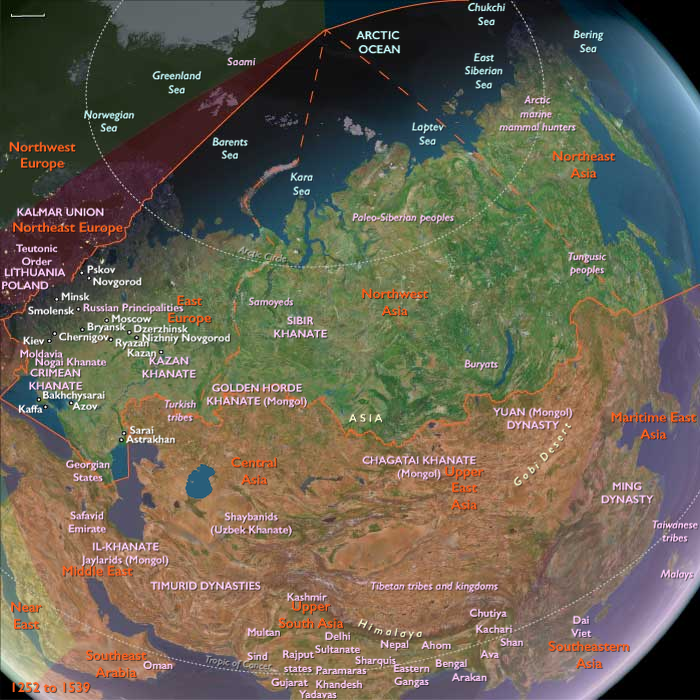
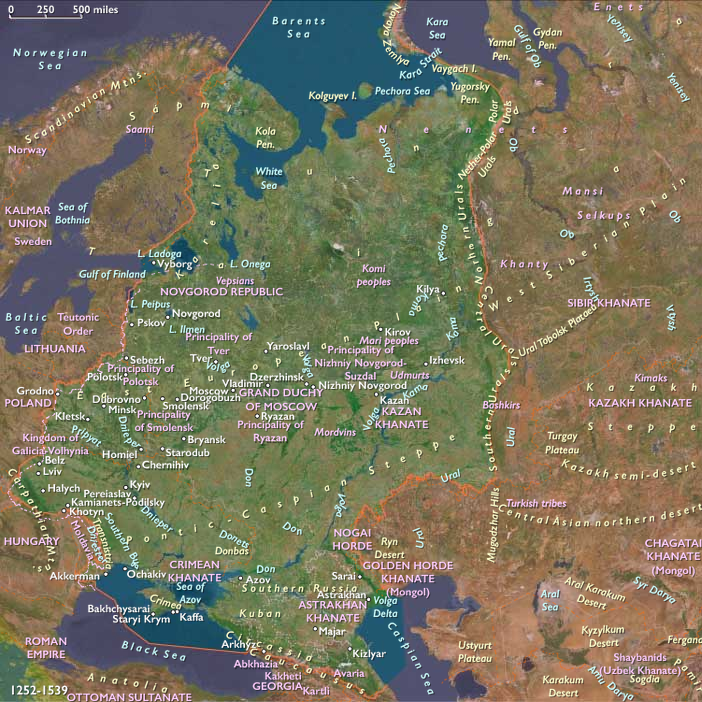
The Lithuanians, under the joint rulership of Kęstutis and Algirdas, conquer the former Kievan Rus' territory of Briansk in the upper Desna River valley in 1359.
Locations
People
Groups
Commodoties
Subjects
Regions
Subregions
Related Events
Filter results
Showing 10 events out of 20 total
There is also British opposition to the tribute.
Undersecretary of State for the Colonies Winston Churchill will visit Cyprus in 1907 and, in a report on his visit, declare, "We have no right, except by force majeure, to take a penny of the Cyprus Tribute to relieve us from our own obligations, however unfortunately contracted."
Parliament will soon afterward vote a permanent annual grant-in-aid of fifty thousand pounds sterling to Cyprus and reduce the tribute accordingly.
Winston Churchill, sent to the Cape Colony by London’s Morning Post to cover the war and subsequently captured by the Boers, makes a daring escape that brings him instant celebrity.
The ANZAC force is involved in the disastrous Churchill-planned Gallipoli invasion of April 25, 1915, which devolves into horrific trench warfare.
The defending Turks take an estimated 251,000 casualties, while the Allied forces suffer about 252,000 casualties, most of whom are the soldiers of Australia and New Zealand.
Effectively, Turkish rule in Transjordan is simply replaced by British rule.
British Lieutenant Colonel Frederick Gerard Peake raises an internal police force, the Arab Legion, to keep order among Transjordanian tribes and to safeguard Transjordanian villagers from Bedouins.
Of this number, about twenty percent live in four towns each having populations of from ten thousand to thirty thousand.
The balance are farmers in village communities and pastoral nomadic and seminomadic tribespeople.
The amirate's treasury operates on British financial aid established on the basis of an annual subsidy.
A native civil service is gradually trained with British assistance, but government is simple, and Abdullah rules directly with a small executive council, much in the manner of a tribal sheikh.
British officials handle the problems of defense, finance, and foreign policy, leaving internal political affairs to Abdullah.
To supplement the rudimentary police, in 1921 a reserve Arab force is organized by F. G. Peake, a British officer known to the Arabs as Peake Pasha.
This Arab force soon is actively engaged in suppressing brigandage and repelling raids by the Wahhabis.
As a result of these deliberations, Britain subdivides the Palestine Mandate along the Jordan River-Gulf of Aqaba line.
The eastern portion—called Transjordan—is to have a separate Arab administration operating under the general supervision of the commissioner for Palestine, with Abdullah appointed as amir.
At a follow-up meeting in Jerusalem with Churchill, High Commissioner Herbert Samuel, and T. E. Lawrence, Abdullah agrees to abandon his Syrian project in return for the amirate and a substantial British subsidy.
British colonial Secretary Winston Churchill, alarmed by the extent of Arab opposition to Zionism, issues a White Paper in June 1922 declaring that Great Britain does "not contemplate that Palestine as a whole should be converted into a Jewish National Home, but that such a Home should be founded in Palestine."
Immigration will not exceed the economic absorptive capacity of the country, and steps will be taken to set up a legislative council.
The Arabs reject these proposals, both because they constitute a large majority of the total mandate population and therefore wish to dominate the instruments of government and rapidly gain independence and because, they argue, the proposals allow Jewish immigration, which has a political objective, to be regulated by an economic criterion.
Northwest Europe (1924–1935): Interwar Britain, Economic Crisis, and Rising Global Tensions
Labour’s Ascendancy and Shifting Political Dynamics (1924–1929)
In January 1924, Britain experienced a landmark political shift when the Labour Party, led by Ramsay MacDonald, formed its first government, a minority administration supported by the Liberals. Though short-lived (January to October), this marked a decisive turning point, demonstrating Labour’s viability as a governing party. Conservatives, under Stanley Baldwin, quickly regained power later in 1924, emphasizing stability, economic discipline, and industrial recovery.
The Conservatives, in power from 1924 to 1929, focused on economic consolidation, cautiously rebuilding Britain's weakened economy through orthodox financial policies, notably under Chancellor Winston Churchill, who controversially returned Britain to the Gold Standard (1925), a decision later criticized for worsening deflation, unemployment, and trade deficits.
The General Strike and Social Turmoil (1926)
Britain’s industrial landscape remained deeply troubled during the 1920s. Persistent economic stagnation, intensified global competition, and depressed wages culminated in the General Strike of May 1926, a monumental nine-day confrontation involving over three million workers. Initially triggered by proposed wage reductions in the coal-mining industry, the strike rapidly spread across multiple sectors, temporarily paralyzing the country.
Though ultimately defeated, the strike dramatically highlighted class tensions and labour discontent, profoundly shaping British social attitudes and labour relations. Baldwin’s Conservative government responded firmly, passing the restrictive Trade Disputes and Trade Unions Act (1927), sharply limiting future union militancy.
Cultural Transformation and the Mass Media Age
This period witnessed dramatic transformations in British society and culture. Mass media, particularly radio broadcasting, reshaped national life. The establishment of the British Broadcasting Corporation (BBC) in 1927 transformed information dissemination and entertainment, creating a unified cultural experience across Britain.
Cinema also flourished, reflecting changing attitudes and values. Hollywood films heavily influenced British audiences, introducing new fashions, attitudes, and cultural norms, particularly among younger generations.
Changing Gender Roles and Women’s Suffrage
British women achieved political equality through the Representation of the People Act (1928), granting suffrage to all women over 21. This completed a long campaign for gender equality and symbolized broader social shifts triggered by women's active roles during World War I. Women's participation in education, employment, and public life expanded markedly, reshaping gender norms and expectations.
Economic Turbulence and the Great Depression (1929–1935)
The global economic crisis of the Great Depression, beginning in 1929, deeply impacted Britain, aggravating existing industrial decline. Unemployment soared, exceeding three million by 1932, with severe distress concentrated in industrial regions dependent on coal mining, shipbuilding, steel, and textiles. Industrial stagnation and mass unemployment severely tested Britain’s social fabric, triggering widespread poverty and protest.
Labour, returning to power in 1929 under MacDonald, grappled painfully with economic crisis. Faced with collapsing public finances, MacDonald controversially pursued austerity measures—spending cuts and reduced unemployment benefits—in 1931, fracturing Labour ranks. Ultimately, MacDonald resigned from Labour, forming a coalition National Government dominated by Conservatives, led first by MacDonald (1931–1935), and then succeeded by Conservative leader Stanley Baldwin (1935).
To stabilize the economy, the National Government abandoned the Gold Standard in September 1931, devaluing the pound, implementing tariffs to protect domestic industries, and pursuing fiscal restraint. These policies eventually produced modest economic stabilization by 1934–1935, although regional disparities and high unemployment persisted, especially in northern England, Scotland, and Wales.
Ireland and the Commonwealth Realignment
Throughout these years, Britain's relationship with Ireland evolved significantly. Following the Anglo-Irish Treaty (1921), the Irish Free State gained dominion status, confirmed formally by the Statute of Westminster (1931), which recognized the sovereignty of dominions. Yet Ireland’s political climate remained unsettled, culminating later in constitutional reforms leading to full independence, while tensions over Northern Ireland persisted unresolved.
International Uncertainties: Rise of European Dictatorships
During the 1920s and early 1930s, Europe witnessed alarming political shifts. Benito Mussolini’s fascist regime in Italy consolidated power and adopted aggressive foreign policies. In Germany, economic turmoil and resentment over Versailles fueled extremist movements. The rise of Adolf Hitler’s Nazi Party culminated in his appointment as Chancellor in January 1933, rapidly dismantling democracy and initiating military rearmament.
Britain initially responded cautiously, deeply scarred by World War I’s horrors, and reluctant to confront continental instability directly. British policymakers pursued policies of cautious neutrality and appeasement, particularly under Baldwin, aiming to avoid renewed conflict through diplomatic moderation.
Imperial Strains and Challenges to British Dominance
Globally, Britain faced significant imperial challenges. Nationalist movements intensified across the empire, notably in India under Mahatma Gandhi’s leadership, advocating peaceful resistance against British rule. British authorities grappled uneasily with these movements, reluctantly conceding incremental political reforms, foreshadowing eventual imperial withdrawal.
Middle Eastern mandates, particularly Palestine and Iraq, posed further problems, with rising tensions and contradictory British promises to Jews and Arabs complicating governance, ultimately fueling future instability.
Technological Advancements and Modern Infrastructure
Despite economic challenges, Britain experienced significant technological and infrastructure developments. Motorcars became increasingly common, prompting improvements in road networks and transportation. Aviation expanded notably; Imperial Airways, established in the 1920s, provided international flights, significantly enhancing Britain’s global connectivity and reinforcing imperial ties.
Scandinavian Stability and Social Democratic Model
Scandinavia, in contrast, enjoyed relative political and social stability during this period. Sweden, Denmark, and Norway successfully navigated economic turmoil through effective social-democratic governance and welfare-state expansions, establishing strong safety nets, low unemployment, and stable democratic institutions. Iceland continued advancing towards greater autonomy, economically resilient despite global disruptions.
Cultural Flourishing and Literary Modernism
Culturally, interwar Britain flourished despite adversity. Modernist literature, exemplified by writers such as Virginia Woolf, T.S. Eliot, and Irish-born James Joyce, explored contemporary anxieties, fragmented identities, and disillusionment following World War I. Modernism profoundly influenced British cultural expression, challenging traditional literary forms and conventional social attitudes.
The performing arts also thrived. Theatre, popularized by playwrights such as Noël Coward and George Bernard Shaw, explored contemporary social issues with sophistication, wit, and sharp social critique. Jazz music, embraced from America, reshaped Britain’s musical landscape, especially among younger generations, symbolizing cultural modernity.
Britain’s Military and Strategic Preparedness
As fascist regimes rose and European tensions mounted, Britain began cautiously reconsidering its military capabilities. Despite severe economic constraints, modest rearmament slowly commenced from 1934 onward, with limited increases in defense spending and modernization of the Royal Air Force. Public and political debates intensified regarding national preparedness, reflecting growing recognition of Germany’s aggressive rearmament under Hitler.
Conclusion: Transition, Crisis, and the Gathering Storm
From 1924 to 1935, Britain navigated complex transitions marked by severe economic turbulence, profound political realignments, and rising international threats. Labour’s ascendancy reshaped British politics fundamentally, highlighting class tensions and reform aspirations. The General Strike and subsequent economic crises revealed severe socioeconomic divides, compelling difficult policy choices, including the formation of the National Government and abandonment of the Gold Standard.
Culturally, rapid transformations—driven by mass media, changing gender roles, and modernist expression—reshaped British society profoundly. Internationally, Britain faced escalating European instability, rising fascism, and imperial challenges, gradually recognizing vulnerabilities requiring military preparedness.
These transformative, uncertain years deeply reshaped Northwest Europe, especially Britain, setting critical foundations for the profound global upheavals soon to follow.
As it had twenty-five years earlier, the island becomes important as a supply and training base and as a naval station.
This time, however, its use as an air base makes it particularly significant to the overall Allied cause.
Patriotism and a common enemy do not entirely erase enosis in the minds of Greek Cypriots, and propagandists remain active during the entire war, particularly in London, where they hope to gain friends and influence lawmakers.
Hopes are sometimes raised by the British government during the period when Britain and Greece are practically alone in the field against the Axis.
British foreign secretary Anthony Eden, for example, hints that the Cyprus problem will
be resolved when the war has been won.
Prime Minister Winston Churchill also makes some vague allusions to the postwar settlement
of the problem.
The wartime governor of the island states without equivocation that enosis is not being considered, but it is probable that the Greek Cypriots hear only those voices that they want to hear.
This election encourages Egyptians to believe that Britain will change its policy.
The end of the war in Europe and the Pacific, however, sees the beginning of a new kind of global war, the Cold War, in which Egypt finds itself embroiled against its will.
Concerned by the possibility of expansion by the Soviet Union, the West will come to see the Near and Middle East as a vital element in its postwar strategy of "containment."
In addition, pro-imperialist British Conservatives like Winston Churchill speak of Britain's "rightful position" in the Suez Canal Zone.
He and Anthony Eden, the Conservative Party spokesman on foreign affairs, stress the vital importance of the Suez Canal as an imperial lifeline and claim international security will be threatened by British withdrawal.
Years: 1359 - 1359
Locations
People
Groups
Commodoties
Subjects
Regions
Subregions