
The Ligurians called themselves Ambrones, according to …
Years: 480BCE - 480BCE
The Ligurians called themselves Ambrones, according to Plutarch, but this does not necessarily indicate a relationship with the Ambrones of northern Europe.
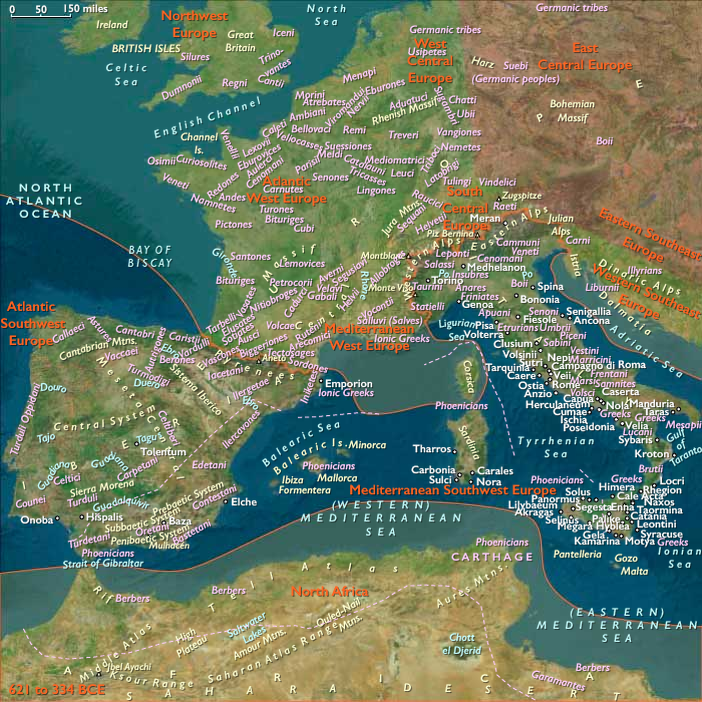
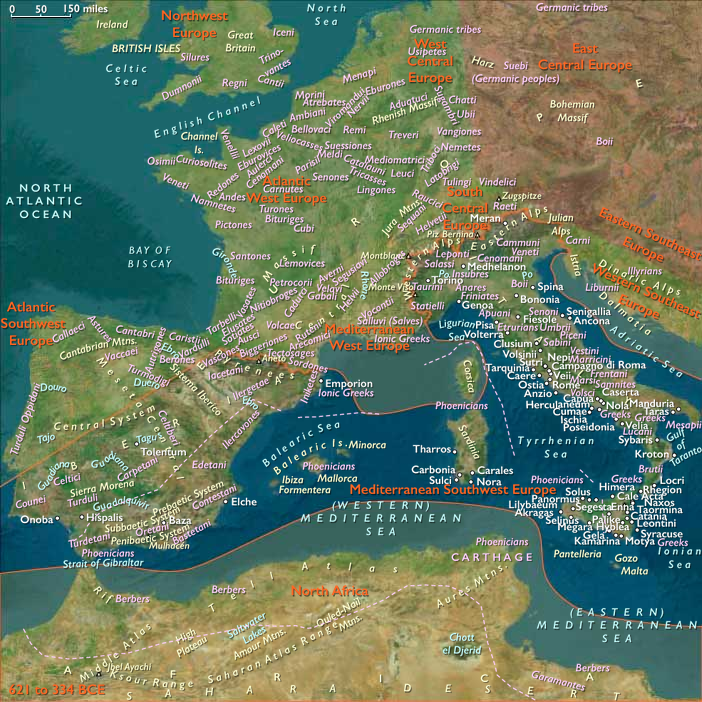
Classical references and toponomastics suggest that the Ligurian sphere once extended further than the present boundary of Liguria.
Ligurian toponyms have been found in Sicily, the Rhône valley, Corsica and Sardinia.
Aeschylus represents Hercules as contending with the Ligures on the stony plains near the mouths of the Rhone, and Herodotus speaks of Ligures inhabiting the country above Massilia (modern Marseilles, founded by the Greeks).
Thucydides also speaks of the Ligures having expelled the Sicanians, an Iberian tribe, from the banks of the river Sicanus, in Iberia.
The Periplus of Pseudo-Scylax describes the Ligyes (Ligures) living along the Mediterranean coast from Antion (Antibes) as far as the mouth of the Rhone; then intermingled with the Iberians from the Rhone to Emporion in Spain.
Little is known of the Ligurian language.
Only place-names and personal names remain.
It appears to be an Indo-European branch with both Italic and particularly strong Celtic affinities.
Strabo tells us that they were of a different race from the Celts (by which he means Gauls) who inhabited the rest of the Alps, though they resembled them in their mode of life.
Lucan in his Pharsalia (around 61 CE) described Ligurian tribes as being long-haired, and their hair a shade of auburn (a reddish-brown): ...Ligurian tribes, now shorn, in ancient days First of the long-haired nations, on whose necks Once flowed the auburn locks in pride supreme.
The Ligurians are ignorant of their own origin.
In the nineteenth century, the Ligures' question got the attentions of not a few scholars.
Dominique-François-Louis Roget, Baron de Belloguet, claimed a "Gallic" origin.
Amédée Thierry, a French historian, linked them to the Iberians, while Karl Müllenhoff, professor of Germanic antiquities at the Universities of Kiel and Berlin, studying the sources of the Ora maritima by Avienus (a Latin poet who lived in the fourth century CE, but who used as source for his own work a Phoenician periplus of the sixth century BCE), held that the name Ligurians generically referred to various peoples who lived in Western Europe, including the Celts, but thought the real Ligurians were a Pre-Indo-European population.
Also favoring a Pre-Indo-European origin thesis were French historian Henri d'Arbois de Jubainville, who argued that the Ligurians, together with the Iberians, constituted the remains of the native population that had spread in Western Europe with the Cardium Pottery culture cardial ceramic, or related to the Bell Beaker folk; and Arturo Issel, a Genoese geologist and paleontologist, who considered them direct descendants of the Early European Modern Humans that lived throughout Gaul from the Mesolithic.
The Ligures seem to have been ready to engage as mercenary troops in the service of others; Ligurian auxiliaries are mentioned in the army of the Carthaginian general Hamilcar in 480 BCE.
Locations
People
Groups
- Sicani
- Ligures (Ligurians)
- Iberians
- Greece, classical
- Celts
- Carthage, Kingdom of
- Massalia (Ionian Greek) city-state of
- Pirates of the Korea Strait
Topics
- Younger Subboreal Period
- Iron Age Europe
- Phoenician colonization
- Greek colonization
- Iron Age Cold Epoch
- Classical antiquity
- Sicilian Wars, or Carthaginian-Syracusan Wars
Commodoties
Subjects
Regions
Subregions
Years: 480BCE - 480BCE
Locations
People
Groups
- Sicani
- Ligures (Ligurians)
- Iberians
- Greece, classical
- Celts
- Carthage, Kingdom of
- Massalia (Ionian Greek) city-state of
- Pirates of the Korea Strait
Topics
- Younger Subboreal Period
- Iron Age Europe
- Phoenician colonization
- Greek colonization
- Iron Age Cold Epoch
- Classical antiquity
- Sicilian Wars, or Carthaginian-Syracusan Wars
Commodoties
Subjects
Regions
Subregions