The Lighthouse of Alexandria may have lost …
Years: 956 - 956
The Lighthouse of Alexandria may have lost its upper tier in 796; it apparently went without repair for about a century.
The lighthouse is badly damaged in the earthquake of 956.
Locations
Groups
Subjects
Regions
Subregions
Related Events
Filter results
Showing 10 events out of 52860 total
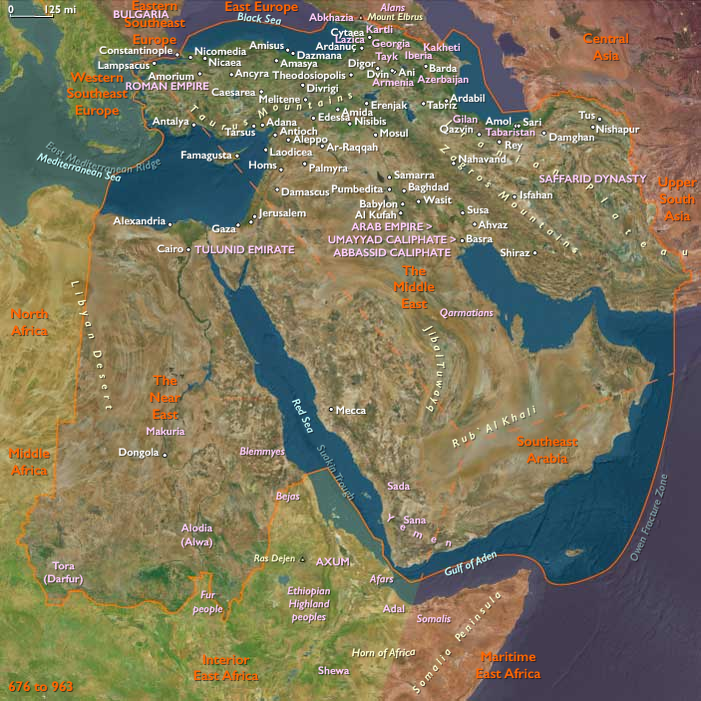
Sayf al-Dawla pre-empts Tzimiskes from a planned assault on Amida in the Jazira, in spring 956, and invades imperial territory first.
Tzimiskes then seizes a pass in Sayf al-Dawla's rear, and attacks him during his return.
The hard-fought battle, fought amid torrential rainfall, results in a Muslim victory as Tzimiskes loses four thousand men.
At the same time, however, …
…Leo Phokas invades Syria and defeats and captures Sayf al-Dawla's cousin, whom he had left behind in his stead.
Abu al-Hasan Ali al-Masudi of Baghdad, called Herodotus of the Arabs, has journeyed north to the Caspian Sea, south to Madagascar, and east into India, Sri Lanka, and the China Sea.
He has compiled much of the knowledge that he acquires in his most famous work, the encyclopedic “Meadows of Gold and Mines of Gems.” Rather than follow the traditional, more random annalistic form consistent with Arab tradition, al-Masudi has organizes his material in topics.
The extant version is only an earlier draft from 947, not the revised 956 edition.
One example of Al-Masudi's influence on Muslim knowledge of the Byzantine world is that we can trace the use of the name Istanbul (in place of Constantinople) to his writings of the year 947, centuries before the eventual Ottoman use of this term.
He writes that the Greeks (i.e., the Byzantines of the tenth century) call it "the City" (bulin in the Arabic script, which lacks the letter p: so Greek polin); "and when they wish to express that it is the capital of the Empire because of its greatness they say Istan Bulin. They do not call it Constantinople. It is only Arabs who so designate it".
A present day analogy would be the use of the phrases "I am going Downtown" or "I am going into the City" by those who live near, say, Chicago or London respectively.
Hasdai renders important services to the caliph by his treatment of an embassy headed by John of Gorze, sent to Córdoba in 956 by Otto I.
The caliph, fearing that the letter of the German king might contain matter derogatory to Islam, commissions Hasdai to open the negotiations with the envoys.
Hasdai, who soon perceives that the letter cannot be delivered to the caliph in its present form, persuades the envoys to send for another letter which should contain no objectionable matter.
John of Gorze said that he had "never seen a man of such subtle intellect as the Jew Hasdeu" ("Vita Johannis Gorziensis," ch.
cxxi., in G. H. Pertz, Monumenta Germaniæ, iv.
371).
Bruno the Great: Archbishop, Duke, and Regent of West Francia (956)
Bruno the Great, the younger brother of Otto I of Germany, was not only Archbishop of Cologne (since 953) but also Duke of Lotharingia, making him one of the most powerful figures in 10th-century Europe. His dual authority as both a spiritual and secular ruler earned him the title of "Archduke," as recorded by his biographer Ruotger.
Following the deaths of King Louis IV of West Francia in 954 and Hugh the Great, Duke of the Franks, in 956, Bruno steps in as regent of West Francia, acting on behalf of his nephews:
- Lothair (b. 941), now King of West Francia, the son of Louis IV and Gerberga of Saxony (Bruno’s sister).
- Hugh Capet (b. 941), Duke of the Franks, son of Hugh the Great and Hedwige of Saxony (also Bruno’s sister).
Bruno’s Role as Regent of West Francia (956–965)
-
Maintaining Stability in West Francia
- With Lothair still a minor, Bruno serves as his regent, guiding the young Carolingian king through a period of political instability.
- He also ensures that Hugh Capet, the heir to Hugh the Great, remains a powerful noble but does not threaten the monarchy.
-
Strengthening Ottonian Influence in France
- As maternal uncle to both Lothair and Hugh Capet, Bruno’s regency extends Ottonian influence into West Francia.
- This helps Otto I’s empire maintain a balance of power over its western neighbor, preventing West Francia from falling into complete chaos.
-
Defending Lotharingia and West Francia
- As Duke of Lotharingia, Bruno ensures the stability of this contested region, preventing further West Frankish interference.
- His control over Lotharingia and West Francia places him in a unique position of influence across both realms.
Conclusion: The Most Powerful Man After Otto I
Bruno the Great’s position as both archbishop and duke made him the most powerful man after Otto I in the Holy Roman Empire and beyond. His role as regent of West Francia ensured that Ottonian control extended into France, stabilizing the Carolingian monarchy under King Lothair and managing the rising power of Hugh Capet, setting the stage for the eventual Capetian takeover of France in 987.
Eadwig is known for his remarkable generosity in giving away land.
His sixty odd gifts of land in 956 alone, make up around five percent of all genuine Anglo-Saxon charters.
No known ruler in Europe will match this yearly total before the twelfth century, and his cessions are plausibly attributed to political insecurity.
Oda of Canterbury, at the death of King Eadred in 955, had been one of the recipients of a bequest from the king, in his case a large amount of gold.
He is probably behind the reestablishment of a bishopric at Elmham, as the line of bishops in that see starts in 956 with Eadwulf of Elmham.
…Kent in the south and …
…Edgar ruling in the north.
Al-Mutanabbi, born in the town of Kufah in Iraq in 915, is the son of a water carrier who claims noble and ancient southern Arabian descent.
Owing to his poetic talent, and claiming predecession of the prophet Saleh, al-Mutanabbi had received an education in Damascus, Syria.
When Shi'ite Qarmatians sacked Al-Kufah in 924, he had joined them and lived among the Bedouin, learning their doctrines and dialect.
Claiming to be a prophet--hence the name al-Mutanabbi ("The Would-be Prophet") he had led a Qarmatian revolt in Syria in 932.
After its suppression and two years of imprisonment, he had recanted in 935 and become a wandering poet.
It is during this period that he began to write his first known poems.
Al-Mutanabbi lives at the time when the Abbasid Caliphate had started coming apart, many of the states in the Islamic world becoming politically and militarily independent from Abbasid authority.
Chief among those states is the Emirate of Aleppo.
Al-Mutanabbi began to write panegyrics in the tradition established by the poets Abu Tammam and al-Buhturi.
In 948, he had attached himself to Sayf al-Dawla, the Hamdanid poet-prince of northern Syria.
Sayf al-Daula is greatly concerned with fighting the Constantinople’s Empire in Asia Minor, where Al-Mutanabbi has fought alongside him.
During his nine years stay at Sayf al-Daula's court, Al-Mutanabbi has versified his greatest and most famous poems, writing in praise of his patron panegyrics that rank as masterpieces of Arabic poetry.
During his stay in Aleppo, great rivalry has occurred between Al-Mutanabbi and many scholars and poets in Sayf al-Daula's court, one of these being Abu Firas al-Hamdani, Sayf al-Daula's cousin.
In addition, Al-Mutanabbi has lost Sayf al-Daula's favor because of his political ambition to be Wāli.
The latter part of this period has been clouded with intrigues and jealousies that culminate in al-Mutanabbi's leaving of Syria for Egypt, now ruled in name by the Ikhshidids.