The Levellers, a major faction on the …
Years: 1648 - 1648
September
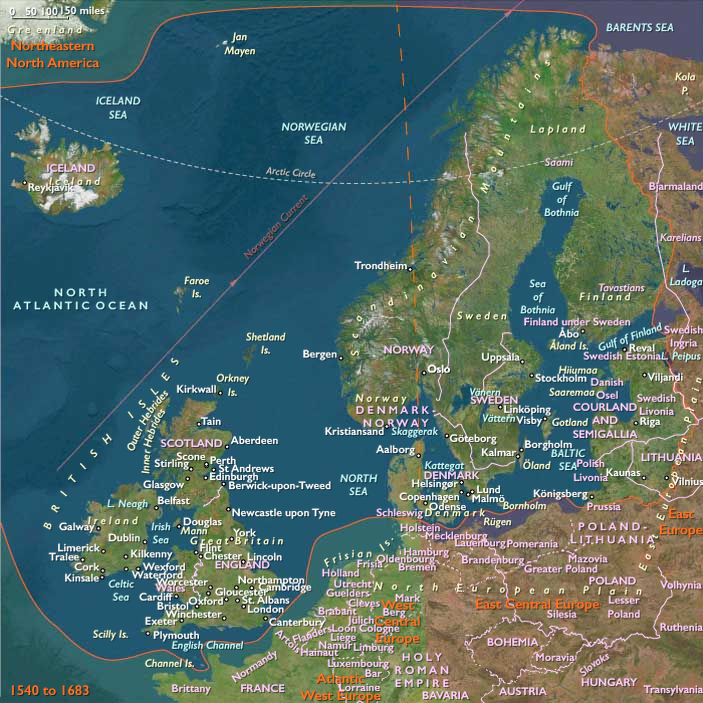
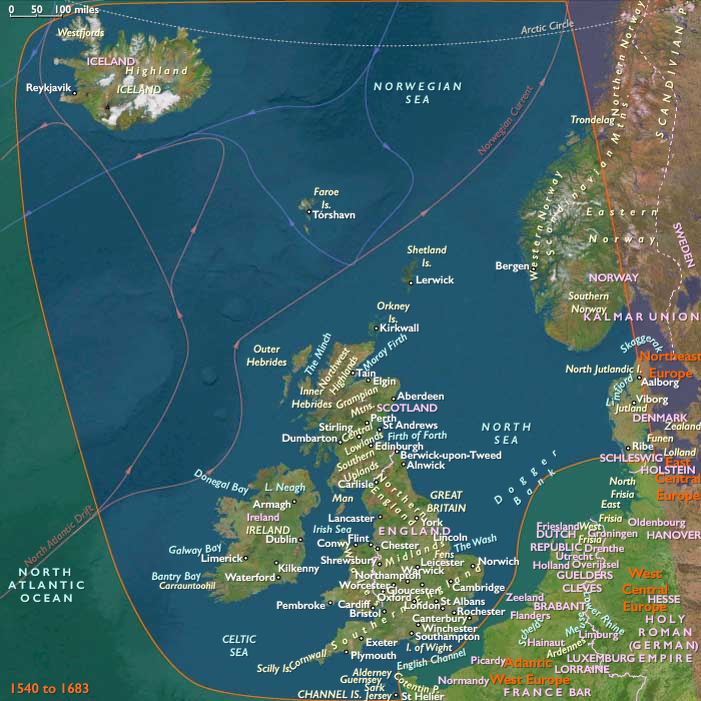
The Levellers, a major faction on the Parliamentarian side who have come to prominence at the end of the First English Civil War, emphasize popular sovereignty, extended suffrage, equality before the law, and religious tolerance, all of which had been expressed in the manifesto Agreement of the People for constitutional changes to the English state issued from 1647.
Leveller views and support are found in the populace of the City of London and in some regiments in the New Model Army.
After amassing signatories including about a third of all Londoners, the Levellers' largest petition, entitled "To The Right Honovrable The Commons Of England", is on September 11, 1648, presented to Parliament.
Locations
People
Groups
Topics
Commodoties
Subjects
Regions
Subregions
Related Events
Filter results
Showing 10 events out of 37 total
Frederick II, Landgrave of Hesse-Kassel, had in 1747 left his wife and children and soon converted to Catholicism, and in 1755 formally ended the marriage.
His father, Landgrave William, had granted the newly acquired principality of Hanau to his daughter-in-law and grandsons, and young William, Frederick’s son, became technically the reigning prince of Hanau, though under his mother's regency.
The young prince William, together with his two younger brothers, were with their mother the landgravine Mary and from 1747 had been fostered by Protestant relatives and soon moved to Denmark, to the care of family of her sister Louise of Great Britain, who had died in 1751.
William of Hanau had married his first cousin Wilhelmina Caroline of Denmark and Norway (1747–1820), the second surviving daughter of Frederick V of Denmark and Norway, on September 1, 1764 at Christiansborg Palace.
William's younger brother Charles followed suit and in 1766 married another of their Danish first cousins.
William and Wilhelmina Caroline had remained mostly in Denmark until the death of his father on October 31, 1785, when he became William IX, Landgrave of Hesse-Kassel and as such, is said to have inherited one of the largest fortunes in Europe at the time, largely gained through the loan of Hessian mercenaries, not least to Great Britain during the American Revolution.
Already in the lifetime of his father, William had received the Principality of Hanau south of the Hessian territories, near Frankfurt, as successor of its newly extinct princes, since the Hanau people did not want to have a Catholic ruler.
Already at Hanau, William had utilized the financial skills of Mayer Amschel Rothschild, who resides in the nearby Frankfurt; the two had become acquainted in 1775, although William doesn’t formally designate Rothschild as overseer until 1801.
During the Napoleonic wars, William has seen the necessity of hiding his fortune from from Napoleon by using his long standing association with the Frankfurt Rothschilds.
This money had then seen its way through to Nathan Mayer, (N.M.) in London, where it had helped fund the British movements through Portugal and Spain.
The budding banker barons have used the interest made from this venture to swiftly develop their fortune and prestige in Europe and Britain.
It is not long before their riches outweigh that of their benefactor.
In 1803, Landgrave William had been created His Royal and Serene Highness The Prince-Elector of Hesse, but his electorate had been annexed in 1806 by the Kingdom of Westphalia, ruled by Jérôme Bonaparte, after Napoleon invaded Hesse in response to Wilhelm's support for Prussia.
The Landgrave went into exile with his family in Schleswig-Holstein, but Rothschild has been able to continue as his banker, investing funds in London.
He has also profited from importing goods in circumvention of Napoleon's continental blockade.
Following the defeat of the Napoleonic armies in the Battle of Leipzig, William had been restored in 1813; he will rule until his death in Kassel in 1821.
In the Congress of Vienna, his ambition is to get recognized as King like other prince-electors (his officials coin for him the title of king of Chattia), but this is not approved, purportedly because his principality had not been electorate in any of the imperial elections.
This leads to him holding extremely tightly the electoral rank, deeming it at least regal.

The founding fortunes of the Rothschild family are made through a conjunction of financial intelligence and the wealth of Prince William I, Elector of Hesse (the House of Hesse is both related and allied to the House of Hanover) in hiding his enormous wealth from Napoleon.
Due in part to the wealth of his estate, William is especially notable for his role in affording the late Mayer Amschel Rothschild both the relationship, and situational means, by assigning some of the care of his properties and tax-gathering, for founding the Rothschild family dynasty.
Mayer had sent each of his five sons to a prominent European commercial center in order to found branches of the family banking empire.
In 1798, at the age of twenty-one, Rothschild’s son Nathan Mayer Rothschild had settled in Manchester and established a business in textile trading, then from 1804 he began to deal on the London stock exchange in financial instruments such as foreign bills of exchange and government securities.
From 1809 Nathan began to deal in gold bullion, and developed this as a cornerstone of his business.
Mayer’s youngest son, Jacob, had been sent to Paris in 1811, enhancing the family's ability to operate across Europe.
This had enabled them to profit from the opportunity of financing Wellington's armies in Portugal, requiring the sourcing of large quantities of gold on behalf of the British government.
In negotiation with Commissary-General John Charles Herries, Nathan had undertaken to transfer money to pay Wellington's troops, and later to make subsidy payments to British allies when these organized new troops after Napoleon's disastrous Russian campaign.
The family has made huge profits over a number of years from this governmental financing by adopting a high-risk strategy involving exchange-rate transactions, bond-price speculations, and commissions.
Nathan’s four brothers help coordinate activities across the continent, and the family has developed a network of agents, shippers and couriers to transport gold—and information—across Europe.
This private intelligence service had enabled Nathan to receive in London the news of Wellington's victory at the Battle of Waterloo a full day ahead of the government's official messengers.
The Rothschilds are rewarded for their financial services to the Crown with positions in the City.
Nathan Rothschild had arranged a five million pound loan to the Prussian government in 1818; the issuing of bonds for government loans formed a mainstay of his bank’s business.
He has gained a position of such power in the City of London that by 1825–26 he will be able to supply enough coin to the Bank of England to enable it to avert a liquidity crisis.
In 1824 he founds the Alliance Assurance Company (now Royal & SunAlliance) with Moses Montefiore, who was born in Leghorn (Livorno in Italian), Italy in 1784.
His grandfather, Moses Vita (Chaim) Montefiore had emigrated from Livorno to London in the 1740s, but had retained close contact with the town, then famous for its straw bonnets.
Montefiore was born while his parents, Joseph Elias Montefiore and his young wife Rachel, the daughter of Abraham Mocatta, a powerful bullion broker in London, were in the town on a business journey, their first child.
The family returned to Kennington in London, where Montefiore went to school and began his career as an apprentice to a firm of grocers and tea merchants.
He then entered a counting house in the City of London, and ultimately became one of the twelve "Jew brokers" licensed by the city.
His brother Abraham had joined him in the business, and their firm gained a high reputation.
Moses married Judith Cohen (1784-1862), daughter of Levi Barent Cohen, in 1812.
Her sister, Henriette (or Hannah) (1783-1850), married Nathan Mayer Rothschild (1777-1836), for whom Montefiore's firm acted as stockbrokers.
Nathan Rothschild headed the family's banking business in Britain, and the two brothers-in-law became business partners.
Montefiore retires from his business in 1824, and uses his time and fortune for communal and civic responsibilities.
Wilhelm Grimm, the younger of the Brothers Grimm, produces his one major scholarly treatise, “Die deutsche Heldensage” (“German Heroic Legends”) in 1829, enumerating the heroes and legends of the German people.
A majority of states of the loose, ineffectual German Confederation, which had been established primarily for defensive purposes and has been plagued by rivalries between Prussia and Austria, form the commercially powerful Zollverein, the German Customs Union established on January 1, 1834.
The member states, initially eighteen, enjoy such advantages as access to the sea, aid in building transportation infrastructures, their own customs administrations, and veto over economic decisions.
The Zollverein removes internal customs barriers, although upholding a protectionist tariff system with foreign trade partners.
The main ideological contributor behind the customs union is Friedrich List, an economist holding mercantilist and protectionist views.
At first including only the close neighbors of Prussia, it will gradually expand to include most of the German states outside of Austria.
The Zollverein totally excludes Austria because of its highly protected industry; this economic exclusion will later exacerbate the Austro-Prussian rivalry for dominance in central Europe during the late ninteenth century.
The population is 23,478,120.
The Zollverein, or German Customs Union, includes all the German states by 1854 save five small northern states and Austria, which the Zollverein totally excludes because of its highly protected industry.
Late Romantic music is characterized by the operatic grandeur of Richard Wagner and ...
...Anton Bruckner.
The first Red Cross Societies are organized in in 1864 as the result of Jean Henri Dunant’s humanitarian appeal to the world in 1859.
The Swiss government had invited the governments of all European countries, as well as the United States, Brazil, and Mexico, to attend an official diplomatic conference.
Sixteen countries send a total of twenty-six delegates to Geneva.
On August 22, 1864, the conference adopts the first Geneva Convention "for the Amelioration of the Condition of the Wounded in Armies in the Field".
Representatives of twelve states and kingdoms sign the convention: Baden, Belgium, Denmark, France, Hesse, Italy, the Netherlands, Portugal, Prussia, Switzerland, Spain, and Württemberg.
The convention contains ten articles, establishing for the first time legally binding rules guaranteeing neutrality and protection for wounded soldiers, field medical personnel, and specific humanitarian institutions in an armed conflict.
Furthermore, the convention defines two specific requirements for recognition of a national relief society by the International Committee: The national society must be recognized by its own national government as a relief society according to the convention, The national government of the respective country must be a state party to the Geneva Convention.
Directly following the establishment of the Geneva Convention, the first national societies will be founded in Belgium, Denmark, France, Oldenburg, Prussia, Spain, and Württemberg.
Also in 1864, Louis Appia and Charles van de Velde, a captain of the Dutch Army, will become the first independent and neutral delegates to work under the symbol of the Red Cross in an armed conflict.