
The so-called Levallois technique of stone working, …
Years: 360333BCE - 339598BCE
The so-called Levallois technique of stone working, in which a large thin flake is struck from a prepared core and used as a blank for making more specialized tools such as knives and scrapers, is invented during this period.
A striking platform is formed at one end, then the core's edges are trimmed by flaking off pieces around the outline of the intended flake.
This creates a domed shape on the side of the core, known as a tortoise core as the various scars and rounded form are reminiscent of a tortoise's shell.
When the striking platform is finally hit, a flake separates from the core with a distinctive plano-convex profile and with all of its edges sharpened by the earlier trimming work.
This method provides much greater control over the size and shape of the final flake, which is employed as a scraper or knife; the technique can also be adapted to produce projectile points known as Levallois points.
The technique is first found in the Lower Paleolithic but is most commonly associated with the Neanderthal Mousterian industries of the Middle Paleolithic.
In the Levant, Levallois methods are also in use in the Upper Paleolithic and later.
The distinctive forms of the flakes were originally thought to indicate a wide-ranging Levallois culture but the wide geographical and temporal spread of the technique has rendered this interpretation obsolete.
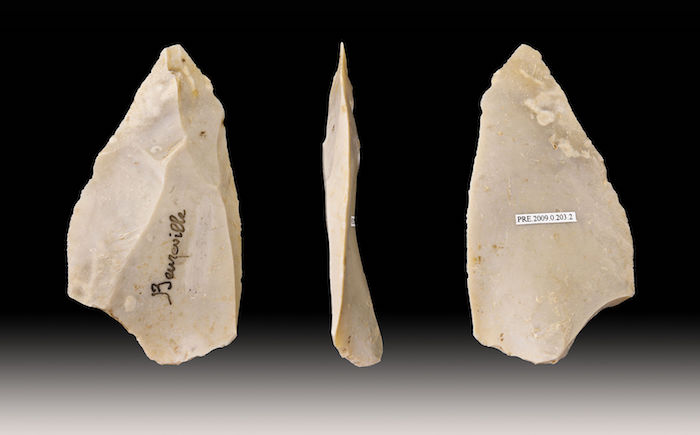
Levallois point Date; Mousterian ; flint Dimensions 9.1 × 5.2 × 1.2 cm (3.6 × 2 × 0.5 in) Museum of Toulouse. Different views of the same specimen taken on 11 August 2010 by Didier Descouens.
Topics
Commodoties
Subjects
Years: 360333BCE - 339598BCE
Levallois point Date; Mousterian ; flint Dimensions 9.1 × 5.2 × 1.2 cm (3.6 × 2 × 0.5 in) Museum of Toulouse. Different views of the same specimen taken on 11 August 2010 by Didier Descouens.