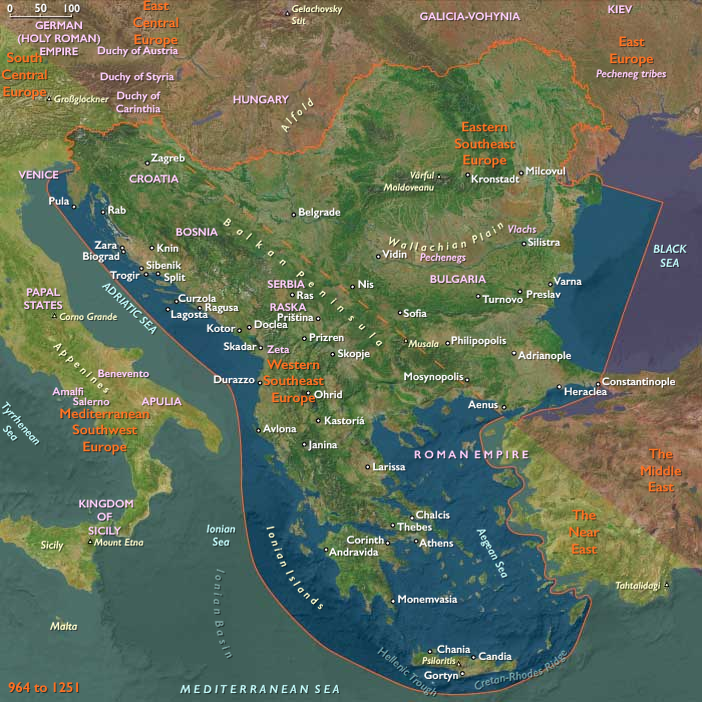
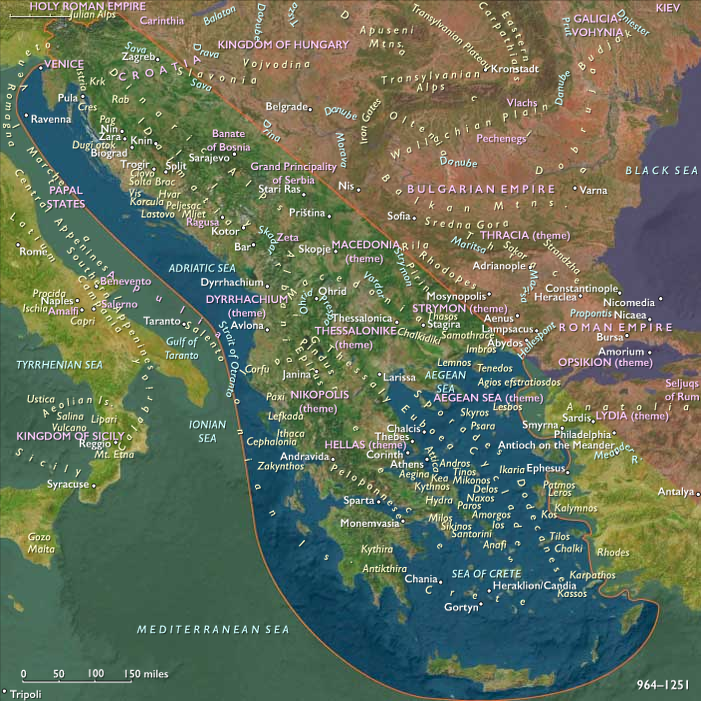
…the Latin principality of Achaea, ruled from …
Years: 1248 - 1248
…the Latin principality of Achaea, ruled from 1246 by William II Villehardouin.
Locations
People
Groups
- Greeks, Medieval (Byzantines)
- French people (Latins)
- Nicaea, Empire of
- Achaea, Principality of
- Epirus, Despotate of
Topics
Commodoties
Subjects
Regions
Subregions
Related Events
Filter results
Showing 10 events out of 46696 total
Bayreuth had been previously (1199) referred to as a villa (village).
As the term civitas ("town") appears for the first time in a document published in 1231, it can therefore be assumed that Bayreuth had been awarded its town charter between 1200 and 1230.
The town is ruled until 1248 by the counts of Andechs-Merania, at which point a branch of the Hohenzollerns takes over.
Jalāl ad-Dīn Muhammad Balkhī, who will later be popularly known in the English-speaking world simply as Rumi, was born to native Persian speaking parents, probably in the village of Wakhsh, a small town located at the river Wakhsh in Persia (in what is now Tajikistan).
Wakhsh belonged to the larger province of Balkh (parts of now modern Afghanistan and Tajikistan), and in the year Rumi was born, his father, Baha ud-Din Walad, a theologian, jurist and a mystic, was a government-appointed scholar there.
When the Mongols invaded Central Asia sometime between 1215 and 1220, Baha ud-Din, with his whole family and a group of disciples, set out westwards.
On May 1, 1228, most likely as a result of the insistent invitation of 'Alā' ud-Dīn Kayqubad, Baha ud-Din had come to and finally settled in Konya in Anatolia, within the westernmost territories of the Seljuq Sultanate of Rûm.
Baha ud-Din had become the head of a madrassa (religious school) and when he died in 1232, Rumi, aged twenty-five, had inherited his father’s position as the Islamic molvi.
One of Baha' ud-Din's students, Sayyed Burhan ud-Din Muhaqqiq Termazi, had continued to train Rumi in the Shariah as well as the Tariqa, especially that of Rumi's father.
For nine years, Rumi had practiced Sufism as a disciple of Burhan ud-Din until the latter died in 1240 or 1241, at which point Rumi's public life began: he became an Islamic jurist, issuing fatwas and giving sermons in the mosques of Konya.
He also served as a Molvi (Islamic teacher) and taught his adherents in the madrassa.
During this period, Rumi had also traveled to Damascus and is said to have spent four years there.
His meeting with the dervish Shams-e Tabrizi on November 5, 1244 had completely changed his life.
From an accomplished teacher and jurist, Rumi had been transformed into an ascetic.
On the night of December 5, 1248, as Rumi and Shams are talking, Shams is called to the back door.
He goes out, never to be seen again.
It is rumored that Shams had been murdered with the connivance of Rumi's son, 'Ala' ud-Din.
Rumi's love for, and his bereavement at the death of, Shams will find their expression in an outpouring lyric poems, Divan-e Shams-e Tabrizi.
He himself goes out searching for Shams and journeys again to Damascus.
Divan-e Shams-e Tabrizi, written in the New Persian language, is considered one of the greatest works of Persian literature.

The Nicaean recovery of some of the territory held by Frankish rulers in Greece follows, although Monemvasia actually falls in 1248 to a Frankish force from …
Ferdinand III besieges and captures the Moorish stronghold of Seville, the capital of al-Andalus, in 1248.
Following their victory, the Spanish Christian conquerors evict the defeated Moorish inhabitants from their homes, and assume control of vast estates.
(The eventual result of this act, perpetrated for the first time in Muslim Spain, will be economic ruination in the region.)
The Deposition of Sancho II and the Rise of Afonso III (1246–1248)
Though a capable military commander, Sancho II of Portugal proved far less adept at administration and governance. His single-minded focus on military campaigns left internal affairs in turmoil, allowing discontent to spread among the nobility, the clergy, and the merchant class.
Noble Discontent and Papal Intervention
Displeased with the king’s governance, the Portuguese nobility began conspiring against him, while merchants clashed frequently with the clergy, with Sancho II failing to intervene. The Archbishop of Porto, frustrated by the king’s negligence, formally petitioned Pope Innocent IV, denouncing the growing instability within the kingdom.
As the most powerful institution of the 13th century, the Church exercised vast influence over European rulers, and in response, Pope Innocent IV issued a papal bull calling for Sancho II’s removal, branding him a heretic and an unfit ruler.
Afonso of Boulogne’s Return and the Deposition of Sancho II (1246–1247)
The dissident nobility, now openly opposing Sancho II, turned to his younger brother, Afonso, then residing in France as the Consort Count of Boulogne. In 1246, they invited Afonso to claim the Portuguese throne.
Afonso swiftly abdicated his French possessions, gathered support, and marched into Portugal. Facing overwhelming opposition, Sancho II was deposed in 1247 and forced into exile in Toledo, where he died on January 4, 1248.
The Coronation of Afonso III (1248)
With Sancho’s removal, his brother was crowned King Afonso III of Portugal in 1248. Unlike his predecessor, Afonso III focused on internal stability, legal reforms, and territorial expansion, setting the stage for Portugal’s continued development as a strong and centralized kingdom.
The Founding of The Hague and the Construction of Its Initial Castle (1248 CE)
In 1248, Count William II of Holland, who was also King of the Romans, ordered the construction of a castle at The Hague (Den Haag in Dutch). Originally a hunting preserve for the Counts of Holland, the site was known as “the count’s enclosure” or “hedge”, from which its Dutch name (’s-Gravenhage, meaning "The Count's Hedge") is derived.
Origins and Purpose of the Castle
- The castle was built as a residence for the Counts of Holland, marking The Hague’s transformation from a hunting retreat into an administrative and political center.
- Count William II, intending to be crowned Holy Roman Emperor, envisioned the castle as a grand seat of power, though he died in battle in 1256 before completing his ambitions.
- The structure served as the foundation for what would later become the Binnenhof, the political heart of the Netherlands.
Legacy of the 1248 Castle and The Hague’s Growth
- The Hague never received formal city rights, but it grew into the political capital of the County of Holland.
- The Binnenhof, originally part of William II’s medieval castle complex, later became the center of Dutch government.
- The city evolved into the seat of the Dutch government and monarchy, despite Amsterdam being the official capital.
The construction of the initial castle at The Hague in 1248 marked the beginning of its rise as one of the most important political centers in Dutch history, a role it continues to hold today as the seat of the Dutch government and the International Court of Justice.
Construction begins on the great German Gothic Köln (Cologne Cathedral) in 1248.
Influenced by the immense French Gothic Amiens Cathedral—in particular, the Rayonnant choir of Amiens—it is intended to rival Beauvais in height.
William of Holland takes Aachen from Frederick's followers in 1248 after a siege of five months.
Only now can he be crowned as king.
The besieged of Parma languish as the Emperor waits for them to surrender from starvation.
He has had a wooden city, which he calls "Vittoria", built around the walls, where he keeps his treasure and the harem and menagerie, and whence he can attend his favorite hunting expeditions.
During one of these absences, the camp is suddenly assaulted and taken on February 18, 1248, and the Imperial side is routed in the ensuing Battle of Parma.
Frederick loses the Imperial treasure and with it any hope of maintaining the impetus of his struggle against the rebellious communes and against the pope, who begins plans for a crusade against Sicily.
Swietopolk retaliates and destroys Christburg, but the Knights rebuild it in a new location.
Both the Prussian and Pomeranian armies fail to capture the new castle.
Years: 1248 - 1248
Locations
People
Groups
- Greeks, Medieval (Byzantines)
- French people (Latins)
- Nicaea, Empire of
- Achaea, Principality of
- Epirus, Despotate of