
The last ruler of the Xia Dynasty …
Years: 1629BCE - 1486BCE
The last ruler of the Xia Dynasty ruled China for fifty-two years until 1618 BCE, according to the Xia Shang Zhou Chronology Project.
According to legend, Tang of Shang overthrew Jie of Xia in the Battle of Mingtiao.
According to the Shiji, the Shang had a long history, and there are different theories about their origin.
An analysis of bones from the remains of Shang people showed a Huaxia (Yellow River area) ethnic origin.
Their civilization was based on agriculture and augmented by hunting and animal husbandry, and in addition to war, the Shang also practiced human sacrifice.
Beginning around 1600, the Shang dynasty takes over a number of petty kingdoms including the Xia and controls a loose confederation of settlement groups in the Henan region of North China.
The Shang have a fully developed system of writing as attested on bronze inscriptions, oracle bones, and a small number of other writings on pottery, jade and other stones, horn, etc.
Their writing system's complexity and sophistication indicates an earlier period of development, but direct evidence of that development is still lacking.
(Chinese writing is thought to descend from a hieroglyphic script.)
Achieving political unification during the sixteenth century, the Shang dynasty maintains cultural continuity in matters of literary functions, as well as social, religious, economic, and governmental controls.
A slave society is apparently emplaced in China under the Shang dynasty, whose urban centers anchor the first true Chinese civilization.
The Shang state employs numerous specialists and distinguishes between commoners, the priesthood, the royal family, the nobility and, almost certainly, the slaves.
Power in Chinese society under the Shang emperors flows from them to the ruling elite, including feudatory landowners and commanders of the organized soldiery, down to the urban artisans and village agriculturists, with enslaved people at the bottom.
Sophisticated bronze metallurgy develops in China in the sixteenth century BCE.
Complex bronze-casting technology (previously undocumented in China) spreads rapidly under the Shang, whose artisans use metal tools in the carving of jade.
The supreme god of the Shangs is Shangdi (Shang-ti), to whom they pray, supplemented by prayers to ancestral spirits.
Locations
Groups
- China, archaic (Three Sovereigns and Five Emperors)
- Chinese Kingdom, Xia Dynasty
- Chinese Kingdom, Shang Dynasty
Topics
Commodoties
Subjects
- Origins
- Commerce
- Symbols
- Writing
- Sculpture
- Environment
- Labor and Service
- Decorative arts
- Conflict
- Faith
- Government
- Custom and Law
- Technology
- Economics
- Anthropology
- Metallurgy
- Archaeology
Regions
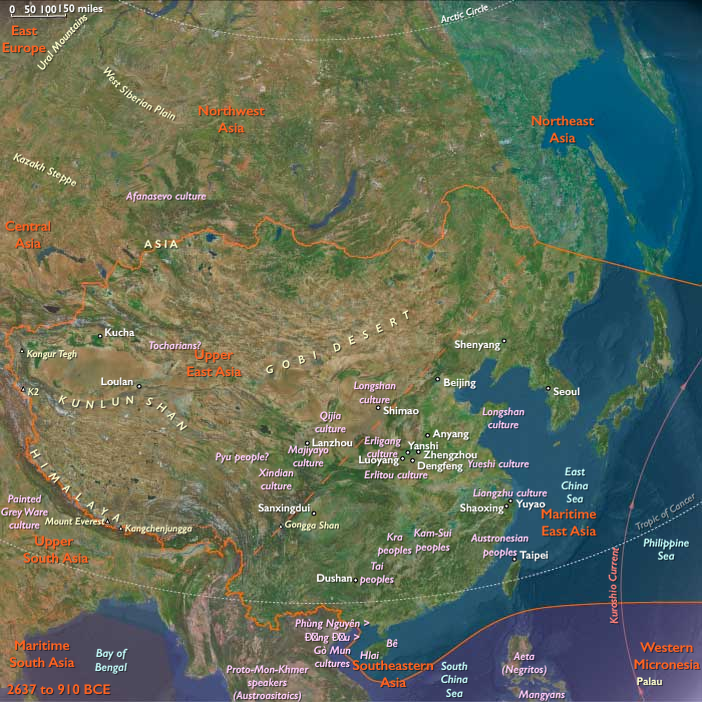
Subregions

Related Events
Showing 10 events out of 67677 total
Years: 1629BCE - 1486BCE
Locations
Groups
- China, archaic (Three Sovereigns and Five Emperors)
- Chinese Kingdom, Xia Dynasty
- Chinese Kingdom, Shang Dynasty
Topics
Commodoties
Subjects
- Origins
- Commerce
- Symbols
- Writing
- Sculpture
- Environment
- Labor and Service
- Decorative arts
- Conflict
- Faith
- Government
- Custom and Law
- Technology
- Economics
- Anthropology
- Metallurgy
- Archaeology
Regions
Subregions