
The last of four books of the …
Years: 28 - 39
The last of four books of the “Maccabees,” largely a philosophical discussion of the primacy of reason, governed by religious laws, over passion, is composed originally in the Greek language, in a manner that Stephen Westerholm of the Eastern / Greek Orthodox Bible calls "very fluently... and in a highly rhetorical and affected Greek style."
It is not in the Bible for most churches, but is an appendix to the Greek Bible, and in the canon of the Georgian Bible.
It was in the 1688 Romanian Bible where it was called "Iosip" but is not printed in the Orthodox Bible today.
According to some scholars, the last chapter shows signs of later addition to the work, though this was disputed by the nineteenth century authors of the Jewish Encyclopedia.
The dispute is based on the weak ending the book would have without the "added" chapter, as well as arguments based on style.
The change of direction with chapter 27 supports the view of the work as a homily held before a Greek-speaking audience on the feast of Hanukkah, as advanced by Ewald and Freudenthal, where this would be a rhetorical element to draw the listeners into the discourse.
Others hold that a homily would have to be based on scriptural texts, which this work is only loosely.
The writer believes in the immortality of the soul, but never mentions the resurrection of the dead.
Good souls are said to live forever in happiness with the patriarchs and God, but even the evil souls are held to be immortal.
The suffering and martyrdom of the Maccabees is seen by the author to be vicarious for the Jewish nation, and the author portrays martyrdom in general as bringing atonement for the past sins of the Jews The book is oratorical in style, but not so much as 3 Maccabees.
The writer appears to be an Alexandrian Jew who used a philosophical approach in order to present a concept of piety.
The author cites what can be interpreted as Stoic philosophy, though there is little original philosophical insight in the text.
Regarded as Jewish literature, it is cited as the best example of syncretism between Jewish and Hellenistic thought.
The book is ascribed to Josephus by Eusebius and Jerome, and this opinion was accepted for many years, leading to its inclusion in many editions of Josephus' works.
Scholars have however pointed to perceived differences of language and style.
The book is generally dated between the first century BCE and the first century CE, due to its reliance on 2 Maccabees and use by some of the early Christians.
It has been suggested that it was written before the persecution of the Jews under Caligula, or before the fall of Jerusalem in 70 CE.
Locations
People
Groups
- Jews
- Greeks, Hellenistic
- Judea (Roman province)
- Roman Empire (Rome): Julio-Claudian dynasty
- Christians, Jewish
Topics
Subjects
Regions
Subregions
Related Events
Filter results
Showing 10 events out of 61909 total
The Trung sisters, whose names are Trung Trac and Trung Nh, are Vietnamese military leaders who rebel against Chinese rule in 39.
Regarded as national heroines of Vietnam, their rebellion begins at the Red River Delta, but soon spreads to other Yue tribes along the coast to the north and south.
A Thracian settlement called Serdica or Sardica, named after the Celtic tribe Serdi that had populated it, had been possessed for a short period during the fourth century BCE by Philip of Macedon and his son Alexander the Great.
The city is conquered by the Romans around 29 BCE and renamed Ulpia Serdica.
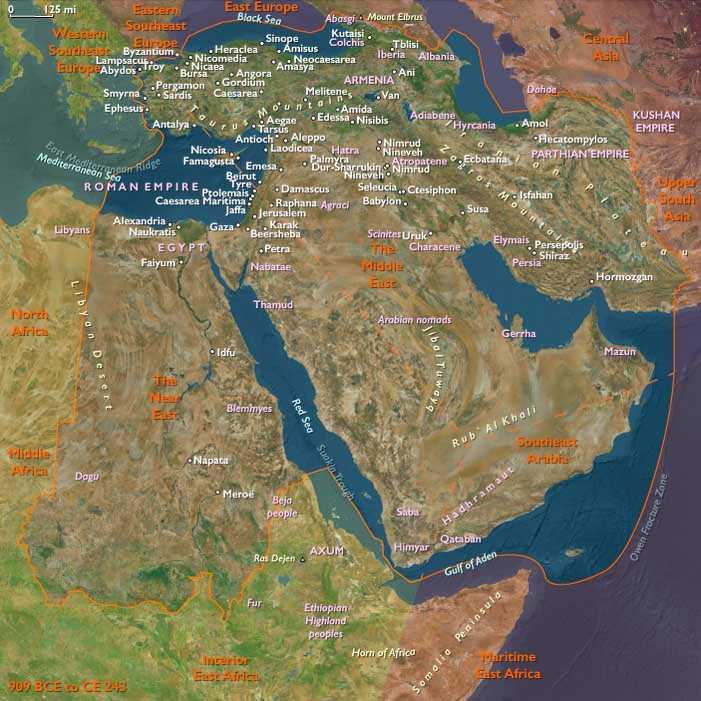
The Middle East: 28–39 CE
Parthian Struggles and Roman Diplomacy
During the period from 28 to 39 CE, tensions within the Parthian Empire continue to challenge regional stability. Artabanus II, initially successful in consolidating authority, now faces intense internal opposition driven by powerful Parthian aristocratic factions increasingly dissatisfied with his centralization efforts and assertive foreign policy.
In 35 CE, discontent among these elites culminates in open rebellion, prompting some Parthian nobles to seek assistance from Rome. Seizing this diplomatic opportunity, Roman authorities under Emperor Tiberius actively encourage instability by supporting rival claimants to the Parthian throne, notably backing Tiridates III, a Parthian prince with significant Roman connections. Roman support for Tiridates culminates in his temporary installation as a rival king in 36 CE, forcing Artabanus II into exile among eastern nomadic tribes.
However, Artabanus swiftly regroups, leveraging tribal alliances to mount a successful counteroffensive. By 37 CE, he regains control over Ctesiphon, expelling Tiridates and restoring his authority. Understanding the limits of Roman intervention, Emperor Caligula, who succeeds Tiberius in 37 CE, chooses not to pursue aggressive confrontation, instead accepting Artabanus’s reinstatement and renewing diplomatic relations.
Simultaneously, Rome carefully manages the delicate political situation in Armenia, maintaining the kingdom as a crucial buffer state and preserving influence through client kings and strategic diplomacy. The Roman-Parthian rivalry thus remains largely unresolved, characterized by intermittent proxy conflicts, strategic maneuvering, and cautious diplomacy, shaping the region’s ongoing balance of power.
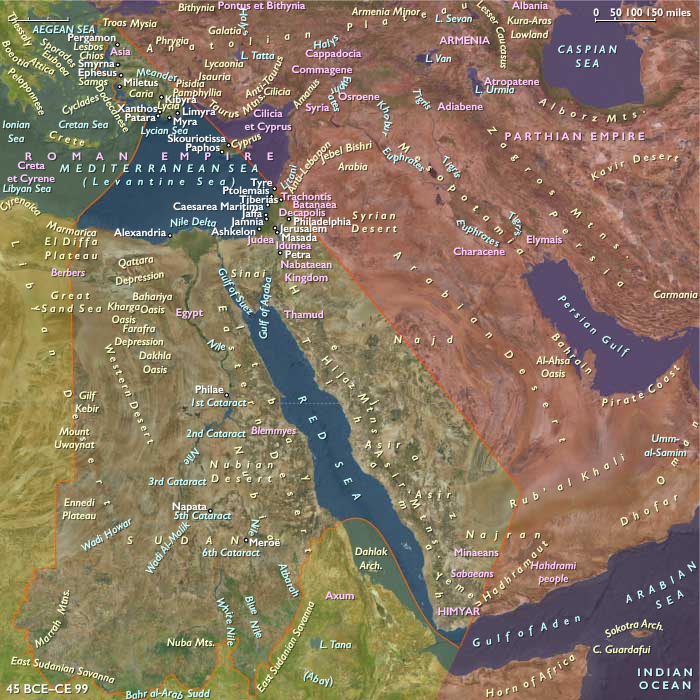
The Middle East: 40–51 CE
Parthian Rivalries and Roman Regional Strategies
Between 40 and 51 CE, the Parthian Empire again descends into internal strife, exacerbated by external Roman intervention. In 40 CE, Emperor Caligula dispatches forces to strengthen Rome's grip over client states and indirectly assert influence over Armenia. His assassination in 41 CE and the accession of Claudius usher in a pragmatic shift in Roman eastern policy, characterized by strategic restraint and careful diplomacy rather than overt military campaigns.
Parthia’s Artabanus II dies around 38 CE, leading to further instability. His successor, Vardanes I, ascends the throne but faces immediate opposition from his brother, Gotarzes II, sparking a destructive civil war. Throughout the early 40s CE, the two brothers engage in intermittent conflicts, with Vardanes briefly securing dominance before his assassination in 45 CE. Gotarzes II regains power but continues to contend with widespread aristocratic unrest and regional rebellions.
Seizing upon Parthian disarray, Rome employs diplomatic maneuvers, indirectly supporting rival claimants to maintain Parthian internal divisions while preserving a manageable frontier. In 49 CE, the Parthian nobility invites Meherdates, a hostage prince raised in Rome, to challenge Gotarzes. Meherdates, however, suffers defeat, securing Gotarzes' tenuous rule until his death in 51 CE.
Amid these conflicts, Rome consistently focuses its influence on Armenia, which remains pivotal to regional stability. The kingdom alternates between pro-Roman and pro-Parthian rulers, reflecting the ongoing, careful diplomatic tug-of-war. Thus, by 51 CE, the Middle East continues as a theater of indirect conflict, shaped by Parthian dynastic rivalries and Rome’s strategic emphasis on diplomatic intervention rather than outright conquest.
Mediterranean Southwest Europe (28–39 CE): Turmoil under Tiberius and Caligula’s Ascension
The era 28–39 CE is marked by significant political upheaval, characterized by the downfall of Sejanus, the increasingly reclusive governance of Tiberius, and the turbulent rise of Caligula, setting the stage for profound changes in Roman leadership and stability.
Downfall of Sejanus and Political Turmoil
In 31 CE, Lucius Aelius Sejanus, whose influence had significantly shaped imperial policies, dramatically falls from power. Accused of treasonous plots against Emperor Tiberius, Sejanus is executed along with numerous allies and family members. His abrupt downfall creates a climate of fear and suspicion, profoundly destabilizing Rome’s political elite.
Reclusive Rule of Tiberius
Following the demise of Sejanus, Tiberius becomes increasingly withdrawn, governing Rome from isolation on the island of Capri. His seclusion contributes to growing uncertainty and instability in Roman political life, as communication with the emperor becomes difficult, leading to greater reliance on intermediaries and bureaucratic officials.
Tiberius’s remote governance style exacerbates tensions within the Senate and among the Roman populace, who perceive his absence as neglectful and suspicious.
Economic Stability and Provincial Administration
Despite political instability in Rome, the provinces—including Mediterranean Southwest Europe—continue to experience relative economic stability and administrative continuity. Tiberius’s careful financial management and established bureaucratic structures help sustain the prosperity and functionality of Roman territories.
Caligula’s Succession and Initial Popularity
In 37 CE, following the death of Tiberius, Caligula, the son of the popular general Germanicus and great-nephew of Tiberius, ascends to power. Initially, Caligula’s accession is met with widespread enthusiasm among the Roman populace, hopeful that he will restore transparency and vitality to imperial leadership after the isolation and suspicion of Tiberius’s later reign.
Early Reign of Caligula and Public Works
Caligula initially embarks on public works projects, generous spending, and measures aimed at regaining popular favor and restoring a more visible imperial presence. His actions reflect a conscious effort to contrast his governance with the withdrawn and unpopular final years of Tiberius.
However, Caligula’s promising start quickly deteriorates into erratic and increasingly autocratic behavior, undermining initial optimism and generating widespread discontent and fear within Roman society and its political establishment.
Cultural and Social Developments
Cultural activities continue during this turbulent era, with ongoing literary, artistic, and architectural endeavors reflecting both continuity and reactions to political instability. Roman culture remains vibrant yet increasingly reflective of underlying societal anxieties and uncertainties brought about by erratic imperial leadership.
Legacy of the Era
The period 28–39 CE dramatically illustrates the vulnerabilities inherent in Rome’s imperial succession and governance. The profound impact of Sejanus’s downfall, Tiberius’s reclusive final years, and Caligula’s turbulent rise to power underscores the fragile nature of imperial stability and sets the stage for continued volatility in Roman leadership.
North Africa (28–39 CE)
Roman Governance, Mauretanian Reorganization, Cyrenaic Prosperity, Berber Stability, and Saharan Networks
Roman Provincial Expansion and Economic Development
From 28 to 39 CE, Rome further enhances administrative control and economic integration within Africa Proconsularis. Continued improvements in infrastructure, agriculture, and urban development strengthen provincial prosperity. Urban centers, particularly Utica, remain significant commercial and administrative hubs, deeply woven into Rome’s vast Mediterranean economic network.
During this period, Leptis Magna, founded originally by Phoenician colonists around 1100 BCE and historically known by its Lybico-Berber name Lpqy, becomes formally incorporated into the Roman Empire under Emperor Tiberius. Although nominally under Carthaginian control until the end of the Third Punic War (146 BCE) and largely independent afterward, Leptis Magna now emerges as one of the leading cities of Roman Africa and a major Mediterranean trading center.
Numidia: Continued Economic Stability and Provincial Integration
Numidia remains stable and prosperous under consistent Roman governance. Benefiting from enhanced agricultural practices and improved trade networks, the province continues contributing robustly to regional economic vitality. Local traditions persist alongside Roman administrative structures, maintaining Numidia’s cultural uniqueness within the broader Roman provincial framework.
Mauretania: Administrative Reorganization and Continued Growth
Following the transitional period after the deaths of King Juba II and Queen Cleopatra Selene II, Mauretania undergoes significant administrative reorganization. Rome increasingly exerts direct influence, refining local governance structures. Caesarea (modern Cherchell) continues thriving culturally and economically, benefiting from extensive Roman-led infrastructure projects and strategic Mediterranean trade. The province sustains its economic prominence through robust commerce in grain, olive oil, and luxury goods, maintaining its essential role within the Roman economic system.
Cyrenaica: Sustained Economic Prosperity and Cultural Vitality
Cyrenaica continues its longstanding economic and intellectual vitality. The Greek Pentapolis—Cyrene, Barce (Al Marj), Euhesperides (Benghazi), Teuchira (Tukrah), and Apollonia (Susah)—maintains robust trade, particularly in grain, wine, wool, livestock, and the highly prized medicinal herb Silphium. Cyrene remains an influential cultural and academic center, attracting renowned scholars, philosophers, and medical professionals from across the Mediterranean.
Berber Communities: Ongoing Economic Integration and Cultural Resilience
Berber communities persist in active economic participation, especially through dynamic coastal trade hubs like Oea (Tripoli). Inland Berber tribes continue benefiting from vibrant coastal economic activities, retaining traditional governance structures and cultural practices. This ongoing interaction ensures regional economic stability, cultural continuity, and resilience.
Garamantes: Sustained Saharan Connectivity and Commerce
The Garamantes remain pivotal to trans-Saharan trade, effectively linking sub-Saharan Africa with Mediterranean economies. Their sophisticated agricultural methods and careful management of trade routes ensure continued regional prosperity, facilitating vibrant economic and cultural exchanges across vast Saharan territories.
Mauri (Moors) and Saharan Pastoral Nomads
The Mauri (Moors) sustain their influential regional role through diplomatic engagements and vibrant economic activities, ensuring continued stability and prosperity in western North Africa.
Saharan pastoral nomads continue facilitating essential economic, cultural, and informational exchanges between varied ecological and economic regions, further reinforcing regional interconnectedness.
Cultural Syncretism and Dynamic Exchange
Cultural interactions among Berber, Roman, Greek, Garamantian, Mauri, and Saharan pastoral populations continue enriching regional arts, crafts, and traditions. Religious syncretism remains robust, blending indigenous Berber practices with Roman, Greek, Phoenician, and Saharan customs, significantly enhancing North Africa’s diverse cultural landscape.
Foundations for Continued Regional Stability and Prosperity
By 39 CE, North Africa exhibits sustained regional stability and prosperity, driven by robust Roman provincial administration, successful Mauretanian reorganization, sustained Cyrenaic economic and intellectual vitality, resilient Berber communities, and dynamic Saharan trade networks. Collectively, these integrated elements affirm North Africa’s strategic importance within the broader Mediterranean geopolitical landscape.
The city of Leptis Magna appears to have been founded by Phoenician colonists sometime around 1100 BCE, who gave it the Lybico-Berber name Lpqy.
The town had not achieved prominence until Carthage became a major power in the Mediterranean Sea in the fourth century BCE.
It had nominally remained part of Carthage's dominions until the end of the Third Punic War in 146 BCE and then became part of the Roman Republic, although from about 200 BCE onward, it has for all intents and purposes been an independent city, and has remained as such until the reign of the Roman emperor Tiberius, when the city and the surrounding area are formally incorporated into the empire as part of the province of Africa.
It soon becomes one of the leading cities of Roman Africa and a major trading post.
Atlantic Southwest Europe (28–39 CE): Roman Provincial Stability Amidst Growing Economic Prosperity
Between 28 and 39 CE, Atlantic Southwest Europe—covering northern and central Portugal, Galicia, Asturias, Cantabria, and northern Spain south of the Franco-Spanish border (43.05548° N, 1.22924° W)—continued to enjoy sustained peace, administrative efficiency, and economic prosperity under established Roman provincial governance. The region became fully embedded within Mediterranean trade networks, heavily reliant upon slave labor, and culturally enriched through an ongoing synthesis of Roman and indigenous traditions. Local tribal identities remained strong, dynamically adapting their cultural practices within an increasingly integrated Roman context.
Political and Military Developments
Continued Stability under Roman Administration
-
Under Emperor Tiberius and subsequently Caligula, Roman provincial governance maintained effective control and internal stability. The robust administrative system, supported by established urban centers, military garrisons, and expansive infrastructure, ensured peace and prosperity throughout the region.
-
Local tribal elites continued active collaboration with Roman authorities, facilitating smooth governance and enhancing regional stability.
Northern Tribal Integration and Stability
-
Northern tribes, including the Gallaeci, Astures, and Cantabri, fully transitioned into stable provincial integration, increasingly cooperating with Roman administration. Previous resistance had largely dissipated, replaced by productive diplomatic and economic engagement.
-
The Vascones maintained their effective diplomatic neutrality, successfully preserving territorial autonomy and cultural identity within the provincial administrative framework.
Economic and Technological Developments
Heightened Mediterranean Economic Integration
-
Atlantic Southwest Europe’s economy further intensified its integration within Roman Mediterranean trade networks. The region thrived through the exportation of metals (silver, copper, tin), salt, agricultural produce, timber, textiles, livestock products, and especially slaves. Imports of luxury items, fine ceramics, wine, olive oil, and sophisticated iron products further reinforced economic growth and regional prosperity.
-
Economic benefits accrued predominantly to provincial elites, reinforcing regional social stratification, economic specialization, and dependency on Roman commerce.
Persistent Centrality of Slave Labor
-
Slavery remained deeply embedded in the regional economic and social structure, extensively employed in mining operations, agricultural estates, domestic service, artisanal production, and urban construction projects. The slave trade flourished, further embedding slavery as a key economic and social institution.
Continued Technological and Infrastructural Advancements
-
Significant advances in metallurgy—particularly ironworking—continued to boost regional agricultural productivity, military capability, and artisanal craftsmanship. Local artisans produced sophisticated iron weapons, armor, agricultural tools, and decorative objects, blending indigenous skills with Roman-influenced technology.
-
Roman infrastructure, including extensive road systems, aqueducts, bridges, fortified settlements, and urban centers, further facilitated economic growth, regional prosperity, and provincial stability.
Cultural and Religious Developments
Cultural Integration and Artistic Expression
-
Regional material culture sustained a dynamic blend of indigenous Iberian, Celtic, and increasingly pervasive Roman artistic influences. Artistic production—including elaborate metalwork, decorative jewelry, pottery, ceremonial objects, and everyday artifacts—highlighted strong regional identities and cultural resilience.
-
Tribal cultures—particularly among the Lusitanians, Gallaeci, Astures, Cantabri, and Vascones—remained robust, adapting dynamically within the Roman provincial environment.
Ongoing Ritual Practices and Cultural Continuity
-
Ritual traditions persisted, incorporating indigenous Iberian, Celtic, and Roman religious elements. Sacred landscapes, sanctuaries, and communal ceremonies continued actively, supporting communal cohesion, cultural continuity, and local identities.
-
Traditional ancestral rites, warrior ceremonies, and local festivals continued to reinforce regional solidarity, identity, and resilience within the integrated Roman provincial structure.
Notable Tribal Groups and Settlements
-
Lusitanians: Fully integrated and prospering economically and culturally under stable Roman governance.
-
Vettones and Vaccaei: Maintained regional prosperity, territorial integrity, and autonomy through ongoing cooperation with Roman provincial authorities.
-
Gallaeci, Astures, Cantabri: Fully adapted into Roman governance structures, maintaining strong local identities and regional traditions.
-
Vascones: Continued diplomatic neutrality, effectively preserving territorial autonomy, cultural distinctiveness, and internal stability under provincial administration.
Long-Term Significance and Legacy
Between 28 and 39 CE, Atlantic Southwest Europe:
-
Reinforced enduring Roman provincial stability, ensuring political continuity, regional peace, and significant economic prosperity.
-
Achieved peak integration within Mediterranean trade networks, embedding slavery as an essential component of the regional economy and social hierarchy.
-
Demonstrated continued cultural resilience, effectively adapting indigenous traditions within the stable, integrated Roman provincial framework.
This period solidified Atlantic Southwest Europe’s position as a stable, prosperous, and culturally vibrant province of the Roman Empire, significantly shaping its long-term historical trajectory.
Atlantic West Europe (28–39 CE): Continued Stability, Urban Expansion, and Provincial Integration under the Julio-Claudian Dynasty
From 28 to 39 CE, Atlantic West Europe—including Aquitaine, the Atlantic coast, northern and central France, Alsace, and the Low Countries—continued to thrive within the broader Roman Empire. Under the later reign of Tiberius and the beginning of Caligula’s rule, the region maintained political stability, economic prosperity, and deepened cultural assimilation.
Political and Military Developments
End of Tiberius’s Stable Reign (28–37 CE)
-
Emperor Tiberius continued stable provincial governance, preserving peace and allowing trade and urban centers to flourish across Atlantic West Europe.
-
The Rhine frontier remained secure, with strong garrisons ensuring protection against external threats from Germanic tribes.
Transition to Caligula’s Rule (37–39 CE)
-
Caligula (r. 37–41 CE) succeeded Tiberius in 37 CE, initially continuing stable imperial policies. Early in his reign, provincial administration remained largely unchanged, securing ongoing regional prosperity.
Economic and Social Developments
Trade and Economic Growth
-
Atlantic ports, particularly Burdigala (Bordeaux) and coastal cities along the English Channel and North Sea (Gesoriacum/Boulogne, Portus Itius), expanded their commercial activities, exporting regional products like wine, grain, and ceramics to Britain, Hispania, and the broader Mediterranean markets.
-
Internal trade strengthened, facilitated by the continuous improvement of Roman roads, especially between cities such as Lugdunum (Lyon, Mediterranean West Europe), Durocortorum (Reims), Lutetia (Paris), and Argentoratum (Strasbourg).
Urbanization and Infrastructure Expansion
-
Urban centers benefited from ongoing imperial investment in infrastructure: new public baths, aqueducts, amphitheaters, and administrative buildings were constructed or enlarged, significantly improving urban life.
-
Lutetia (Paris), Augustodunum (Autun), and Divodurum (Metz) continued to grow in population and influence, increasingly drawing people from rural areas into these Romanized urban centers.
Cultural and Religious Developments
Deepening Gallo-Roman Identity
-
Roman culture continued its profound integration into local customs, with Gallo-Roman elites increasingly embracing Roman lifestyles, language, and governance practices.
-
Latin spread further as the administrative language, reinforcing cultural unity across diverse local communities.
Religious Practices and Imperial Cult
-
Worship of the imperial cult remained widespread, strengthening political loyalty and cultural cohesion among the provincial populations.
-
Religious syncretism remained common, blending Roman and indigenous deities, leading to distinct local religious traditions.
Key Figures and Events
-
Tiberius (d. 37 CE): His stable and prudent governance concluded with his death, ending a lengthy period of sustained prosperity and integration for the region.
-
Caligula (from 37 CE): Initially sustained imperial stability, ensuring continued economic and cultural prosperity in Atlantic West Europe.
Long-Term Significance
By 39 CE, Atlantic West Europe maintained its trajectory of stable governance, economic growth, and increasing Roman cultural assimilation:
-
Early stability under Caligula preserved and furthered the achievements of Tiberius’s reign.
-
Urban growth and infrastructure development continued, strengthening economic and administrative integration within the Roman Empire.
-
The established Gallo-Roman elite emerged as central players in the provincial governance and cultural unity of Atlantic West Europe, setting the stage for continued regional development.
The Frisii Revolt Against Rome (28 CE) and the Battle of Baduhenna Wood
The earliest recorded mention of the Frisii comes from Drusus' campaigns in 12 BCE, during Rome’s expansion along the Rhine frontier. Unlike other Germanic tribes that resisted Roman incursions, the Frisii were "won over"without direct confrontation, suggesting that they accepted Roman suzerainty in exchange for peace.
However, this arrangement deteriorated over time due to heavy taxation and Roman abuses, culminating in the Frisii Revolt of 28 CE, one of the most successful acts of Germanic resistance against Rome.
Drusus' Initial Deal with the Frisii (12 BCE)
- In 12 BCE, General Nero Claudius Drusus led a Roman military campaign against the Rhine Germans and the Chauci.
- The Romans passed through Frisii lands without conflict, securing nominal control over the tribe.
- Drusus imposed a moderate tax on the Frisii, which they initially accepted.
Escalating Roman Oppression and Frisii Resistance
- Over time, a later Roman governor drastically increased taxation, leading to:
- Confiscation of Frisii cattle and land.
- Enslavement of Frisii women and children.
- By 28 CE, the Frisii had had enough.
- They hanged the Roman tax collectors and besieged a nearby Roman fortress, forcing the governor to flee.
The Roman Response and the Battle of Baduhenna Wood
- The propraetor of Lower Germany, Lucius Apronius, launched a counteroffensive by:
- Summoning legionary reinforcements from Upper Germany.
- Constructing roads and bridges to support heavy troops.
- Ordering the Canninefates cavalry and allied German auxiliaries to flank the Frisii from the rear.
Roman Tactical Failures
- The Frisii, already in battle formation, repelled the initial Roman cavalry attack.
- The auxiliaries were sent in piecemeal, instead of launching a coordinated charge.
- Roman units, arriving in disjointed waves, collapsed under Frisii counterattacks, leading to panic and retreat.
- The 5th Legion, led by Cethegus Labeo, intervened just in time to prevent total disaster, saving the remnants of the auxiliaries and cavalry.
The Massacre at Baduhenna Wood
- 900 Romans were surrounded and slaughtered over two days in Baduhenna Wood, named after a Frisian war goddess.
- Another 400 Romans, fearing betrayal, committed mass suicide in the house of Cruptorix, a former Roman auxiliary soldier.
- The battle resulted in a staggering loss of Roman officers, including tribunes, prefects, and centurions.
Rome’s Unusual Response: No Retaliation
- Despite the humiliating defeat, the Romans did not seek revenge.
- Tacitus provides no clear explanation, but possible reasons include:
- Rome’s military overextension along the Rhine and Danube.
- The death of key officers, weakening Rome’s ability to launch an immediate counterstrike.
- A desire to avoid further costly engagements with the highly mobile and elusive Frisii warriors.
Consequences and the Rise of Frisii Prestige
- The Frisii’s stunning victory elevated their status among the Germanic tribes.
- They became feared and respected by neighboring Chauci, Batavi, and other tribes along the North Sea coast.
- While the Romans maintained nominal control over the region, the Frisii were largely left alone, effectively securing their independence from direct Roman rule.
Legacy of the Frisii Revolt
- The Battle of Baduhenna Wood was one of the worst Roman defeats in the northern frontier, comparable to the Battle of Teutoburg Forest (9 CE).
- The failure to subjugate the Frisii demonstrated Rome’s limits in Germania, reinforcing the Rhine as a practical frontier.
- The event highlighted the resilience of Germanic resistance and foreshadowed the continuing struggle between Rome and the northern tribes.
Despite Rome’s vast power, the Frisii Revolt of 28 CE proved that even a relatively small Germanic tribe could successfully challenge the empire’s authority—a lesson that would repeat itself in later centuries.
Years: 28 - 39
Locations
People
Groups
- Jews
- Greeks, Hellenistic
- Judea (Roman province)
- Roman Empire (Rome): Julio-Claudian dynasty
- Christians, Jewish
