…the larger part had settled in the …
Years: 650 - 650
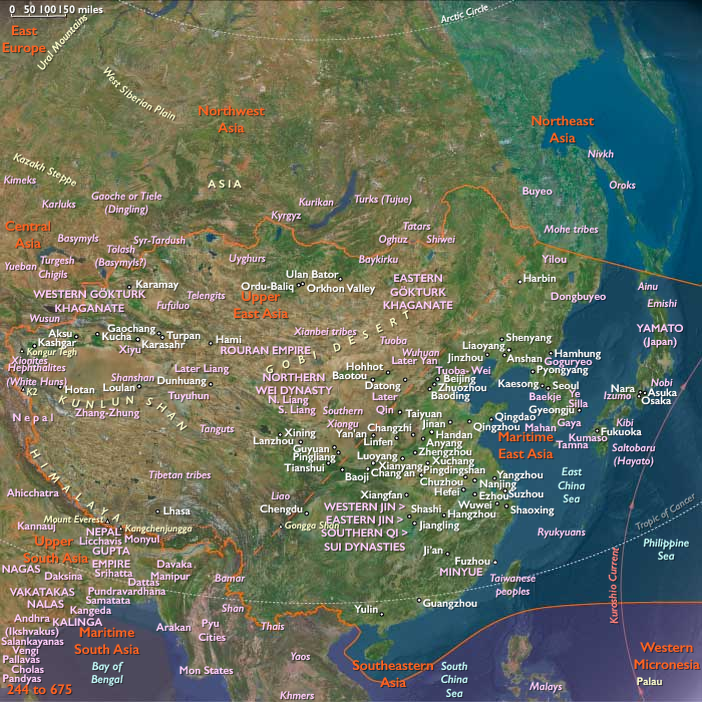
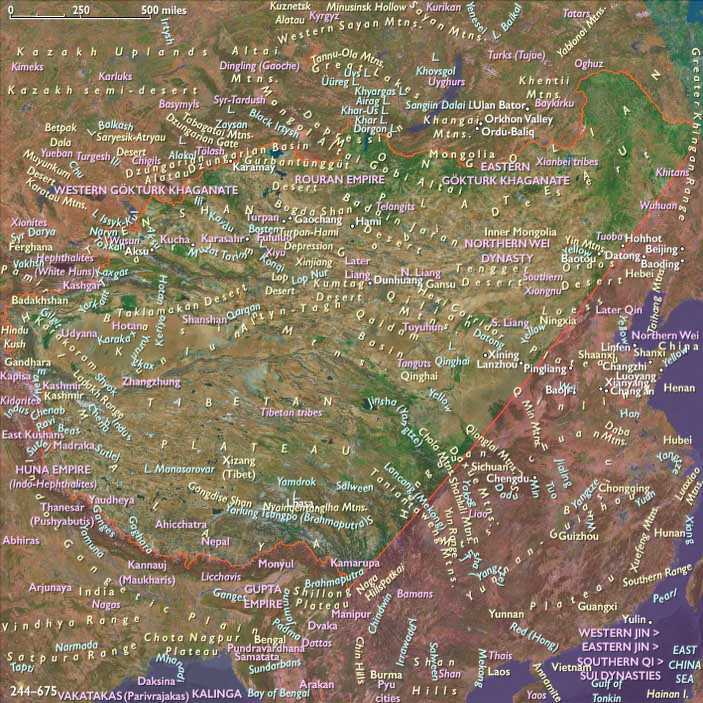
…the larger part had settled in the area between Altai and the eastern Tien Shan.
At the time of their submission to the Chinese in 650, the Karluks have three tribes: Meulo, Chjisy (Popou), and Tashili.
On paper, the Karluk divisions receive Chinese names as Chinese provinces, and their leaders receive Chinese state titles.
Locations
Groups
- Chinese (Han) people
- Karluks
- Eastern (Göktürk) Qaghans
- Western Turkic Khaganate
- Chinese Empire, Tang Dynasty
Topics
Commodoties
Subjects
Regions
Subregions
Related Events
Filter results
Showing 10 events out of 56431 total
Cymbals, drums, and Persian harps with upper sound chests begin to enrich China’s music, following the Chinese conquest of the Kingdom of Kucha in eastern Turkestan.
The Karluks had allied with the Tiele and their leaders the Uyghurs against the Turkic Kaganate, and had participated in enthroning the victorious head of the Uyghur (Toquz Oghuz).
After that, a smaller part of the Karluks had joined the Uyghurs and settled around Bogd Khan Mountain in Mongolia, …
Balanjar, a city located in the North Caucasus region, between the cities of Derbent and Samandar, probably on the lower Sulak River, flourishes from the seventh to the tenth centuries CE.
The legendary founder of Balanjar, according to the Arab chroniclers Ibn al-Faqih and Abu al-Fida, was named Balanjar ibn Japheth.
Balanjar was a capital of the Baranjar state in the 630s.
Some scholars speculate that the name derives from the Turkic root "Bala" or "Great", and the clan-name "Endzhar".
They are first mentioned in Arab chronicles of the seventh century.
They were supposedly settled in the northern Caucasus Mountains in the 370s CE, having come to Europe with the nomadic Huns.
From the second half of the sixth century, they were subjected to the Göktürk Khaganate.
After the collapse of the Göktürk power in the 630s, they formed a state centered on the town of Balanjar on the lower Terek and Sulak rivers in Daghestan and along the western shore of the Caspian Sea.
Their independence was short-lived, however, and by the end of the 630s they were incorporated into the Bulgar Khaganate and later the Khazar Khanate.
The Khazars establish a major commercial empire covering the southeastern section of modern European Russia.
With the rest of the Baranjar domains, the city becomes part of the Khazar Khaganate around 650; Balanjar will serve as the capital of Khazaria until the early 720s.
Hindu temple building, for which the fifth-century brick temple at Bhitargaon is a prototype, begins to make a significant impact in India on the accession of the Hindu dynasties beginning in 647.
A shelter for the deity's image rather than a place of public assembly, the Hindu temple's form often symbolizes the world mountain.
The oldest and the most important type of Hindu temple, the nagara, is conical or convex in shape, and crowned with a spire known as a sikhara.
Another type, the dravida, consists of a series of ascending terraces, or “bhumis,” representing the hierarchy of the divinities; on each terrace is a stupika, or "little stupa."
A third type, the “vesara,” is typically a barrel-vaulted hall derived from Buddhist chaitya halls.
A Hindu temple dedicated to Parashurameshvara is built in about 650 in the east central Indian city of Bhubaneswar, of fine-cut stone and closed over by corbeled vaults.
Consisting of a low, broad pavilion and a high tower, which rises directly over the icon in the innermost sanctum, the temple’s outer surfaces are richly and delicately carved in aesthetically pleasing proportions.
The temple is dedicated to Shiva and is one of the oldest temples in Orissa.
The mid-seventh century date is agreed by most scholars based on style, and the presence of the eight planets which appear over the door to the inner sanctum (later temples have nine).
Uthman, as caliph, promulgates an official version of the Qur'an, which had existed in various versions.
He has followed the same general policies as had 'Umar, but he has a less forceful personality than his predecessor.
He has continued the conquests that have steadily increased the size of the Islamic empire, but the victories now come at a greater cost and bring less booty in return.
In trying to create a cohesive central authority to replace the loose tribal alliance that had emerged under Muhammad, Uthman has established a system of landed fiefs and has distributed many of the provincial governorships to members of his family.
Thus, much of the treasure received by the central government goes to 'Uthman's family and to other provincial governors rather than to the army.
Unlike Umar, who had been strong enough to impose his authority on the governors, whatever their clan or tribe, Uthman, because of his policies, is opposed by the army, and he is often dominated by his relatives.
By 650, rebellions have broken out in the provinces of Egypt and Iraq.
The growing opulence of the Mesoamerican urban religious centers engenders envy and then resentment in the rural villages, whose labor supplies the surplus necessary to support the magnificence of the city-states of central and southern Mexico.
The larger highland communities, in a ruthless quest for food and security, loot and annex the smaller settlements on the coast or periphery, where vigorous hunting cultures still obtain.
A spreading revolt interrupts commerce, disrupting the food supply and causing the abandonment of the great ceremonial centers.
The aggressive competition between the city-states of central and southern Mexico ends in about 650, when famine and overpopulation generate increasingly frequent wars of conquest that deteriorate into chronic slaughter.
Warlike peoples begin in about 650 to invade, burn, and plunder Teotihuacán, which has lost its dominance of the region.
The mainland ceremonial centers of both the Mayans and the Teotihuacáns abruptly begin to fall into disuse (a process that is to continue for three centuries).
An embassy from the Rashidun Caliphate led by Saad ibn Abi Waqqas arrives in the Tang capital Chang'an via an overseas route.
They are greeted by emperor Gaozong, who orders the establishment of the first Chinese mosque.
Muslim commander Ahnaf ibn Qais marches north directly to Merv, in present Turkmenistan, where Yazdegerd III holds his court.
On hearing of the Muslim advance, Yazdegerd III leaves for Balkh.
No resistance is offered at Merv, and the Muslims occupy the capital of Khurasan without a fight.
Ahnaf stays at Merv and waits for reinforcements from Kufa.
Meanwhile, Yazdegerd has also gathered considerable power at Balkh and has sought alliance with the Khan of Farghana, who personally leads the Turkish contingent to help Yazdegerd III.
Uthman orders that Yazdegerd’s allied forces should be weakened by breaking up the alliance with the Turks.
Al-Ahnaf obeys the orders but keeps an eye on Yazdgerd III‘s moves.
When he later learns that the Turks have joined the Persians and both are approaching, he rallies his army and camps outside the town.
With an army that is only a fraction of the enemy's, he manages to defeat the Persians in Battle of Oxus river, killing their leader, while the Turks retreat to their land.
Yazdegerd's army retreats across the Oxus to Transoxiana; Yazdegerd himself has a narrow escape and fled to China.
Balkh is occupied by the Muslims, and with this occupation the Persian war is over.
The Muslims have now reached the outermost frontiers of Persia, beyond which lie the lands of the Turks and still further lies China.
The old and mighty empire of the Sassanids has ceased to exist.
Yazdgerd III then flees eastward from one district to another.
When Yazdegerd arrives in Merv, he demands tax from the Marzbān of Merv, losing also his support and making him an ally of Nezak Tarkan, the Hephthalite ruler of Badghis, who had helped him defeat Yazdegerd and his followers.
After his defeat, Yazdegerd is killed by a local miller for his purse while he is trying flee from Merv in 651.

Khorasan, as the second largest province of the Sassanid Persian Empire, stretches from what present north eastern Iran, Afghanistan and Turkmenistan.
Its capital is Balkh in Bactria, in present northern Afghanistan.
The mission of conquering Khurasan in 651 is assigned to Ahnaf ibn Qais.
Ahnaf marches from Kufa and takes a short and less frequent route via Rayy and Nishapur.
Rayy is already in Muslim hands and …
Years: 650 - 650
Locations
Groups
- Chinese (Han) people
- Karluks
- Eastern (Göktürk) Qaghans
- Western Turkic Khaganate
- Chinese Empire, Tang Dynasty