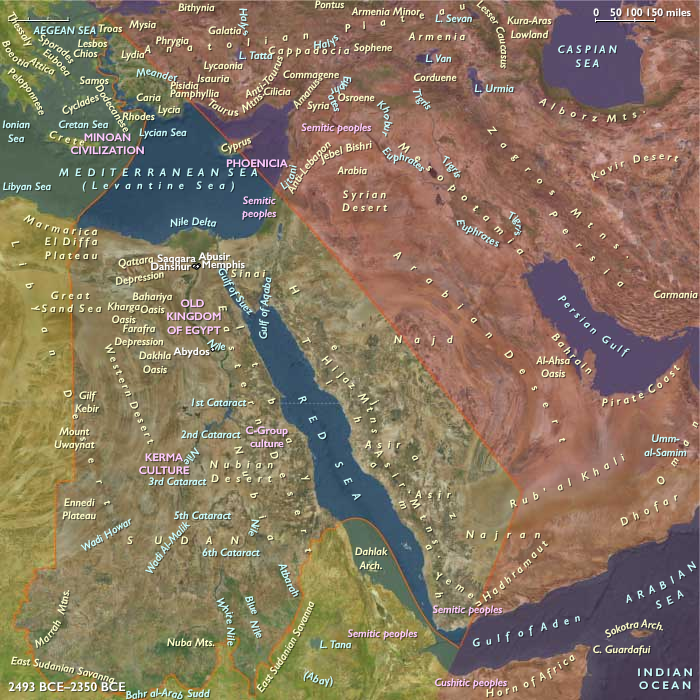
The Middle East (2493–2350 BCE): Emergence of Political Authority and Economic Networks
Transition from Priestly to Secular Kingship
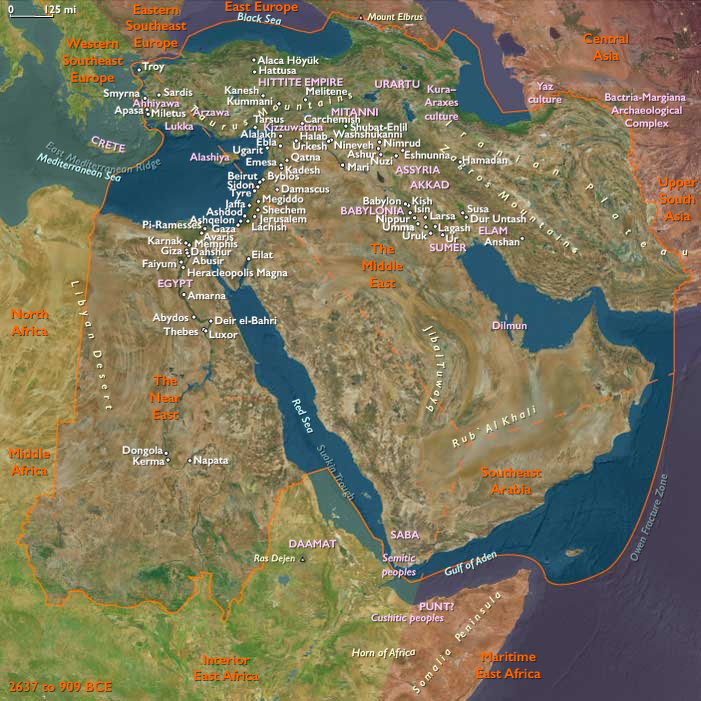
From 2493 to 2350 BCE, a significant transformation occurred in Sumerian political structures, marking the shift from priestly rule toward secular authority. Unlike earlier religious rulers, new kings wielded explicit political control independent of religious functions. This period saw intense rivalry among prominent Sumerian city-states such as Umma, Kish, and Lagash, each vying for dominance over the fertile river valleys of lower Mesopotamia.
Expansion of Economic and Commercial Networks
During this era, an extensive commercial network emerged, interlinking regions as diverse as Anatolia, Mesopotamia, Egypt, the Aegean, and the Syrian coast. Central to this vast economic system was the influential kingdom of Ebla, identified at Tall Mardikh. Ebla flourished as a sophisticated and powerful indigenous empire, controlling large parts of northern Syria and exerting considerable influence on portions of lower Mesopotamia, Anatolia, and Iran.
Foundation and Early Occupation of Assur
Archaeological discoveries indicate the initial occupation of the site of Assur around 2500 BCE, possibly by groups migrating from Syria or the southern regions. The city's early foundations, including structures discovered beneath the Ishtar temple and the Old Palace, foreshadowed its eventual prominence as a significant Assyrian center.
Artistic and Technological Sophistication
The Sumerians demonstrated remarkable artistic sophistication during this period, creating intricate jewelry pieces including necklaces, earrings, rings, and bracelets. Exceptional craftsmanship is exemplified by finds from the royal tombs of Ur, where luxurious artifacts such as gold headdresses adorned with lapis lazuli pendants highlight advanced techniques like casting, cloisonné, granulation, and filigree.
Akkadian Ascendancy and Linguistic Developments
Semitic-speaking Akkadians began to dominate northern Mesopotamia around 2410 BCE, significantly altering regional power dynamics. The Akkadian language, employing the cuneiform writing system, became widespread. The proliferation of scribal schools across Sumer supported this linguistic and administrative transformation.
Intercultural Relations and Conflicts
The city-state of Mari, inhabited by Semitic peoples related to the Eblaite and Akkadian groups, developed significant cultural and political connections with southern Mesopotamia. Artifacts and votive statues from Mari's temples indicate stylistic influences from Sumerian art, reflecting extensive intercultural interactions. Conflicts, particularly between the city-states of Lagash, Kish, and others, intensified during this period, epitomized by military exploits such as those led by King Eannatum of Lagash.
Elamite Political Ascendance
Elam, with its distinct language and matrilineal succession, solidified its political presence in the region through the establishment of the Awan dynasty. This dynasty's hegemony and trade relations with Sumer, particularly under Elamite rulers who occasionally dominated Sumerian cities, underscored its significant role in regional politics and economics.
Ebla's Administrative and Cultural Legacy
The city-state of Ebla emerged prominently during this period, known for extensive administrative records on clay tablets discovered at the site. Written in the Eblaite language, these tablets provided insights into diplomatic communications, trade practices, and cultural exchanges, highlighting Ebla’s status as an economic powerhouse with far-reaching commercial ties extending across the Near East.
Phoenician Maritime Influence
Phoenician cities such as Byblos (Gubla) continued to expand maritime trade, exporting goods like cedar, olive oil, and wine, and importing luxury items from Egypt. Depictions in Egyptian reliefs from this era notably portray Phoenician maritime activities, emphasizing their significant role in Mediterranean commerce.
Military and Urban Developments
Militarily, innovations in infantry formations became apparent, illustrated by the Stele of the Vultures, which depicted organized formations akin to a phalanx. The period also saw substantial urban fortifications, notably the legendary construction of extensive defensive walls around Uruk ordered by the semi-mythological King Gilgamesh.
Ur's Dynastic Prominence
Under Mesannepada, the city of Ur rose to preeminence, marked by impressive constructions including elaborate royal tombs. These tombs, notably that of Queen Puabi, evidenced Ur’s wealth, power, and sophisticated cultural practices.
The era from 2493 to 2350 BCE was thus characterized by pronounced shifts toward political authority distinct from religious power, extensive economic networks, artistic and technological advancements, and complex intercultural relations, laying crucial foundations for future regional dynamics.