
The Lakhmid Kingdom had been founded by …
Years: 325 - 325
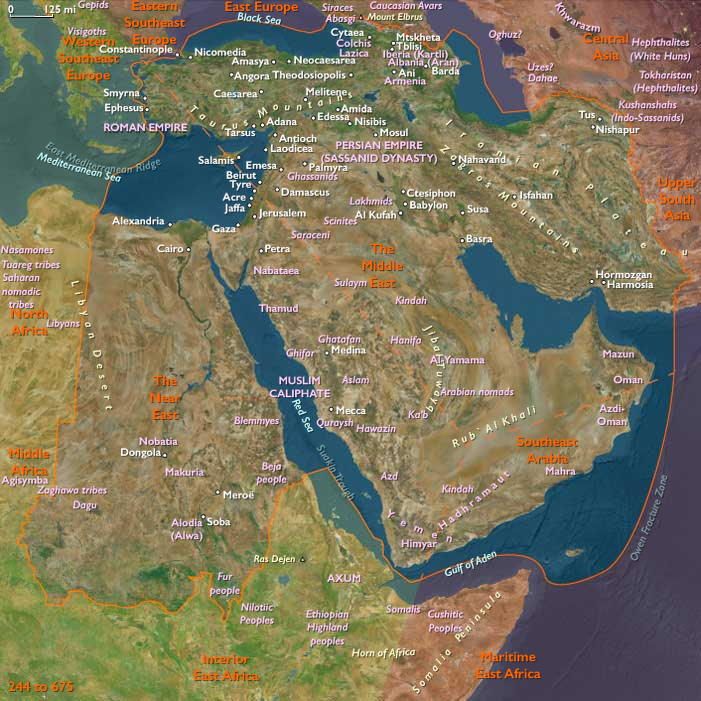
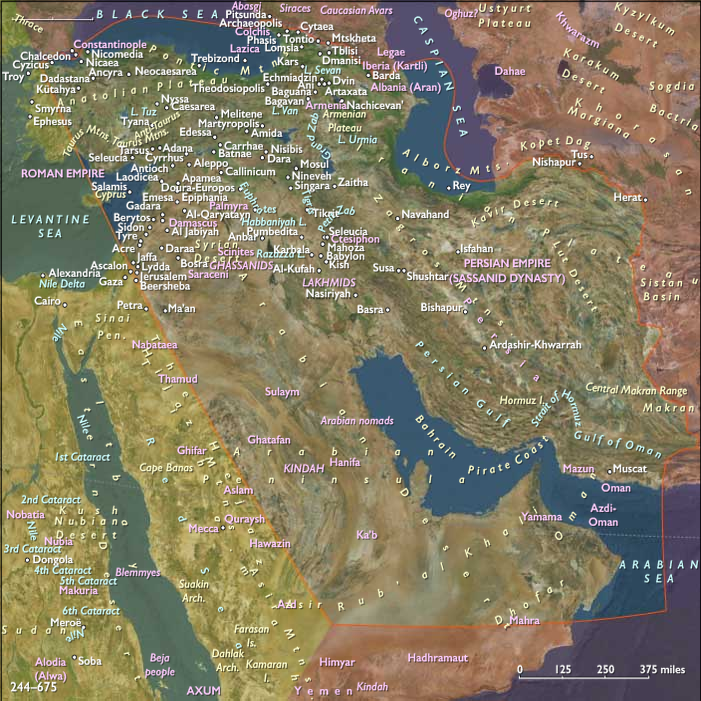
The Lakhmid Kingdom had been founded by the Lakhum tribe that emigrated from Yemen in the seconnd century and ruled by the Banu Lakhm, hence the name given it.
The founder of the dynasty was 'Amr, whose son Imra' ul-Qays (not to be confused with the famous poet Imru' al-Qais who lived in the sixth century) is claimed to have converted to Christianity according to Western authors.
Imra' ul-Qays dreams of a unified and independent Arab kingdom and, following that dream, had seized many cities in Arabia.
He had then formed a large army and developed the Kingdom as a naval power, which consists of a fleet of ships operating along the Bahraini coast.
From this position he has attacked the coastal cities of Persia—which at that time was in civil war due to a dispute as to the succession—even raiding the birthplace of the Sassanid kings, the province of Pars (Fars).
The Persians, led by Shapur II, had initiated a campaign against the Arab kingdom in 325.
When Imra' ul-Qays realizes that a mighty Persian army composed of sixty thousand warriors is approaching his kingdom, he asks for the assistance of the Roman Empire, but no help comes from that quarter.
The Persians advance toward al-Hirah and a series of vicious battles takes place over al-Hirah and the surrounding cities.
Shapur crushes the Lakhmid army and captures al-Hirah, then orders the extermination of its population in retaliation for their raids on Pars.
In this, the young Shapur acts much more violently than is customary at this time in order to demonstrate to the Arab Kingdoms and the Persian nobility his power and authority.
Shapur's title in Arabic is Zol 'Aktaf, meaning the one who pierces shoulders, as he did this with some of his captives.
He installs Aus ibn Qallam and gives the city autonomy, thus making the kingdom a buffer zone between the Persian Empire and the territory of other Arabs in the Peninsula.
Imra' ul-Qays escapes to Bahrain, taking his dream of a unified Arab nation with him.
Locations
People
Groups
- Arab people
- Persian people
- Persian Empire, Sassanid, or Sasanid
- Lakhmid kingdom of al-Hira
- Roman Empire: Constantinian dynasty (Nicomedia)
Topics
Commodoties
Subjects
Regions
Subregions
Years: 325 - 325
Locations
People
Groups
- Arab people
- Persian people
- Persian Empire, Sassanid, or Sasanid
- Lakhmid kingdom of al-Hira
- Roman Empire: Constantinian dynasty (Nicomedia)
Topics
Commodoties
Subjects
Regions
Subregions