
The lack of men and materials and …
Years: 1481 - 1481
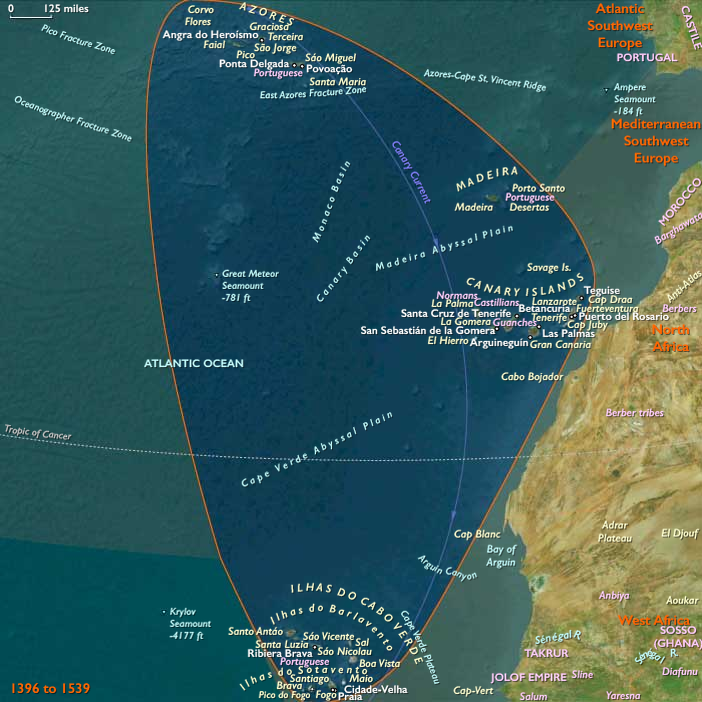
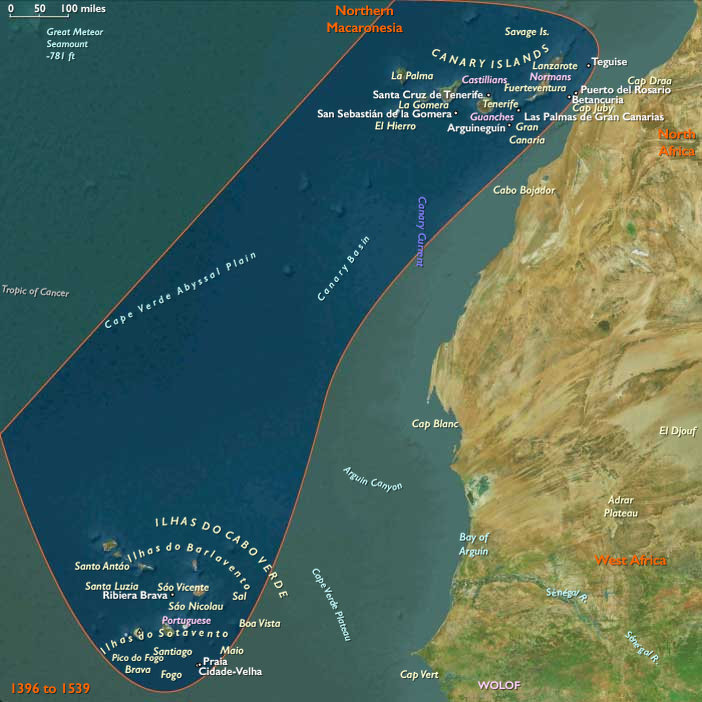
The lack of men and materials and internal disputes between the invaders of the Canary Islands has done little to quell the aboriginal resistance in the mountainous interior.
Juan Rejón is dismissed on the orders of the Catholic Monarchs and his place taken by Pedro Fernández de Algaba, who is subsequently executed by order of the deposed Rejón.
The naming of Pedro de Vera as the new governor of the island and the arrest of Juan Rejón puts an end to the infighting in 1481.
Locations
People
Groups
- Papal States (Republic of St. Peter)
- Castillian people
- Christians, Roman Catholic
- Aragón, Kingdom of
- Aragon, Crown of
- Castile, Crown of
Topics
Commodoties
Subjects
Regions
Subregions
Related Events
Filter results
Showing 10 events out of 40570 total
John, born at Aalborghus, in Aalborg, to Christian I of Denmark and Dorothea of Brandenburg, daughter of Margrave John of Brandenburg, had in 1478 married Christina of Saxony, granddaughter of Frederick the Gentle of Saxony.
This produced the following offspring: Christian II, Francis, Knud, and Elisabeth, who later married as princess of Brandenburg.
In 1458, John's father, King Christian I, had had the Norwegian Council of the Realm commit to electing Christian's eldest son as next king of Norway upon his death.
A similar declaration had been made in Sweden.
In 1467, John had been hailed as successor to the throne in Denmark.
John uses the title heir to the throne of Norway, in line with Norway's old status as a hereditary kingdom, but this is a claim the Norwegian Council had not immediately recognized.
Consequently, upon King Christian's death in May 1481, John's position is unchallenged in Denmark, whereas …
…in Norway the Council of the Realm assumes royal authority, and an interregnum ensues.
No serious rival candidates to the Norwegian throne exist, but the Council is determined to demonstrate Norway's status as a sovereign kingdom.
Bayezid II's younger brother Cem captures the city of Inegöl with an army of four thousand, only six days after the installation of as his brother as Ottoman Sultan.
Bayezid sends his army under the command of vizier Ayas Pasha to kill his brother.
Cem defeats Bayezid's army and on May 28 declares himself Sultan of Anatolia, establishing his capital at Bursa to avoid the Janissaries.
He proposes dividing the empire amicably between them, leaving Bayezid only Europe.
Bayezid, adhering to the doctrine of indivisibility of rule formulated by their father, and reinforced by religious arguments and personal ambition, furiously rejects the proposal.
Declaring "between rulers there is no kinship," he marches on Bursa.
The decisive battle between the two rivals to the Ottoman throne takes place near the town of Yenişehir.
Cem loses and flees with his family to Mamluk Cairo.
John II of Portugal: The "Perfect Prince" and His Battle Against the Nobility (1481–1483)
Upon the death of Afonso V "the African" in 1481, his 26-year-old son, John II, ascended the Portuguese throne. Determined to restore absolute royal authority, he quickly earned the nickname "the Perfect" (O Príncipe Perfeito) for his ruthless efficiency in suppressing noble power and centralizing the monarchy.
The Cortes of Évora (1481): John II’s First Blow Against the Nobility
- In the first year of his reign (1481), John II convened the Cortes at Évora, signaling his intent to reduce aristocratic influence.
- He introduced sweeping restrictions on noble privileges, including:
- A loyalty oath requirement for the aristocracy, ensuring their allegiance to the Crown.
- Revoking the nobility’s right to administer justice on their estates, thereby ending their quasi-feudal autonomy.
These reforms weakened the power of the landed aristocracy, who had grown excessively wealthy and politically influential under his father, Afonso V.
Noble Resistance and the House of Braganza’s Conspiracy
- The high nobility, especially the House of Braganza, felt threatened by John II’s policies.
- Fernando II, Duke of Braganza, the wealthiest and most powerful noble in Portugal, became the leader of aristocratic opposition.
- Letters of complaint and pleas for intervention were exchanged between:
- Fernando II, Duke of Braganza.
- Queen Isabella I of Castile, who had historical ties with the Braganza family.
John II was aware of these secret correspondences, and rather than tolerating opposition, he acted decisively.
John II’s Response: The Execution of the Duke of Braganza (1483)
- In 1483, John II accused Fernando II of Braganza of treason, claiming he plotted against the Crown with Castilian support.
- A swift trial was conducted, and Fernando was found guilty.
- The Duke of Braganza was executed in Évora, and John II confiscated the vast Braganza estates, dealing a major blow to the aristocracy.
This was just the first step in John II’s campaign against noble resistance, setting the stage for further purges and consolidations of power.
Legacy: The Path to an Absolute Monarchy
John II’s actions:
- Crushed the power of the nobility, ensuring that the monarchy ruled without aristocratic interference.
- Eliminated the feudal privileges of noble families, strengthening Portugal’s centralized government.
- Shifted the kingdom’s focus from noble politics to overseas expansion, paving the way for Portugal’s Golden Age of Exploration.
The crackdown on noble conspiracies, starting with the Duke of Braganza’s execution in 1483, marked John II’s transformation of Portugal into an absolute monarchy, setting the stage for a strong and centralized empire.
King John II of Portugal: The Ruthless Centralizer and Architect of Empire
King John II of Portugal (r. 1481–1495), known as "The Perfect Prince" (O Príncipe Perfeito), dedicated his reign to strengthening royal authority, crushing noble resistance, and expanding Portugal’s overseas empire.
The Noble Conspiracies and John II’s Brutal Response
- The Portuguese nobility had grown immensely powerful under John’s predecessors, particularly due to the lavish land grants and privileges bestowed upon them by Afonso V.
- As a centralizing monarch, John II sought to curb noble power and restore royal authority, implementing strict reforms that angered the high aristocracy, especially the House of Bragança.
- This led to conspiracies and revolts, which John II ruthlessly suppressed with executions, assassinations, and land confiscations.
Key Events in John II’s Crackdown on the Nobility
-
The Execution of the Duke of Bragança (1483)
- Fernando II, Duke of Bragança, leader of Portugal’s most powerful noble house, was accused of treason for conspiring with Castile.
- John II ordered his trial and execution, confiscating Bragança lands and wealth, which significantly weakened the aristocracy.
-
The Killing of the Duke of Viseu (1484)
- In 1484, John II personally stabbed his cousin, Diogo, Duke of Viseu, in the royal palace after discovering his involvement in a second conspiracy against the Crown.
- This act sent a clear message to other nobles that defiance would not be tolerated.
-
Confiscation of Noble Lands
- John II seized vast estates from noble families, reducing their ability to challenge the Crown.
- Many aristocrats fled Portugal, fearing for their lives.
Popular Support from the Middle Class and Peasantry
- While the nobility despised John II, he was widely supported by the Portuguese middle class and peasantry.
- His policies benefited merchants and commoners by:
- Reducing aristocratic corruption and privileges.
- Strengthening trade and maritime commerce.
- Encouraging exploration, which created new economic opportunities.
John II’s Patronage of Exploration and the Arts
Once royal power was firmly established, John II turned to patronage of the arts and overseas expeditions, securing Portugal’s place as a global naval power.
- He financed exploration along the West African coast, leading to:
- Bartolomeu Dias rounding the Cape of Good Hope (1488), opening the sea route to India.
- Establishment of Portuguese trading outposts, boosting the economy.
- Encouraged cartography and scientific advancements, ensuring Portugal had the best navigators in Europe.
- Supported architecture and literature, making his court a center of Renaissance learning.
Legacy: Portugal’s Strongest Monarch Before the Age of Exploration
- John II transformed Portugal into a centralized and absolute monarchy, setting the stage for its Golden Age of Exploration.
- His brutal suppression of the nobility ensured that future Portuguese kings would not be overshadowed by aristocrats.
- His reforms made Portugal an efficient, financially strong kingdom, ready to dominate the spice trade and global exploration in the 16th century.
Despite his ruthless methods, John II is remembered as one of Portugal’s greatest kings, a leader who secured royal power and paved the way for the Portuguese Empire.
Mino da Fiesole’s friends and fellow-workers Desiderio da Settignano and Matteo Civitali were born within a few years of him.
Mino’s work, influenced by his master Desiderio and by Antonio Rossellino, is characterized by its sharp, angular treatment of drapery.
Unlike most Florentine sculptors of his generation, Mino has passed two lengthy sojourns in Rome, from about 1459 to 1464 and again from about 1473/1474 until 1480.
Mino's sculpture is remarkable for its finish and delicacy of details, as well as for its spirituality and strong devotional feeling.
Of his earlier works, the finest are in the cathedral of Fiesole, the altarpiece and tomb of Bishop Leonardo Salutati, who died in 1466.
His most arduous and complicated commission involves an altarpiece and tombs for the church of the Benedictine monastery in Florence known as the Badia.
The first, completed about 1468, was essentially a private commission for the Florentine lawyer and diplomat Bernardo Giugni.
The second, directly commissioned by the monks and finished in 1481, honors the memory of their founder, the tenth century Ugo, count of Tuscany.
In the wall monuments, portraits and bas-reliefs are worked into complex structures with elaborate highly individualistic decorative moldings.
The extraordinary diversity of contemporary and ancient sources that Mino draws from to create in these tomb sculptures distinguish him from other sculptors active in mid-quattrocento Florence. (The monuments have been reinstalled in the rebuilt church.)
King Ferdinand I of Naples allies himself in the tumultuous affairs of Italy chiefly with Florence, with whose help he expels the Turks from Otranto in 1481.
There is some fear that Rome will suffer the same fate as Constantinople, which had fallen only twenty-seven years earlier.
Plans are made for the Pope and citizens of Rome to evacuate the city.
Pope Sixtus IV repeats his 1471 call for a crusade.
Several Italian city-states, Hungary and France respond positively to this.
The Republic of Venice does not, as it had signed an expensive peace treaty with the Ottomans in 1479.
An army is raised by king Ferdinand I of Naples to be led by his son Alphonso II of Naples, and king Matthias Corvinus of Hungary provides a contingent of troops.
The Christian forces besiege the city on May 1, 1481, but when the Sultan of the Ottoman Empire, Mehmed II, dies on May 3 without the quarrels about his succession being finalized, the subsequent succession crisis results in the failure to send Ottoman reinforcements to relieve Otranto.
The Turkish garrison in Otranto is forced to negotiate with the Christian forces, which permit the Turks to withdraw to Albania.
The Vatican’s Sistine Chapel, begun in 1473 for Pope Sixtus IV under the supervision of Giovanni de Dolci, is completed in 1481.
Sixtus enlarges the Vatican Library and opens it to the public.
The two papal bulls issued by Pope Nicholas V, Dum Diversas of 1452 and Romanus Pontifex of 1455, had effectively given the Portuguese the rights to acquire enslaved people along the African coast by force or trade.
These concessions are confirmed by Sixtus in his own bull, Aeterni regis of June 21, 1481.
Arguably the "ideology of conquest" expounded in these texts becomes the means by which commerce and conversion are facilitated.
Years: 1481 - 1481
Locations
People
Groups
- Papal States (Republic of St. Peter)
- Castillian people
- Christians, Roman Catholic
- Aragón, Kingdom of
- Aragon, Crown of
- Castile, Crown of
