
The Knights of the Sword have been …
Years: 1219 - 1219
June
The Knights of the Sword have been attempting to Christianize the peoples of the eastern Baltic, but by 1219 they are being hard pressed and turned to Denmark’s King Valdemar II for help.
Pope Honorius III, via the bishop of Riga, elevates Valdemar's invasion of Estonia into a crusade.
Valdemar raises an army and calls all of Denmark's ship to gather to transport the army eastward.
Once assembled, the fleet numbers fifteen hundred ships.
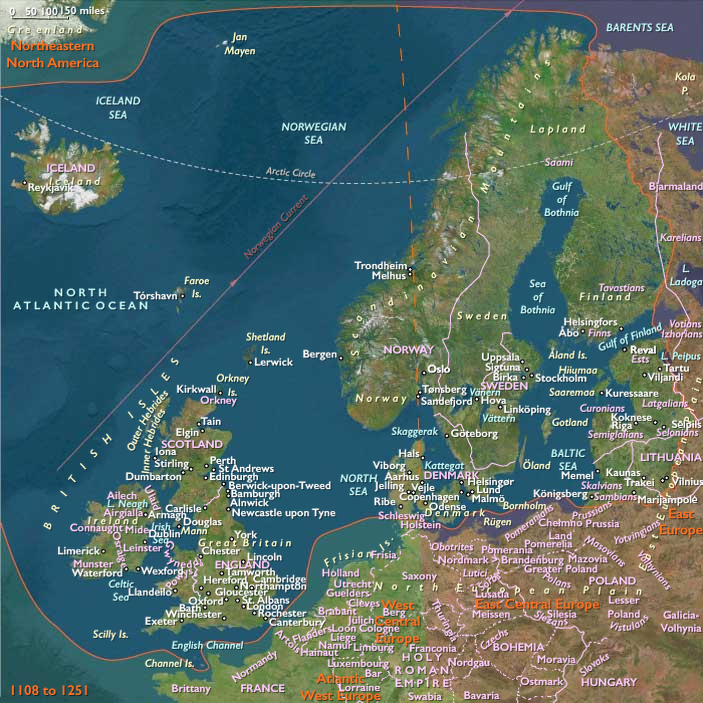
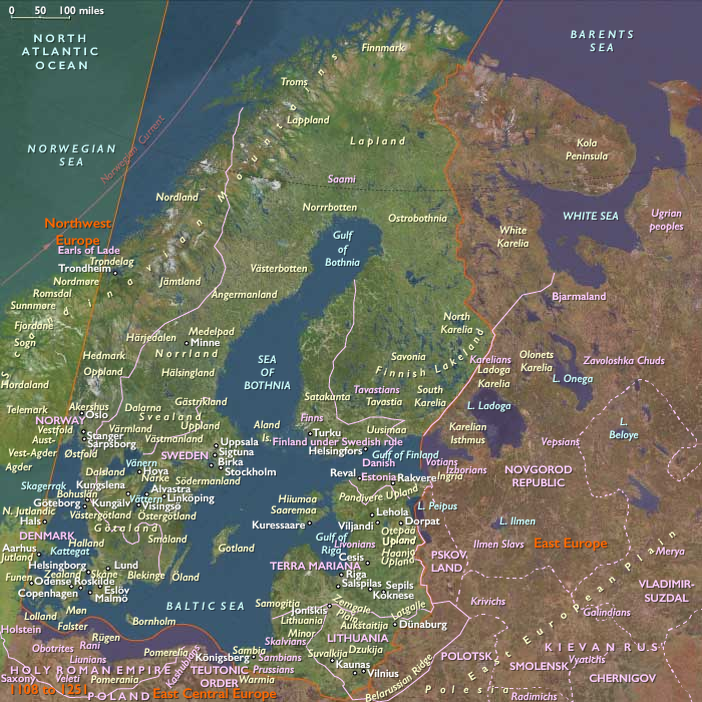
When the army lands at Reval, located on Tallinn Bay, an inlet of the Gulf of Finland, the chiefs of the Estonians, who have come under the influence of the Orthodox Russians, sit down with the Danes and agree to acknowledge the Danish king as their overlord.
A few of them allow themselves to be baptized, which seems a good sign.
While suing for peace, the vastly outnumbered Estonian-Russian forces are clandestinely building their troop strength.
While the Danes are attending mass three days later, thousands of Estonians launch a surprise five-pronged counterattack on the Danish camp on June 15, 1219.
Confusion reigns and things look bad for Valdemar's crusade.
Luckily for him, Vitslav of Rügen gathers his men in a second camp and attacks the Estonians from the rear.
After destroying Reval, Valdemar builds a fortress on the site—called Tallin, which means "Danish castle" in Estonian—garrisoning it with soldiers to enforce conversion to Western Christianity.
The legend traces the origin of the Danish national flag, a white cross on a red field, to this encounter, called Battle of Lyndanisse, also known as the Battle of Valdemar.
Although myth holds that it fell from heaven during the battle to give victory to the Danes, is probably based on the war flag of the Holy Roman Empire.
Locations
People
Groups
- Polytheism (“paganism”)
- Estonia, independent
- Denmark, Kingdom of
- Christians, Roman Catholic
- Christians, Eastern Orthodox
- Novgorod Republic
- Knights of the Sword (Order of the Livonian Brothers of the Sword, or Livonian Knights)
- Estonia, Danish
Topics
Commodoties
Subjects
- Origins
- Commerce
- Symbols
- Watercraft
- Engineering
- Labor and Service
- Conflict
- Faith
- Government
- Technology
Regions
Subregions
Related Events
Showing 10 events out of 47213 total
Years: 1219 - 1219
June
Locations
People
Groups
- Polytheism (“paganism”)
- Estonia, independent
- Denmark, Kingdom of
- Christians, Roman Catholic
- Christians, Eastern Orthodox
- Novgorod Republic
- Knights of the Sword (Order of the Livonian Brothers of the Sword, or Livonian Knights)
- Estonia, Danish
Topics
Commodoties
Subjects
- Origins
- Commerce
- Symbols
- Watercraft
- Engineering
- Labor and Service
- Conflict
- Faith
- Government
- Technology
Regions
Subregions