
The Knights of St. John, with their …
Years: 1480 - 1480
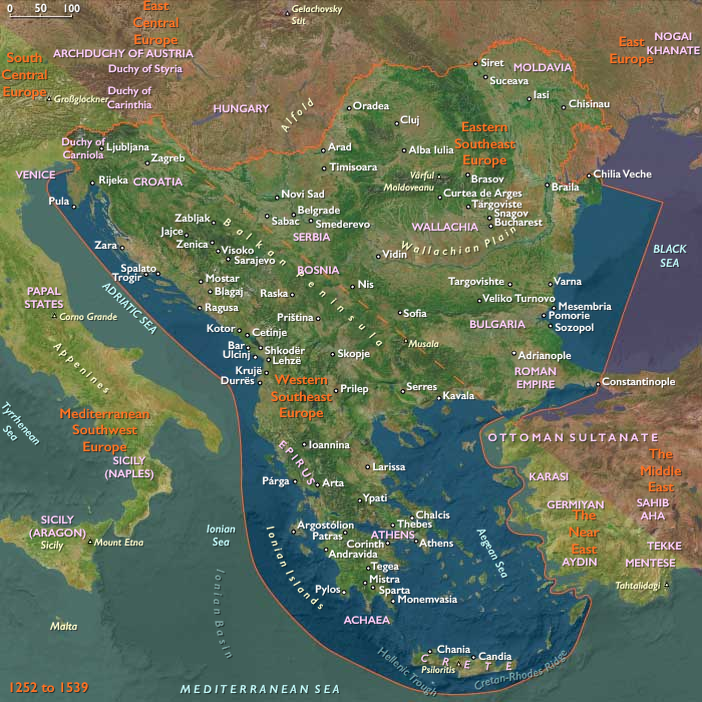
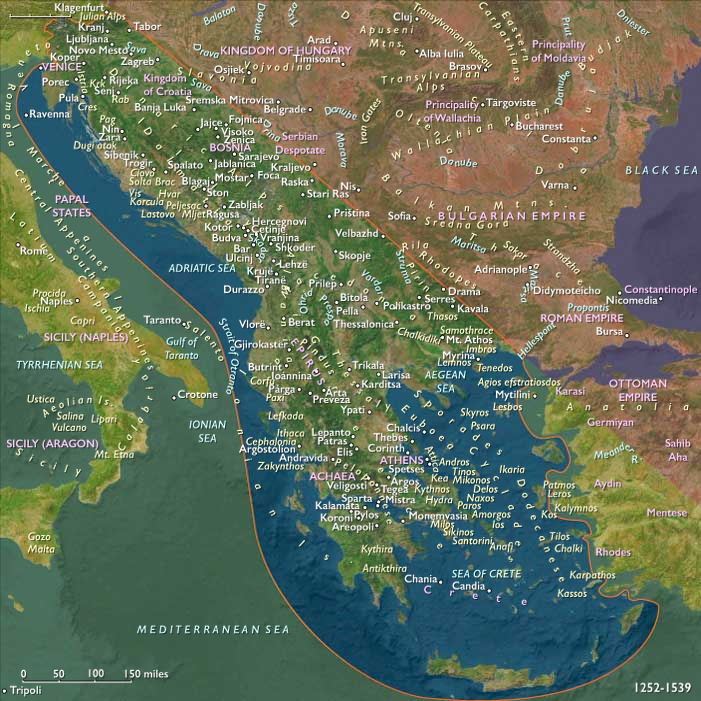
The Knights of St. John, with their headquarters at Rhodes, hold the island as a bar to Ottoman expansion in the Aegean.
Pierre d'Aubusson, a son of French nobility who joined the Knights around 1453, had become grand master of the order in 1476.
The island of Tilos (located between Rhodes and another island, Kos) had been evacuated to Rhodes in 1470 because they were susceptible to attacks from the Ottoman Empire.
The island of Chalki (six kilometers west of Rhodes, the smallest inhabited island of the Dodecanese) had also been evacuated to Rhodes in 1475 for the same reason.
An Ottoman fleet of one hundred and sixty ships appears on May 23, 1480, before Rhodes, at the gulf of Trianda, along with an army of seventy thousand men under the command of Gedik Ahmed Pasha or Mesih Pasha.The Knights Hospitaller garrison is led by d'Aubusson.
The Knights are reinforced from France by five hundred knights and two thousand soldiers under d'Aubusson's brother Antoine.
The Ottomans' first strategic goal is to capture the Tower of St Nicholas, which is the knights' key point in the defense of the two harbors: the commercial, Mandraki, and the one to the east bay of Akandia.
The Turkish artillery keeps up an unbroken bombardment and on June 9 the infantry makes a series of attacks.
Grand Master d'Aubusson himself speeds to the aid of the garrison and after a fierce struggle the enemy is repelled.
Shortly after comes a second attack on the tower, this time on the eastern sector of the wall towards the bay of Akandia, which is the battle station of the "tongue" of Italy and is quite weak.
During the bombardment from the Turkish artillery, the Knights and the people meanwhile dig a new moat on the inside of the wall at this point and construct a new internal fortification.
Once again the Knights react valiantly and decisively and after a bitter battle with many casualties on both sides, the danger is once more averted.
The Turks at dawn on July 27, launch a vigorous offensive on the Jewish quarter of the city, and their vanguard of around twenty-five hundred Janissaries manages to take the tower of Italy and enter the city.
A frenzied struggle ensues.
The grand master, wounded in five places, directs the battle and fights with lance in hand.
After three hours of fighting the enemy are decimated and the exhausted survivors begin to withdraw.
The Knights’ counterattack causes the Turks to beat a disorderly retreat, dragging along with them the Vizier and commander-in-chief.
The Hospitallers reach as far as his tent and take, along with other booty, the holy standard of Islam.
On this day between three and four thousand Turks are slain.
The Ottoman fleet on August 17, 1480, abandon their attempt to capture Rhodes.
Sultan Mehmed II is furious and would have attacked the island again, but his death in 1481 will put a stop to the attempt.
The French knight Guillaume Caoursin, vice-chancellor of the Knights Hospitaller, fought in the siege of Rhodes and writes its description in his Obsidionis Rhodiae Urbis Descriptio (an English translation exists as a part of Edward Gibbon's Crusades).
D'Aubusson's own report on the siege can be found in John Taaffe's history of the Holy, military, sovereign order of st. John of Jerusalem.
D'Aubusson gains widespread fame in Europe for his successful defense of the island.
Locations
People
Groups
Topics
Commodoties
Subjects
Regions
Subregions
Years: 1480 - 1480
Locations
People
Groups
Topics
Commodoties
Subjects
Regions
Subregions