
The Knights Hospitallers at Krak des Chevaliers, …
Years: 1271 - 1271
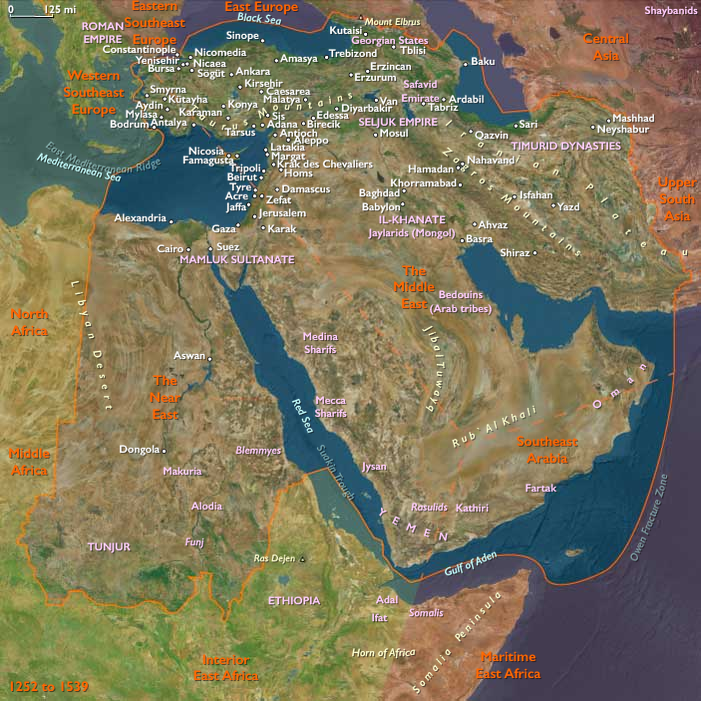
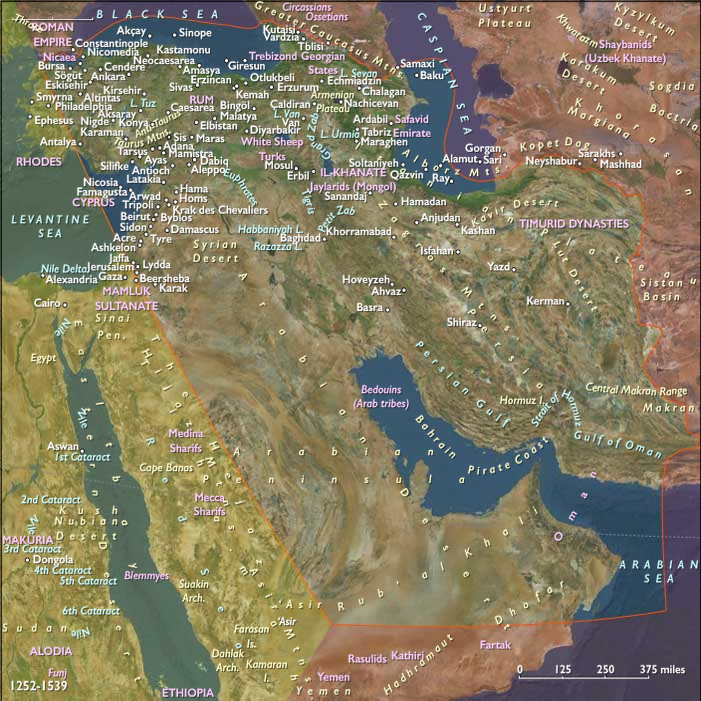
The Knights Hospitallers at Krak des Chevaliers, the primary fortress guarding approaches to the crusader's County of Tripoli, a state founded after the First Crusade, control a number of castles along the border of the County of Tripoli.
Krak des Chevaliers is among the most important and acts as a center of administration as well as a military base.
After a second phase of building was undertaken in the thirteenth century, Krak des Chevaliers became a concentric castle.
This phase created the outer wall and gave the castle its current appearance.
The first half of the century has been described as Krak des Chevaliers' "golden age".
At its peak, Krak des Chevaliers housed a garrison of around two thousand.
Such a large garrison has allowed the Hospitallers to extract tribute from a wide area.
The fortunes of the Hospitallers had taken a turn for the worse in 1252, when an army estimated to number ten Master Hugh Revel had complained in 1268 that the area, which had previously been home to around ten thousand people, was deserted and the order's property in the Kingdom of Jerusalem was producing little income; he also noted that by this point there were only three hundred of the order's brothers left in the east.
One of the effects of Baibars’ unification of Egypt and Syria that Muslim settlements which had previously paid tribute to the Hospitallers at Krak des Chevaliers are no longer intimidated into doing so.
Baibars had ventured in the area around Krak des Chevaliers in 1270 and allowed his men to graze their animals on the fields around the castle.
When he received news that year that King Louis IX of France was leading the Eighth Crusade, Baibars had left for Cairo.
Louis died in 1271 and Baibars returned north to deal with Krak des Chevaliers.
Before marching on the castle he captures the smaller castles in the area, including Chastel Blanc.
On March 3, Baibars' army arrives at Krak des Chevaliers.
By the time the Sultan arrived the castle may already have been blockaded by Mamluk forces for several days.
There are three Arabic accounts of the siege; only one, that of Ibn Shaddad, was by a contemporary although he was not present.
Peasants who lived in the area had fled to the castle for safety and are kept in the outer ward.
As soon as Baibars arrives he begins erecting mangonels, powerful siege weapons which he will turn on the castle.
According to Ibn Shaddad, two days later the first line of defenses was captured by the besiegers; he was probably referring to a walled suburb outside the castle's entrance.
Rain interrupts the siege, but on March 21, a triangular outwork immediately south of Krak des Chevaliers, possibly defended by a timber palisade, is captured.
On March 29, the tower in the southwest corner is undermined and collapses.
Baibars' army attacks through the breach and on entering the outer ward, they encounter the peasants who had sought refuge in the castle.
Though the outer ward had fallen, and in the process a handful of the garrison killed, the Crusaders retreat to the more formidable inner ward.
Locations
People
Groups
- Muslims, Sunni
- Christians, Roman Catholic
- Jerusalem, Latin Kingdom of
- Tripoli, County of
- Hospitallers of St. John of Jerusalem
- Cyprus, Kingdom of
- Egypt and Syria, Mamluk Bahri Sultanate of
- Palestine, Mamluk
Topics
Commodoties
Subjects
Regions
Subregions
Related Events
Showing 10 events out of 45728 total
Years: 1271 - 1271
Locations
People
Groups
- Muslims, Sunni
- Christians, Roman Catholic
- Jerusalem, Latin Kingdom of
- Tripoli, County of
- Hospitallers of St. John of Jerusalem
- Cyprus, Kingdom of
- Egypt and Syria, Mamluk Bahri Sultanate of
- Palestine, Mamluk
Topics
Commodoties
Subjects
Regions
Subregions