
The king's power had remained paramount in …
Years: 1252 - 1252
The king's power had remained paramount in Hungary until the end of the twelfth century.
He was the largest landowner, and income from the crown lands nearly equaled the revenues generated from mines, customs, tolls, and the mint.
In the thirteenth century, however, the social structure has changed, and the crown's absolute power has begun to wane.
Béla IV, who had succeeded to the throne in 1235, had tried with little success to reestablish royal preeminence by reacquiring lost crown lands.
His efforts, however, had created a deep rift between the crown and the magnates just as the Mongols were sweeping westward across Russia toward Europe.
Aware of the danger, Béla had ordered the magnates and lesser nobles to mobilize.
Few responded, and the Mongols had routed Béla's army in April 1241.
Béla fled first to Austria, where Duke Frederick II of Babenberg had held him for ransom, then to Dalmatia.
The Mongols had meanwhile reduced Hungary's towns and villages to ashes and slaughtered a great part (estimates reach twenty-five to thirty percent) of the population before news arrived in 1242 that the Great Ögedei Khan had died in Karakorum.
The Mongols had withdrawn, sparing Béla and what remained of his kingdom.
Realizing that reconstruction will require the magnates' support, Béla has abandoned his attempts to recover former crown lands and has instead granted crown lands to his supporters.
He has reorganized the army by replacing light archers with heavy cavalry, and granted the magnates concessions to redevelop their lands and construct stone-and-mortar castles that can withstand enemy sieges.
Repopulating the country with a wave of immigrants, Béla has transformed royal castles into towns and populated them with Germans, Italians, and Jews.
Mining has begun anew, farming methods have improved, and crafts and commerce have developed in the towns.
Romanians (Wallachs)—who already have settlements in Transylvania—are also welcomed.
After Béla's reconstruction program, the magnates, with their new fortifications, emerge as Hungary's most powerful political force.
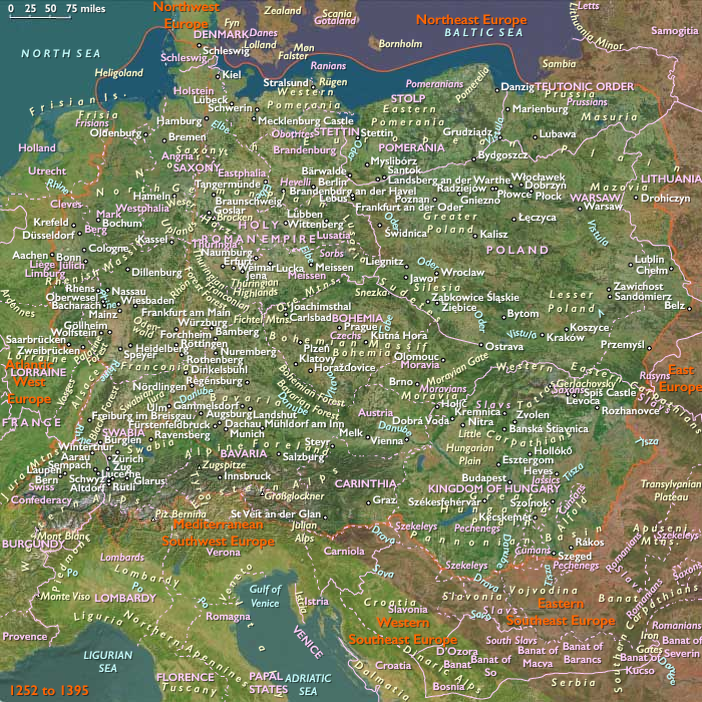
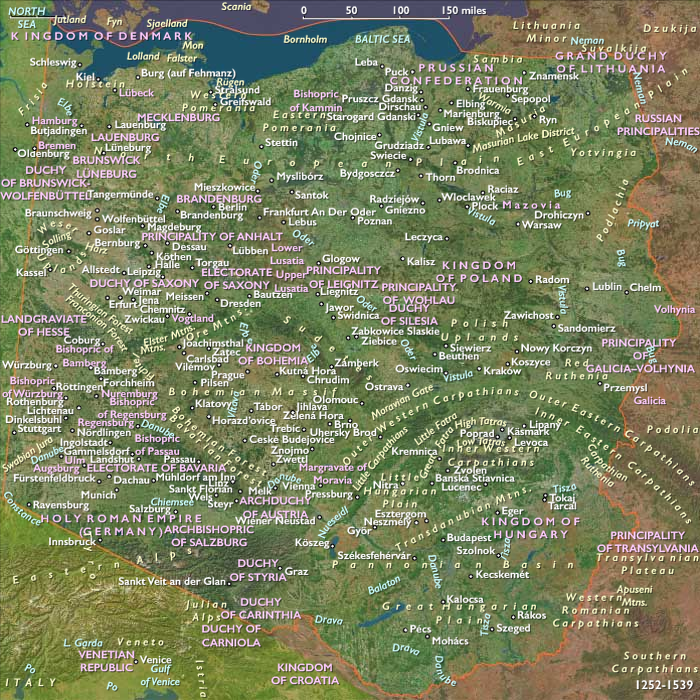
Now, deciding to intervene in the struggle for the inheritance of the House of Babenberg, Béla arranges a marriage between Gertrude of Austria, the twenty-six-year-old niece of the deceased Duke Frederick, and twenty-two-year-old Roman Danylovich, a son of Daniil Romanovich, or Daniel of Galicia, a powerful prince of lands east from Kraków (and later king of those regions, known variously as Ruthenia, Halych, and Volhynia).
Having formed a loose alliance with the Duke of Bavaria and claiming the Duchy of Styria, which has been a component of Austria since 1192, Béla leads his armies against Austria and occupies the Vienna Basin.
However, King Ottokar II of Bohemia, newly wed to Margaret, the sister of the late Frederick, also declares his claim to the two duchies.
Locations
People
Groups
- Jews
- Germans
- Vlachs
- Romanians
- Dalmatia region
- Italians (Latins)
- Mongols
- Austria, Archduchy of
- Styria, Duchy of
- Bavaria, Wittelsbach Duchy of
- Bohemia, Kingdom of
- Galicia–Volhynia, Principality of
- Mongol Empire
- Hungary, Kingdom of
- Galicia–Volhynia, Kingdom of
Topics
Commodoties
Subjects
Regions
Subregions
Years: 1252 - 1252
Locations
People
Groups
- Jews
- Germans
- Vlachs
- Romanians
- Dalmatia region
- Italians (Latins)
- Mongols
- Austria, Archduchy of
- Styria, Duchy of
- Bavaria, Wittelsbach Duchy of
- Bohemia, Kingdom of
- Galicia–Volhynia, Principality of
- Mongol Empire
- Hungary, Kingdom of
- Galicia–Volhynia, Kingdom of
Topics
Commodoties
Subjects
Regions
Subregions