The Transformation of Francia Under Chlodio …
Years: 459 - 459
The Transformation of Francia Under Chlodio
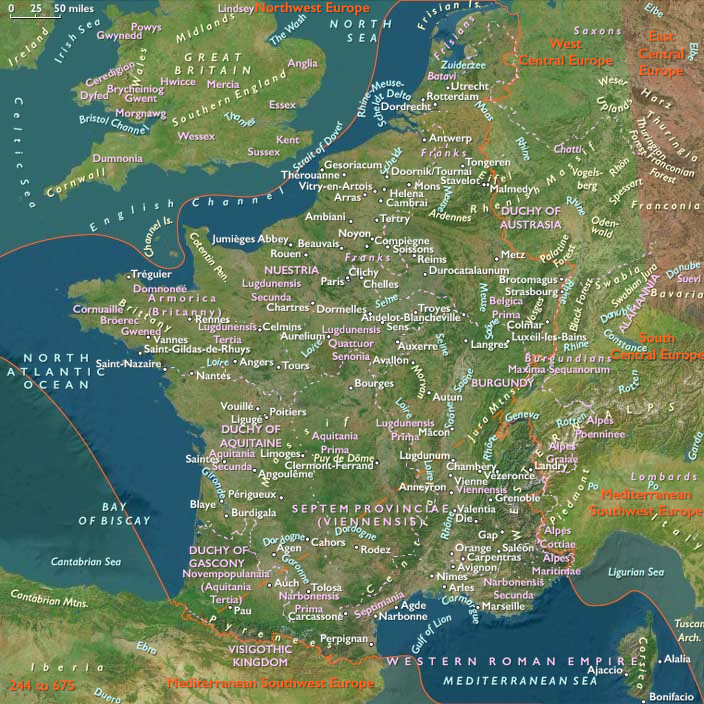
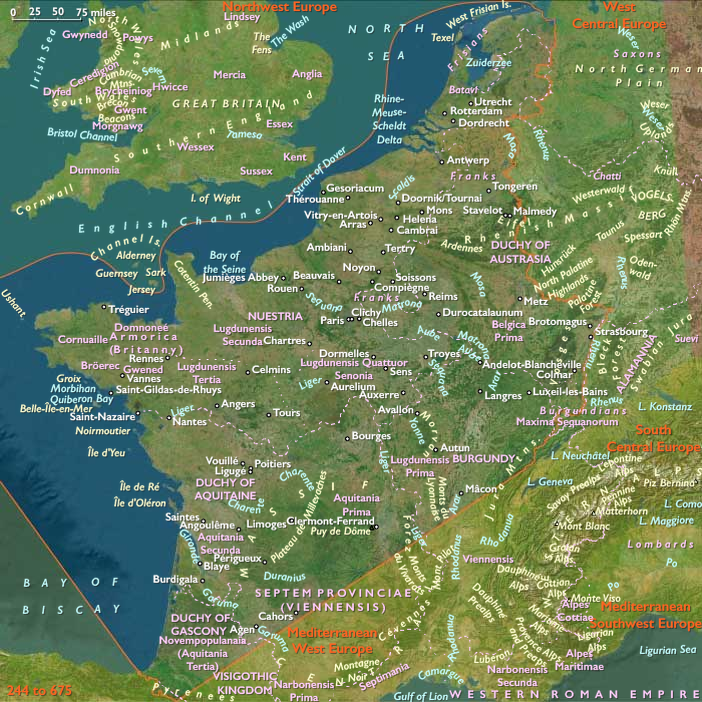
Under Chlodio, the concept of Francia undergoes a fundamental shift, both in geography and in political meaning. No longer merely barbaricum trans Rhenum—a term used by the Romans to describe barbarian lands beyond the Rhine—Francia emerges as a landed political entity on both sides of the river, firmly embedded in the power struggles of the Western Roman Empire.
From a Tribal Federation to a Territorial Kingdom
- Chlodio’s expansion into northern Gaul, including the conquest of Cambrai and Tournai, permanently alters the borders of Francia.
- The Franks, once considered external raiders, now rule over former Roman territories, integrating themselves into the imperial system as foederati.
- This transformation means that Francia is no longer just a tribal collective, but a recognized political force within the collapsing Roman world.
The Merovingian Expansion
Chlodio’s family, the Merovingians, will continue this territorial consolidation:
- Childeric I will strengthen Frankish control over Belgica Secunda, aligning with the Romans.
- Clovis I will extend Francia even further south, ultimately defeating the last remnants of Roman authority in Gaul and establishing the Frankish Kingdom as the dominant successor state to the Western Roman Empire.
Saxon Pressure and the Southward Shift of the Franks
As the Saxons expand from the northeast, they press the Frankish borders southwestward. This results in a gradual migration of most of the original Frankish people toward a new core region, roughly between:
- The Somme River (to the west).
- Münster (to the east, in modern Germany).
This shift solidifies the Frankish heartland in what is now northern France and western Germany, creating the geographic foundation of what will eventually evolve into the Carolingian Empire and medieval France.
Locations
People
Groups
- Germania
- Franks
- Germania Inferior (Roman province)
- Gallia Belgica (Roman province)
- Saxons
- Gaul, Diocese of
- Gaul, Praetorian prefecture of
- Roman Empire, Western (Ravenna)
- Francia (Merovingians)
Topics
Subjects
Regions
Subregions
Related Events
Filter results
Showing 5 events out of 5 total
During his regency, Pedro had given the task of producing a coherent economic policy to Luis de Menenses, count of Ericeira, who had been appointed head of the treasury.
Known as the "Portuguese Colbert," Ericeira has implemented mercantilist policies in Portugal similar to those of France.
These policies seek to protect Portuguese industries against foreign competition.
He publishes laws to enforce sobriety and criticizes luxury.
Ericeira organizes the textile industry and imports looms from England.
He stimulates the national production of wool and silk by decreeing that only Portuguese woolens and silks can be worn.
Atlantic Southwest Europe (1660–1671 CE): Stability, Economic Renewal, and Cultural Flourishing
Between 1660 and 1671, Atlantic Southwest Europe—encompassing northern and central Portugal (including Lisbon), Galicia, Asturias, Cantabria, northern León and Castile, northern Navarre, northern Rioja, and the Basque Country—entered a transformative period of relative peace, economic revitalization, and notable cultural advancement. Following the Treaty of the Pyrenees (1659) and the firm establishment of Portuguese independence, the region experienced internal consolidation, renewed commercial growth, and intensified cultural expressions rooted in regional identities and Baroque aesthetics.
Political and Military Developments
Portugal’s Political Stabilization under Afonso VI and Pedro II
Under King Afonso VI (1656–1667) and subsequently his brother, regent (and later King) Pedro II, Portugal secured political stability and diplomatic recognition, successfully preserving independence following decades of Spanish threats. Northern and central Portugal—particularly the influential cities of Lisbon, Porto, and Viana do Castelo—benefited significantly from this stable environment, reinforcing local governance structures and promoting economic prosperity.
Spanish Consolidation and Regional Autonomy
Following the Treaty of the Pyrenees, the Spanish monarchy under Philip IV (until 1665) and Charles II (from 1665)turned toward internal stabilization, allowing northern Spanish regions greater regional autonomy within a royal framework. Territories such as Galicia, Asturias, Cantabria, the Basque provinces, northern Navarre, and northern Rioja reaffirmed their treasured fueros (traditional privileges), enabling stronger local governance and fostering political stability.
Reduced Military and Fiscal Pressures
The cessation of prolonged international conflicts after 1659 notably diminished military and fiscal burdens on northern Spanish territories. Galicia, Asturias, Cantabria, and the Basque provinces benefited from reduced taxation and fewer conscription demands, facilitating economic recovery, social stability, and improved relations with central authority.
Economic Developments: Maritime Prosperity and Industrial Revival
Portuguese Maritime and Commercial Expansion
Portugal experienced marked economic revival, particularly through flourishing maritime commerce in the Atlantic. Lisbon thrived as an essential commercial and imperial hub, while Porto consolidated its status as a leading exporter of port wine, significantly bolstered by strengthened trading partnerships with Britain. Northern ports such as Viana do Castelo likewise prospered through shipbuilding and transatlantic commerce.
Revival of Northern Spanish Maritime Trade
Northern Spanish coastal cities, including Vigo, Santander, and Bilbao, saw renewed maritime prosperity through enhanced trading relationships with England, France, and the Netherlands. Improved security in Atlantic waters facilitated growth in fisheries, shipbuilding, and regional trade networks, contributing to economic stability.
Strengthening Local Industries
In northern Spain, regional industries—particularly shipbuilding, wool production, fishing, and iron manufacturing—experienced renewed vitality, notably in the Basque Country. This industrial revival bolstered regional economic independence and lessened reliance on Madrid, further solidifying local autonomy and prosperity.
Religious and Cultural Developments
Sustained Counter-Reformation Influence
Throughout Atlantic Southwest Europe, the Counter-Reformation retained considerable cultural and social influence. Catholic orthodoxy, reinforced by monastic institutions, universities, and inquisitorial tribunals, continued to shape local religious and intellectual life, particularly prominent in Lisbon, Braga, Valladolid, and Pamplona.
Regional Cultural Flourishing and Baroque Influence
Cultural activities surged across the region, notably reflecting Baroque artistic and architectural ideals. In northern and central Portugal, significant architectural projects flourished in Lisbon, Porto, and Braga, symbolizing national pride and renewed confidence in Portuguese identity. Literary, poetic, and musical expressions flourished, reinforcing distinct Portuguese cultural heritage.
In northern Spain, similar cultural flourishing occurred, with Baroque architecture prominently featured in cathedrals and public buildings in Santiago de Compostela, Burgos, and Santander. Galician, Basque, and Navarrese traditions were celebrated, reinforcing regional identity alongside broader Iberian cultural currents.
Social and Urban Developments
Urban Expansion and Enhanced Social Mobility
Major urban centers—Lisbon, Porto, Bilbao, Santander, and Santiago de Compostela—experienced significant population growth, driven by rural-to-urban migration and increased commercial activity. Merchant and artisan classes expanded notably, promoting greater social mobility and reshaping urban landscapes with improved infrastructure and vibrant civic life.
Reinforced Regional Identities and Autonomy
Across northern Spain, traditional fueros empowered local authorities in Galicia, the Basque provinces, and northern Navarre. Regional governance thrived, balancing loyalty to central monarchy with local interests and cultural distinctiveness. These strengthened regional identities laid enduring foundations for local governance and future autonomy movements.
Persistent Rural Challenges
While urban centers prospered, rural regions in Galicia, Asturias, and northern León continued experiencing hardships. Persistent agricultural stagnation, taxation pressures, and demographic changes prompted rural populations to migrate to burgeoning urban centers or emigrate to overseas colonies in the Americas, reshaping demographic structures.
Notable Regional Groups and Settlements
-
Portuguese (Northern and Central): Benefited from political stability, maritime prosperity, and cultural flourishing, particularly in Lisbon, Porto, and Braga.
-
Galicians and Asturians: Enjoyed modest economic recovery but continued facing rural challenges, maintaining strong cultural traditions.
-
Cantabrians and Northern Castilians: Experienced economic revitalization through maritime trade and local industries but remained cautious of central authority.
-
Basques and Navarrese: Successfully reinforced local autonomy, vigorously defending fueros and regional governance structures, ensuring long-term cultural and political resilience.
Long-Term Significance and Legacy
Between 1660 and 1671, Atlantic Southwest Europe:
-
Achieved crucial political stability, allowing economic revitalization and regional consolidation after prolonged warfare.
-
Experienced notable maritime prosperity, particularly in central and northern Portuguese cities, laying critical foundations for sustained economic growth.
-
Intensified cultural expressions, significantly shaped by the Baroque aesthetic, profoundly reinforcing national and regional identities.
-
Strengthened regional autonomy through renewed affirmation of fueros, deeply influencing the region’s governance structures and long-term political stability.
This era marked a decisive shift toward internal prosperity, cultural vitality, and regional autonomy in Atlantic Southwest Europe, significantly shaping the region’s historical trajectory and laying enduring foundations for future developments.
Atlantic Southwest Europe (1672–1683 CE): Political Consolidation, Maritime Prosperity, and Cultural Renaissance
Between 1672 and 1683, Atlantic Southwest Europe—including northern and central Portugal (notably Lisbon and Porto), Galicia, Asturias, Cantabria, northern León and Castile, northern Navarre, northern Rioja, and the Basque Country—entered a dynamic period defined by sustained political stability, remarkable economic expansion through maritime commerce, and an artistic and cultural renaissance deeply influenced by the exuberant Baroque aesthetic. Regional identities flourished amid strengthened local governance, and enhanced economic ties with northern Europe reinforced the region's growing prominence within broader European networks.
Political and Military Developments
Portugal: Consolidating Independence under Pedro II
Under the capable regency and subsequent reign of Pedro II (r. 1667–1706), Portugal solidified its independence from Spain, enhancing administrative efficiency and ensuring domestic stability. Lisbon functioned as a vibrant political and diplomatic center, managing strengthened alliances with Britain and the Dutch Republic. Simultaneously, Porto emerged as a crucial economic and administrative hub, reflecting northern Portugal's growing prosperity and increasing regional autonomy.
Northern Spanish Territories: Stability and Autonomy under Charles II
Despite Spain’s ongoing imperial decline under Charles II (r. 1665–1700), northern Spanish territories enjoyed notable political stability, benefiting significantly from reaffirmed regional privileges (fueros). The Basque provinces, along with Navarre and northern regions of Castile and León, maintained strong local institutions that fostered autonomy, regional identity, and economic prosperity, successfully insulating them from broader imperial challenges.
Reduced Military Engagements
A relative absence of external military pressures during this period permitted territories such as Galicia, Asturias, Cantabria, and the Basque Country to prioritize economic investment over defense spending. The resulting peace enabled sustained regional economic development and improved local governance.
Economic Developments: Maritime Expansion and Industrial Growth
Portuguese Maritime Prosperity
Northern and central Portugal witnessed significant economic growth driven by robust maritime trade. Lisbon solidified its status as a leading Atlantic commercial port, profiting greatly from trade with Britain, the Dutch Republic, and colonial possessions in Africa, Brazil, and Asia. Likewise, Porto expanded dramatically as an international exporter, with Port wine exports from the Douro Valley surging and creating substantial wealth for regional merchants and landowners.
Shipbuilding flourished along the northern Portuguese coastline, notably at Viana do Castelo and other maritime centers, directly supporting expanding commerce and naval capabilities.
Basque and Cantabrian Industrial Expansion
In northern Spain, the Basque Country and Cantabria experienced a pronounced industrial upswing, particularly in shipbuilding and iron production. Bilbao became an essential center for iron exports, integrating deeply into European economic networks. The port city of Santander similarly enhanced its economic profile through maritime commerce and fisheries, facilitating stronger regional growth and prosperity.
Galician Maritime Revival
Galicia significantly improved its economic fortunes through expanded fishing and maritime trade. Coastal cities such as Vigo and A Coruña revitalized their commercial sectors, benefitting from stronger trade ties to northern European markets, notably England and the Netherlands, thus enhancing regional economic resilience.
Religious and Cultural Developments
Flourishing Baroque Art and Architecture
Across Atlantic Southwest Europe, cultural expression flourished dramatically under Baroque influences. In Portugal, impressive architectural and artistic projects adorned the cities of Lisbon, Porto, and Braga, with religious and secular buildings showcasing intricate Baroque styles reflecting Portuguese pride and identity.
Similarly, northern Spanish cities like Santiago de Compostela, Bilbao, Burgos, and Santander embraced Baroque aesthetics, significantly enhancing local cultural landscapes through new churches, palaces, and public buildings. Cultural institutions flourished, providing vital patronage to artists, architects, and scholars who collectively reinforced regional artistic and intellectual traditions.
Continued Dominance of Counter-Reformation Catholicism
The Catholic Church maintained considerable influence, reinforcing orthodoxy through institutions of education, religious festivals, and artistic patronage. Monastic communities and religious orders in cities such as Valladolid, Braga, and Pamplona continued shaping local religious life, strengthening communal bonds and reinforcing traditional practices and identities through vibrant festivals and regional pilgrimage traditions.
Social and Urban Developments
Urban Expansion and Merchant Class Ascendancy
Urban centers throughout Atlantic Southwest Europe experienced marked growth, driven by thriving maritime commerce and industrial prosperity. In Portugal, both Lisbon and Porto underwent significant demographic and infrastructural expansion, accommodating burgeoning merchant and artisan communities, enhancing urban life, and reflecting improved economic conditions.
In northern Spain, similar patterns emerged, with notable urban development occurring in Bilbao, Santander, Vitoria-Gasteiz, and Santiago de Compostela, where infrastructure improvements supported rising trade volumes and growing urban populations.
Reinforced Regional Autonomy and Identity
Across northern Spain, traditional fueros strongly supported local governance, economic autonomy, and regional identity. The Basque provinces, Navarre, Galicia, and northern parts of Castile and León continued affirming their distinctive traditions, resisting centralizing pressures from Madrid. These enduring institutions significantly enhanced regional cohesion, cultural pride, and political resilience.
Persistent Rural Challenges
Despite urban prosperity, rural communities—particularly in Galicia, Asturias, and northern Castile and León—continued facing economic stagnation and agricultural challenges. Persistent rural poverty prompted significant migration toward urban centers and overseas colonies, notably in the Americas, reshaping demographic dynamics and social structures.
Notable Regional Groups and Settlements
-
Portuguese (Central and Northern): Enjoyed political stability, economic prosperity, and cultural renaissance, notably in Lisbon, Porto, and Braga.
-
Galicians and Asturians: Benefited from maritime economic improvements, yet continued confronting rural hardship and migration pressures.
-
Cantabrians and Northern Castilians: Experienced robust maritime and industrial growth, maintaining cautious but effective autonomy from central governance.
-
Basques and Navarrese: Successfully preserved regional autonomy through fueros, strengthening political and economic resilience amid broader Spanish decline.
Long-Term Significance and Legacy
Between 1672 and 1683, Atlantic Southwest Europe:
-
Solidified political stability through robust regional autonomy in Spain and reinforced independence in Portugal, fostering significant economic growth.
-
Experienced remarkable maritime and industrial expansion, deeply integrating the region into broader European trade networks.
-
Cultivated vibrant cultural expressions, profoundly shaped by Baroque influences, enhancing local pride, identity, and social cohesion.
-
Strengthened enduring regional autonomy, preserving fueros and laying critical foundations for long-term political stability and regional resilience.
This pivotal period substantially advanced Atlantic Southwest Europe’s trajectory, embedding economic prosperity, cultural richness, and political autonomy as defining characteristics that would shape its subsequent historical evolution.

Atlantic Southwest Europe (1684–1695 CE): Regional Autonomy, Economic Stability, and Cultural Dynamism
Between 1684 and 1695, Atlantic Southwest Europe—including northern and central Portugal (Lisbon and Porto), Galicia, Asturias, Cantabria, northern León and Castile, northern Navarre, northern Rioja, and the Basque Country—experienced continued political stability, economic resilience, and cultural vitality. Despite broader European conflicts, the region thrived through maritime commerce, sustained local autonomy, and robust artistic and intellectual activity, reflecting its distinct historical trajectory.
Political and Military Developments
Portuguese Stability and Economic Growth
Under King Pedro II of Portugal (r. 1683–1706), Portugal maintained political stability, strengthening governance structures particularly in Lisbon and Porto. This stability encouraged maritime commerce, notably the continued expansion of trade in Port wine, textiles, and colonial goods, reinforcing Portugal’s international standing.
Northern Portuguese cities, especially Porto, enhanced their economic autonomy, benefiting from consistent commercial relations with England through the Methuen Treaty negotiations (formalized in 1703 but emerging in informal arrangements during this period).
Continued Regional Autonomy in Northern Spain
In northern Spain, traditional autonomy flourished through the sustained defense of regional fueros. The Basque provinces, Navarre, and parts of Galicia strongly resisted centralization attempts from Madrid, maintaining local administrative independence, fiscal privileges, and self-governance.
Under the reign of Spain’s last Habsburg monarch, Charles II (r. 1665–1700), the central government faced internal weakness, inadvertently bolstering regional autonomy, as northern territories filled administrative gaps through local governance.
Limited Military Engagements
The period saw relative peace within the region, enabling a focus on economic and cultural developments. Limited military involvements, primarily defensive actions against maritime piracy and protection of Atlantic trade routes, allowed resources to be redirected towards urban and economic growth.
Economic Developments: Maritime Prosperity and Industrial Stability
Expansion of Portuguese Maritime Commerce
Portuguese ports, particularly Lisbon and Porto, continued to prosper due to vibrant trade networks with northern European powers (especially Britain and the Netherlands). Port wine exports grew substantially, solidifying Porto’s role as an international commercial hub.
The shipbuilding industry along the Portuguese coast, particularly in northern cities like Viana do Castelo, remained robust, further fueling economic growth and urban expansion.
Industrial Growth in Northern Spain
The Basque Country and Cantabria maintained strong industrial sectors. Bilbao’s iron production and Santander’s maritime trade continued thriving, supplying both domestic and international markets.
In Galicia, maritime industries, especially fishing and related shipbuilding in ports like Vigo and A Coruña, maintained consistent economic stability, further integrating the region into Atlantic trade networks.
Religious and Cultural Developments
Continued Influence of the Counter-Reformation
Catholic institutions retained strong influence throughout Atlantic Southwest Europe. Ecclesiastical patronage of education, art, and architecture remained prominent in cities such as Lisbon, Braga, Santiago de Compostela, and Valladolid, continuing to shape cultural life according to Counter-Reformation ideals.
Cultural Dynamism and Regional Expression
The late Baroque period witnessed remarkable artistic achievements across Atlantic Southwest Europe. Elaborate religious architecture and vibrant artistic expression flourished, exemplified by ornate churches, monasteries, and civic buildings constructed in cities like Braga, Lisbon, and Santiago de Compostela.
In the Basque Country and Galicia, literary and linguistic expressions further reinforced local identities, with increased patronage of regional literature, folklore, and music fostering vibrant cultural communities distinct from centralized Spanish influence.
Social and Urban Developments
Urban Growth and Merchant Influence
Cities like Lisbon, Porto, Bilbao, and Santander expanded significantly due to prosperous maritime commerce and industrial growth. Urban populations increased, fostering vibrant merchant and artisan classes that actively participated in civic governance, reshaping local social dynamics.
Rural Stability and Economic Integration
Improved economic conditions strengthened rural communities in Galicia, Asturias, and northern León and Castile. Increased agricultural productivity, coupled with stable maritime trade, supported rural livelihoods, reducing emigration pressures and stabilizing demographic patterns.
Notable Regional Groups and Settlements
-
Portuguese (Central and Northern): Enhanced political stability and economic prosperity, notably through maritime trade centered around Lisbon and Porto.
-
Galicians and Asturians: Benefited from stable maritime economies and improved rural productivity, reinforcing local identities.
-
Basques, Navarrese, and Cantabrians: Successfully maintained traditional autonomy and robust economic activities, particularly in industry and trade, enhancing regional distinctiveness.
-
Northern Castilians and Riojans: Retained strong local governance, supporting regional stability amid broader Spanish weaknesses.
Long-Term Significance and Legacy
From 1684 to 1695, Atlantic Southwest Europe:
-
Continued strengthening its regional autonomy, particularly through robust fueros and local governance structures.
-
Experienced significant economic resilience and maritime prosperity, reinforcing its integration within broader European trade networks.
-
Enjoyed dynamic cultural and artistic flourishing, reinforcing distinct regional identities and sustaining intellectual vitality.
-
Established enduring foundations for political stability and economic sustainability, setting critical conditions for future regional growth and cultural expression.
This era represented a key stage in consolidating Atlantic Southwest Europe's distinct historical identity, underscored by thriving maritime commerce, sustained political autonomy, and vibrant cultural life, shaping the region's path into the eighteenth century.
Atlantic Southwest Europe (1696–1707 CE): Dynastic Shifts, Economic Pressures, and Cultural Continuity
From 1696 to 1707, Atlantic Southwest Europe—including northern and central Portugal (Lisbon and Porto), Galicia, Asturias, Cantabria, northern León and Castile, northern Navarre, northern Rioja, and the Basque Country—experienced a critical period marked by significant political upheaval, economic strain from broader European conflicts, and ongoing regional resilience. The death of Spain’s last Habsburg monarch and subsequent War of the Spanish Succession reshaped political alignments, intensified local autonomy efforts, and challenged economic stability, while cultural and religious traditions persisted robustly despite external turmoil.
Political and Military Developments
Death of Charles II and Dynastic Crisis
The death of the childless Spanish king, Charles II, in 1700, triggered the War of the Spanish Succession (1701–1714). Atlantic Southwest Europe was drawn into the conflict, facing profound uncertainty as European powers vied to install their preferred successors—either Bourbon candidate Philip of Anjou or Archduke Charles of Austria—on the Spanish throne.
Impact on Northern Spanish Regions
The conflict significantly impacted northern Spain. The Basque Country, Navarre, and Galicia became strategically important territories due to their proximity to France and critical Atlantic trade routes. Regional leaders deftly negotiated their positions, seeking to maintain local autonomy and protecting their fueros amid centralizing pressures from Madrid under Bourbon rule.
Portugal's Strategic Realignment
Initially cautious, King Pedro II of Portugal (r. 1683–1706) and his successor João V (r. 1706–1750) eventually sided with the Grand Alliance (Britain, Austria, and the Netherlands) against Bourbon Spain and France. This alignment reinforced Portugal’s independence and secured valuable diplomatic and commercial support from Britain and other maritime powers, crucially benefiting Portuguese trade.
Economic Developments: Challenges and Resilience
Disruption from the War of Succession
The conflict severely disrupted regional trade networks, notably impacting maritime cities such as Bilbao, Santander, Porto, and Lisbon. Frequent naval engagements and privateering along Atlantic trade routes temporarily depressed commercial activities and strained local economies reliant on maritime trade.
Portuguese Economic Adaptation
Despite these disruptions, Portugal successfully adapted, strengthening trade partnerships with Britain and the Netherlands. Northern Portugal, especially Porto, continued to expand its international trade in Port wine, leveraging the Anglo-Portuguese alliance to mitigate wartime disruptions and maintain economic resilience.
Industrial and Commercial Stability in Northern Spain
The Basque Country and Cantabria sustained industrial output, particularly iron production in Bilbao and shipbuilding in Santander, despite increased demands from wartime pressures. Galicia maintained a robust fishing economy, partially offsetting disruptions caused by reduced maritime commerce during the war.
Religious and Cultural Developments
Continuation of Counter-Reformation Orthodoxy
Throughout the political and military upheaval, the Counter-Reformation remained influential. Ecclesiastical institutions in cities like Lisbon, Coimbra, Santiago de Compostela, and Pamplona reinforced religious orthodoxy and community cohesion, maintaining a sense of continuity and stability amid external uncertainties.
Flourishing Baroque Cultural Expression
Cultural and artistic activity continued to thrive, exemplified by rich Baroque architecture and artistic patronage throughout the region. Major construction and artistic projects persisted in Lisbon, Porto, Braga, Santiago de Compostela, and numerous Basque and Castilian cities, demonstrating sustained regional creativity and identity despite broader political challenges.
Social and Urban Developments
Urban Pressures and Regional Stability
Despite economic strains, urban centers such as Lisbon, Porto, Bilbao, and Santander remained resilient, leveraging stable governance and continued trade partnerships to sustain social stability. Urban populations continued to grow, bolstered by rural migration and local economic adaptation strategies.
Reinforcement of Local Autonomy
Amid broader centralizing pressures from the new Bourbon monarchy, the Basque territories, Navarre, and Galicia vigorously defended their fueros, maintaining a strong sense of regional identity and administrative autonomy. Local elites strategically negotiated with Madrid, preserving regional privileges and limiting central intervention.
Notable Regional Groups and Settlements
-
Portuguese (Northern and Central): Strengthened economic alliances with Britain, preserving maritime trade and political stability despite wartime disruptions.
-
Galicians and Asturians: Managed to sustain maritime economies and regional autonomy despite external military pressures.
-
Basques, Navarrese, and Cantabrians: Reinforced industrial and economic strength while fiercely defending traditional fueros against centralizing Bourbon policies.
-
Northern Castilians and Riojans: Maintained regional stability and local governance, carefully navigating political tensions resulting from the dynastic crisis.
Long-Term Significance and Legacy
Between 1696 and 1707, Atlantic Southwest Europe:
-
Endured significant political upheaval resulting from the Spanish dynastic crisis and War of Succession, shaping subsequent regional alignments.
-
Demonstrated economic resilience through strategic alliances and adaptation to wartime trade disruptions, notably benefiting northern Portugal.
-
Sustained vibrant cultural and religious life, with Baroque artistic flourishing and Counter-Reformation continuity providing regional stability.
-
Reinforced strong local autonomy through vigorous defense of regional privileges (fueros), profoundly influencing future regional governance structures.
This pivotal era set the stage for Atlantic Southwest Europe’s long-term trajectory, characterized by continued regional autonomy, resilient economies, and vibrant cultural expressions that shaped its enduring historical identity.
Years: 459 - 459
Locations
People
Groups
- Germania
- Franks
- Germania Inferior (Roman province)
- Gallia Belgica (Roman province)
- Saxons
- Gaul, Diocese of
- Gaul, Praetorian prefecture of
- Roman Empire, Western (Ravenna)
- Francia (Merovingians)