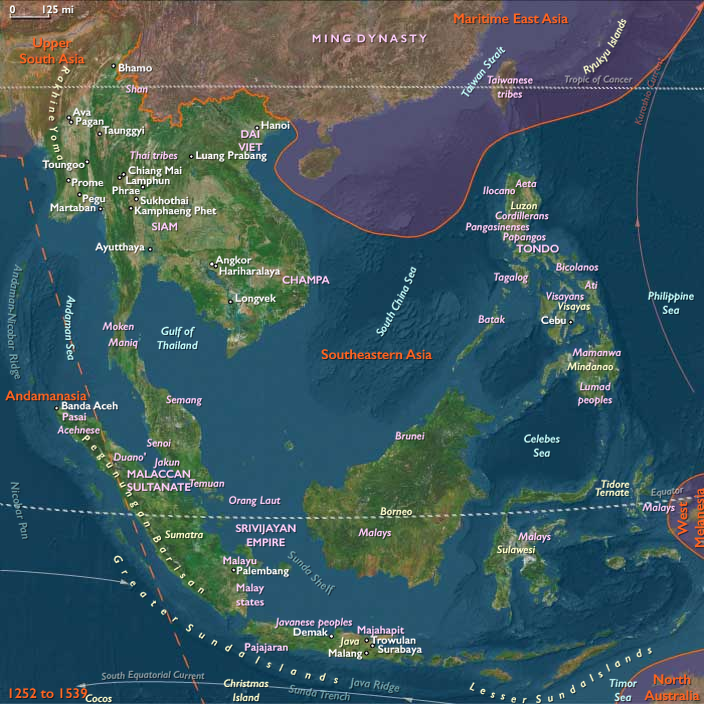
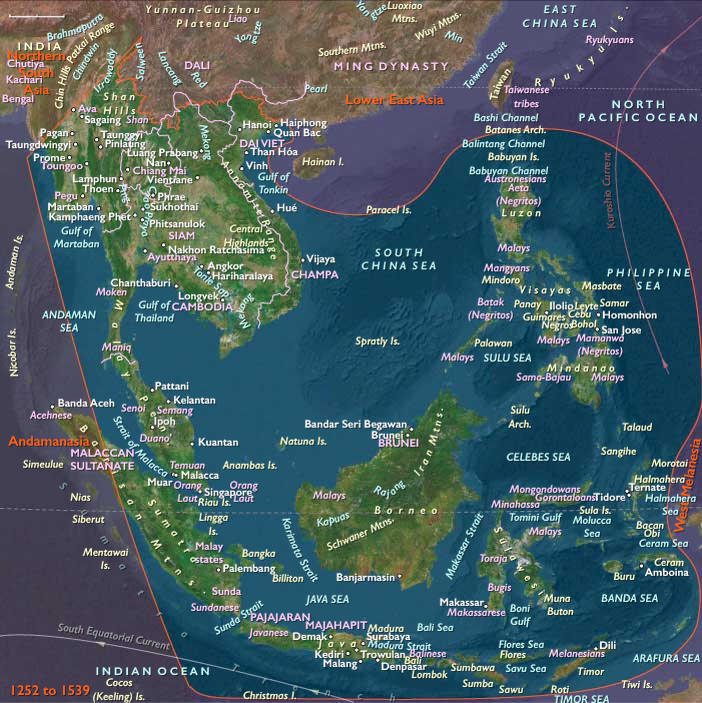
The Kingdom of Ayuthayya annexes its vassal …
Years: 1438 - 1438
The Kingdom of Ayuthayya annexes its vassal state of Sukhothai in 1438.
Locations
Groups
Subjects
Regions
Subregions
Related Events
Filter results
Showing 10 events out of 41864 total
Chinese forces under Wang Chi, intent on fulfilling the Ming dynasty’s goal of conquering the Shan states of Upper Burma, invade in 1438 and achieve partial victory.
The Ming court, just two years after allowing landowners paying the grain tax to settle their accounts in silver instead, now decides to close all silver mines and to ban all private silver mining in Zhejiang and Fujian provinces.
This is a concerted effort to halt the increase of silver circulating into the market.
Illegally mining silver is now an offense punishable by death; although illegal mining became a dangerous affair, the high demand for illegal mining also makes it very lucrative, so many choose to defy the government and continue to mine silver.
Isidore, failing to gain Vasily's support, departs for the council in Italy.
Vasily's reign meanwhile sees the collapse of the Golden Horde and its break up into smaller Khanates.
Now that his throne is relatively secure, he has to deal with the Tatar threat.
Refusing any assistance to the Tatars, Vasily drives their khan, Olug Moxammat, from Muscovy to …
…Kazan' on the Volga River, thus providing the infuriated Tatars with a reason to continually attack and harass Moscow from the khanate’s new capital.
The rebels' loss has enabled Erik to gain his former position.
The nobles had persuaded the Riksdagl to abolish the position of administrator, but after Erik permits his forces to ravage Swedish coastal areas on his return to Denmark, the infuriated council retaliates by again choosing an administrator, Karl Knutsson, to rule from 1438.
Albert Habsburg is on January 1, 1438, crowned king of Hungary, elected king of Germany on March 18, and, despite opposition, actually crowned king of Bohemia on June 29.
Calling a diet at Nürnberg 1438, he ends all feuds based on the right of private warfare and appoints arbiters to settle disputes.
He further divides Germany into administrative circles, again with the maintenance of peace in mind.
The site of Sebes, an important town in Transylvania, situated in the valley of the Sebes River, had Neolithic and Daco-Roman settlements before its refounding in the twelfth century by German settlers.
By the fourteenth century it had survived a Tatar sacking and had been refortified, but in 1438 it falls to the Ottoman Turks.
The Transylvanian nobles form the Union of Three Nations in 1438, jointly pledging to defend their privileges against any power except that of Hungary's king.
The document declares the Magyars, Saxons (Germans), and Szeklers the only recognized nationalities in Transylvania; henceforth, all other nationalities there, including the Romanians, are merely "tolerated."
This union will successfully maintain special privileges and social status in its own community while provided by Hungary the Transylvania diet as a guarantee of self-rule within the Hungarian kingdom.
Antonio Pisanello's elegantly decorative “Saint George and the Princess,” created around 1437-38 for Sant’ Anastasia in Verona, clearly recalls, in its emphasis on visual splendor and detailed observation, the International Gothic style of his mentor, Gentile da Fabriano.
With preoccupations paralleling those of contemporary Florentine artists, Pisanello explores in his drawings the effects of three-dimensional space and foreshortening. (Of the group of frescoes that he executes, only three major pictorial schemes survive, together with a large number of drawings and an important body of portrait medals.)
Born Antonio Pisano in about 1395, he has worked extensively as a painter and medalist for the courts of powerful ruling families such as the Gonzaga of Mantua, the Visconti of Milan, and the Este of Ferrara; in 1431-32, he also filled commissions in Rome for Pope Eugene IV.

Della Quercia completes the decoration of the main portal of San Petroni for the Cathedral of Bologna, creating, in the ten marble relief panels that flank the doorway, depicting stories from the Book of Genesis, the most impressive sculpture of the age.
He balances a somewhat conservative treatment of space with his powerful conception of the human body, eloquently expressed by the weighty, monumental figures and muscular, idealized nudes.
He dies on October 20, 1438.