
The Khazar Khaganate at its height is …
Years: 829 - 829
The Khazar Khaganate at its height is an immense and powerful state.
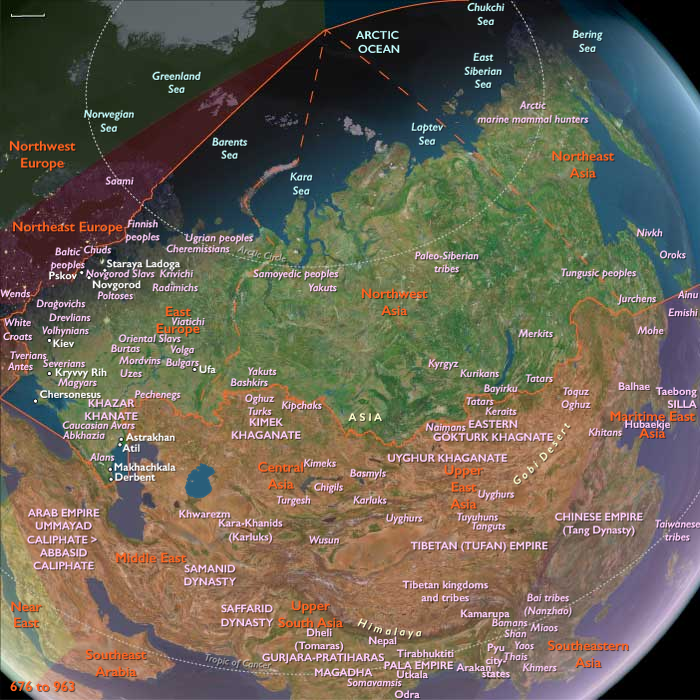
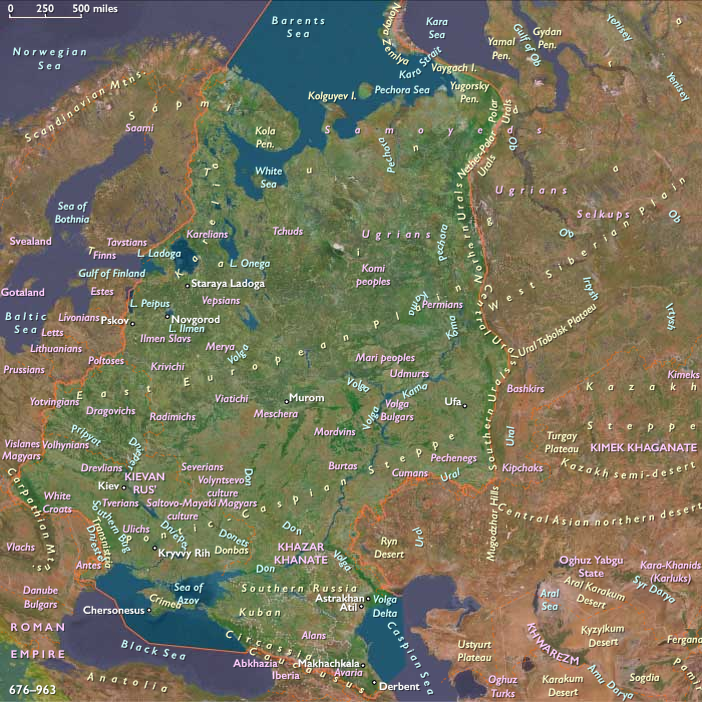
The Khazaria heartland is the lower Volga and the Caspian coast as far south as Derbent.
Khazar dominion over most of the Crimea and the northeast littoral of the Black Sea dates from the late seventh century.
By 800, Khazar holdings included most of the Pontic steppe as far west as the Dnieper River and as far east as the Aral Sea (some Turkic history atlases show the Khazar sphere of influence extending well east of the Aral).
During the Arab–Khazar war of the early eighth century, some Khazars had evacuated to the foothills of the Ural Mountains, and some settlements may have remained.
For a century and a half, the Khazars have ruled the southern half of Eastern Europe and present a bulwark blocking the Ural-Caspian gateway from Asia into Europe, while serving as a major artery of commerce between northern Europe and southwestern Asia along the Silk Road.
Their territory comprises much of modern-day southern European Russia, western Kazakhstan, eastern Ukraine, Azerbaijan, large portions of the northern Caucasus (Circassia, Dagestan), parts of Georgia, the Crimea, and northeastern Turkey.
Various place names invoking Khazar persist today.
The Caspian Sea, traditionally known as the Hyrcanian Sea and Mazandaran Sea in Persian, is still known to Muslims as the 'Khazar Sea' (Bahr ul-Khazar).
Many other cultures still use the name "Khazar Sea".
In Hungary, there are villages (and people with family names) called Kozár and Kazár.
At the peak of their empire, the Khazar permanent standing army may have numbered as many as one hundred thousand, controlling or exacting tribute from thirty different nations and tribes inhabiting the vast territories between the Caucasus, the Aral Sea, the Ural Mountains, and the Ukrainian steppes.
Khazar armies were led by the Khagan Bek and commanded by subordinate officers known as tarkhans.
When the bek sent out a body of troops, they would not retreat under any circumstances.
If they were defeated, every one who returned was killed.
Bulan was a Khazar king who led the conversion of the Khazars to Judaism.
The date of his reign is unknown, as the date of the conversion is hotly disputed, though it is certain that Bulan reigned some time between the mid-700s and the mid-800s.
Nor is it settled whether Bulan was the Bek or the Khagan of the Khazars.
D. M. Dunlop was certain that Bulan was a Khagan; however, more recent works, such as The Jews of Khazaria by Kevin Brook, assume that he was the Bek due to references to him leading military campaigns.
Khazar tradition held that before his own conversion, Bulan was religiously unaffiliated.
In his quest to discover which of the three Abrahamic religions would shape his own religious beliefs, he invited representatives from each to explain their fundamental tenets.
In the end, he chose Judaism.
Locations
Groups
Topics
Subjects
Regions
Subregions
Related Events
Showing 10 events out of 54375 total
Years: 829 - 829
Locations
Groups
Topics
Subjects
Regions
Subregions