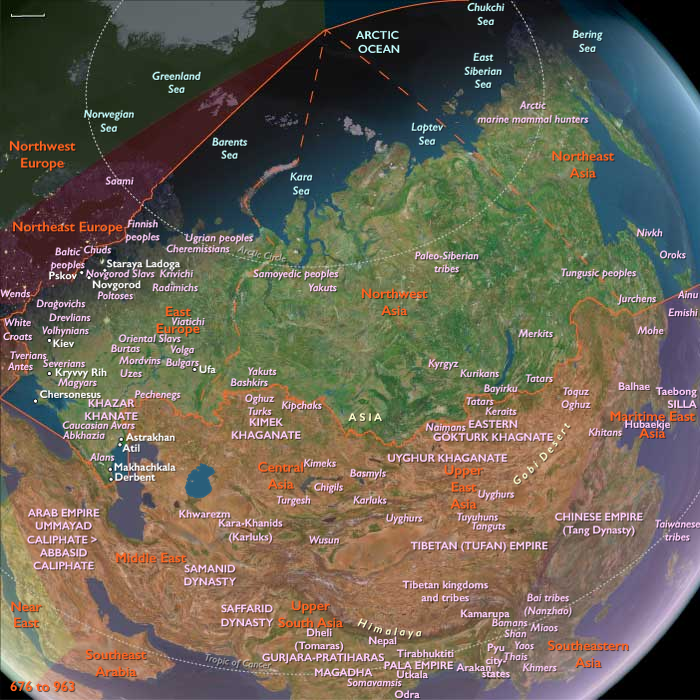
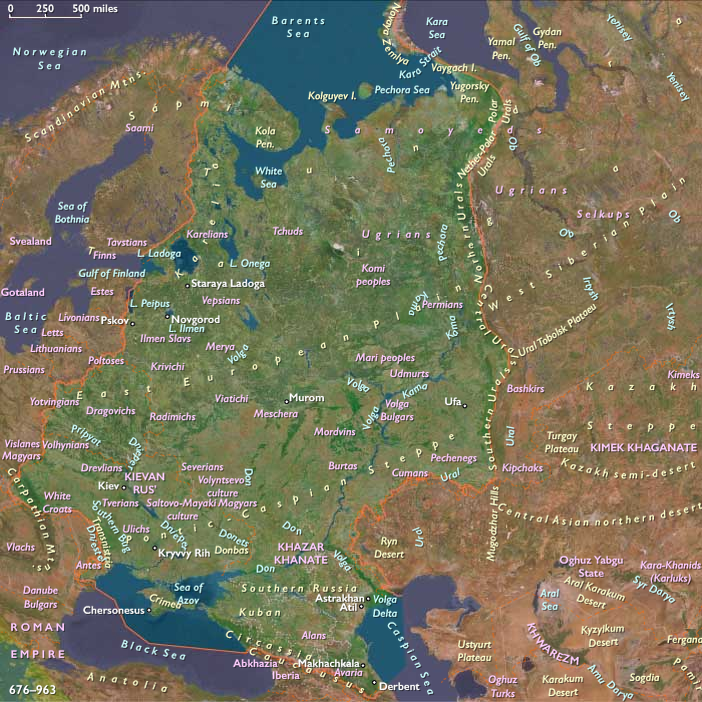
The Khagan of the Khazars, who shares …
Years: 796 - 807
The Khagan of the Khazars, who shares the name Harun (Aaron) with the current caliph, adopts Rabbinic Judaism in about 800, two generations after his peoples' general conversion to the Jewish faith.
Locations
People
Groups
Topics
Subjects
Regions
Subregions
Related Events
Filter results
Showing 10 events out of 54939 total
Polynesian seafarers are skilled ocean navigators and astronomers.
At a time when Western boats rarely go out of sight of land, Polynesians often travel long distances.
The early settlement history of Hawaiʻi is still not completely resolved.
Substantial archaeological as well as paleoecological evidence confirms Hawaiian settlement no later than 800 CE, and quite possibly as early as 300–500 CE (Kirch 1985; Athens 1997).
Some believe that the first Polynesians arrived in Hawaiʻi in the third century from the Marquesas.
The colonists brought along with them clothing, plants and livestock and established settlements along the coasts and larger valleys.
Upon their arrival, the settlers grew kalo (taro), maiʻa (banana), niu (coconut), ulu (breadfruit), and raised pua'a (pork), moa (chicken), and ʻīlio (poi dog), although these meats were eaten less often than fruits, vegetables, and seafood.
Popular condiments include pa'akai (salt), ground kukui nut, limu (seaweed), and ko (sugarcane) which is used as both a sweet and a medicine.
In addition to the foods they brought, the settlers also acquired ʻuala (sweet potato), which has yet to be adequately explained, as the plant originates in South America.
A few researchers have argued that the presence of the sweet potato in the ancient Hawaiian diet is evidence of pre-Columbian transoceanic contact with the Americas.
As soon as they arrived, the new settlers built hale (homes) and heiau (temples).
Archaeologists currently believe that the first settlements were on the southern end of the Big Island of Hawai'i and that they quickly extended northwards, along the seacoasts and the easily accessible river valleys.
As the population increased, settlements were made further inland.

The Tibetan people known as the Pyu have, for the past two centuries, migrated into the valleys of the upper Irrawaddy River and its Chindwin tributary.
Rather than push southward, the Pyu halt there in the northern Burmese dry zone.
The Pyu establish overland commercial and cultural contacts with such Indian border centers as Chittagong.
A monarch of central Java’s wealthy and powerful Saliendra dynasty establishes, in about 800, a major Buddhist monument at Borobudur, located about twenty-five miles (forty kilometers) from Jogjakarta.
The great shrine, built of dark gray volcanic stone with no interior spaces, crowns a small hill, and consists of a square base four hundred feet (one hundred and twenty-one meters) on each side.
Above the base are eight diminishing tiers of terraces—the lower five square, and bounded by a roofless corridor; the upper three unwalled and circular—connected by stairways.
From the uppermost terrace, a colossal stupa, or bell-shaped dome, rises another one hundred feet (thirty meters).
The walls of the lower five terraces of the great shrine feature intricately carved bands of narrative relief profusely illustrating the progress of the Bodhisattva in his striving for all-encompassing compassion.
The gently rounded contours of the ornate relief sculpture on each terrace depict a stage of the Bodhisattva’s development: the more mundane lower scenes contain moral lessons; the higher scenes, executed in a more severe and static in style, are more spiritual.
The upper three terraces carry seventy-two stupas containing large, stone-cut Buddha images, enclosed in stone latticework, which encircle the huge central stupa.
The complex in its entirety is an architectural mandala—the world’s largest—with the central stupa representing the world axis.
The walls of the lower five terraces of the great shrine feature intricately carved bands of narrative relief profusely illustrating the progress of the Bodhisattva in his striving for all-encompassing compassion.
The gently rounded contours of the ornate relief sculpture on each terrace depict a stage of the Bodhisattva’s development: the more mundane lower scenes contain moral lessons; the higher scenes, executed in a more severe and static in style, are more spiritual.
Kanmu had abandoned universal conscription in 792, but he still wages major military offensives to subjugate the Ainu, a north Asian Caucasoid people, sometimes referred to as Emishi, living in northern and eastern Japan.
After making temporary gains in 794, in 797 Kanmu appoints a new commander under the title seii taishogun (barbarian-subduing generalissimo, often referred to as shogun).
By 801 the shogun has defeated the Ainu and extended the imperial domains to the eastern end of Honshu.
Imperial control over the provinces is tenuous at best, however, and in the ninth and tenth centuries much authority will be lost to the great families who disregard the Chinese-style land and tax systems imposed by the government in Kyoto.
Stability comes to Heian Japan, but, even though succession is ensured for the imperial family through heredity, power again concentrates in the hands of one noble family, the Fujiwara.
The broad territories of Goguryeo are not conquered, however, and a Goguryeo general named Tae Cho-yong establishes a successor state called Balhae that extends to both sides of the Amnok and Tuman rivers.
Balhae forces Silla to build a northern wall in 721 and keeps Silla forces below a line running from present-day P'yongyang to Wonsan.
By the eighth century, Balhae controlled the northern part of Korea, all of northeastern Manchuria, and the Liaodong Peninsula.
Both Silla and Balhae continued to be influenced deeply by Tang civilization.
Scandinavian colonists, having settled Aldeigja (Ladoga) in the 750s, have played an important role in the early ethnogenesis of the Rus' people and in the formation of the Rus' Khaganate, the origins of which are unclear.
The first Norse settlers of the region had arrived in the lower basin of the Volkhov River in the mid-eighth century.
The country comprising the present-day Saint-Petersburg, Novgorod, Tver, Yaroslavl, and Smolensk regions becomes known in Old Norse sources as "Garðaríki", the land of forts.
Dendrochronology suggests that Staraya Ladoga, a trading post located on the Volkhov River near Lake Ladoga, eight kilometers north of the present own of Volkhov, was founded in 753.
Old (staraya means "old") Ladoga's inhabitants are Norsemen, Finns, and Slavs, hence different names for the city.
The original Finnish name, Alode-joki (i.e., "lowland river"), is rendered as "Aldeigja" in Norse language and as "Ladoga" in Old East Slavic.
A multiethnic settlement, it is dominated by Scandinavians who are called by the name of Rus and for this reason it is sometimes called the first capital of Russia.
The Scandinavian tribal divisions of Norse, …
…Swedes, and …
…Danes emerge around 800 in their respective homelands.
Avar hegemony in the northern Balkans ends as the Franks, under Charles the Great, or Charlemagne, crush their empire and cart the Avar treasury west to Aachen, using the vast hoard of gold—protection money extorted for centuries from the Eastern Empire—to fuel the Carolingian Renaissance.