
The Kandariyâ Mahâdeva Temple, the largest and …
Years: 1020 - 1020
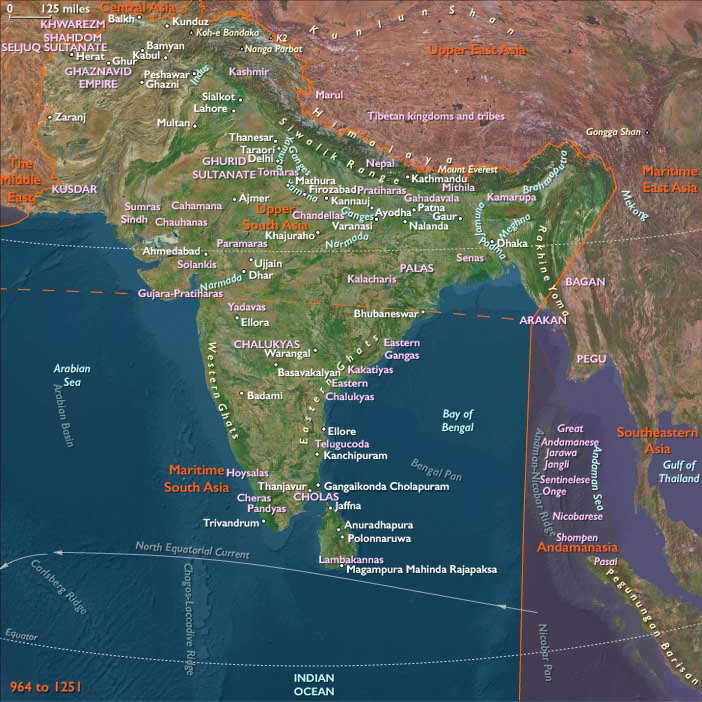
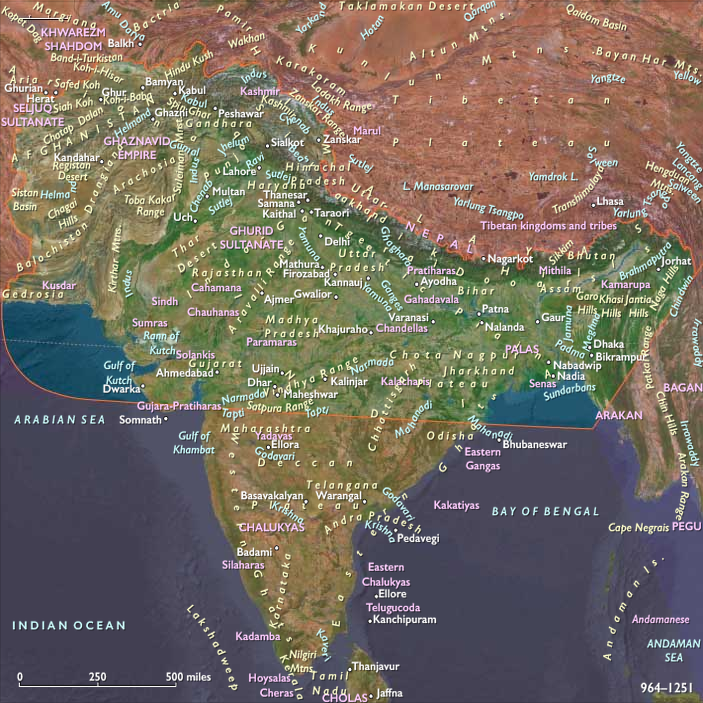
The Kandariyâ Mahâdeva Temple, the largest and most ornate Hindu temple in the medieval temple group found at Khajuraho in Madhya Pradesh, India, is considered one of the best examples of temples preserved from the medieval period in India.
Khajuraho, the religious capital of the Chandela Rajputs, is today is one of the most popular tourist destinations in India.
Built around 1050 on Hindu beliefs dating back to 1000 BCE, the main spire or sikhara rises thirty-one meters to depict Mount Kailash, the Himalayan mountain abode of Shiva and is surrounded by eighty-four miniature spires (or Urushringas).
Inside the sanctum is a marble linga representing Shiva.
Locations
Groups
Topics
Subjects
Regions
Subregions
Related Events
Filter results
Showing 10 events out of 51684 total
Yaroslav, in one of first actions as a grand prince, confers numerous freedoms and privileges on the loyal Novgorodians, who had helped him to gain the Kievan throne).
Thus, the foundation of the Novgorodian republic is laid.
For their part, the Novgorodians respect Yaroslav more than they did other Kievan princes; and the princely residence in their city, next to the marketplace (and where the veche often convene) wis named Yaroslavovo Dvorishche ("Yaroslav's Court") after him.
It probably is during this period that Yaroslav promulgated the first code of laws in the East Slavic lands, "Yaroslav's Justice" (now better known as Ruskaia Pravda, "Rus Truth [Law]").
Henry II, a sincerely religious ruler, encourages monastic reform, founding and richly endowing the bishopric of Bamberg in 1007 and personally appointing most of the German princes.
Pope Benedict VIII visits him in at Bamberg 1020 and consecrates his new cathedral here.
After settling some controversies with the bishops of Mainz and Würzburg, the pope persuades the emperor to return to Italy for a third (and final) campaign to counter the growing power of the Constantinople in the south, where the Lombard princes have made submission to the Greeks.
The oldest Jewish quarter in Germany is established in 1020 at Regensburg, an important trading center on the Danube River.
Forty years earlier, the city already had an important Jewish community located next to the Abby of Saint Emmeran; the settlement had probably been established a century before.
Bernard II, who is regarded as the greatest of the Billungers, has expanded the powers of the duke in Saxony.
Originally a supporter of Emperor Henry II, Bernard had accompanied him into Poland and negotiated the treaty of Bautzen of 1018.
He revolts in 1019–102 and gains the recognition of the tribal laws of Saxony, something his father had failed to do.
The Fatimid military is based largely on the Kutama Berber tribesmen brought along on the march to Egypt, and they had remained an important part of the military even after Tunisia began to break away.
After their successful establishment in Egypt, local forces have also been incorporated into the army, though they are to remain a relatively minor part of the Fatimid forces (and of succeeding dynasties as well).
A fundamental change had occurred when the Fatimid Caliph attempted to push into Syria in the later half of the tenth century.
The Fatimids had been faced with the now Turkish-dominated forces of the Abbasid Caliph and had begun to realize the limits of their current military.
Thus during the reign of Abu Mansur Nizar al-Aziz Billah and Al-Hakim bi-Amr Allah, the Caliph had begun incorporating armies of Turks and later sub-Saharan Africans (even later, other groups such as Armenians will also be used).
The army units are generally separated along ethnic lines, thus the Berbers are usually the light cavalry and foot skirmishers, while the Turks are the horse archers or heavy cavalry (later to be known as Mamluks).
The sub-Saharan Africans, Syrians, and Arabs generally act as the heavy infantry and foot archers.
This ethnic-based army system, along with the partial slave status of many of the imported ethnic fighters, will remain fundamentally unchanged in Egypt many centuries after the fall of the Fatimid caliph.
While the ethnic-based army has been generally successful on the battlefield, it has begun to have negative effects on Fatimid internal politics.
Traditionally, the Berber element of the army had had the strongest sway over political affairs, but as the Turkish element has grown more powerful, it has begun to challenge this, and by 1020 serious riots have begun to break out among the Black African troops who are fighting back against a Berber-Turk Alliance.
The great Ottonian school of manuscript painting on the Monastic island of Reichenau in Lake Constance, which houses a Benedictine scriptorium and artists' workshop that has a claim to having been the largest and artistically most influential in Europe during the late tenth and early eleventh centuries, produces another masterful illumination, the lavishly illustrated Pericopes of Henry II, around 1020.
An unrivalled series of liturgical manuscripts is produced at Reichenau under the highest patronage of Ottonian society.
(Other centers include scriptoria at Lorsch, Trier and Regensburg.)
Unlike a Gospel Book, gospel pericopes contain only the passages from the gospels which are to be read during the liturgical year, making it easier for the priest celebrating Mass to find the gospel reading.
The Changing Status of Jews in Early Christian Spain
In the early stages of the Christian Reconquista, the counts of Castile and the first kings of León showed little tolerance toward Jewish communities, often targeting them during their military campaigns against the Moors. Synagogues were destroyed, and Jewish scholars and teachers were killed, as part of the broader conflict.
However, over time, the Christian rulers came to recognize that, surrounded by powerful Muslim adversaries, they could not afford to alienate the Jewish population.
Legal Protections and Economic Integration
- In 974 CE, García Fernández, Count of Castile, issued the Fuero of Castrojeriz, granting Jews certain legal rights and placing them on equal footing with Christians in many respects.
- In 1020 CE, at the Council of León, presided over by King Alfonso V, similar measures were adopted, further formalizing Jewish protections.
Jewish Life in León
During this period, León, the metropolis of Christian Spain until the conquest of Toledo, became home to a thriving Jewish community. Jews:
- Owned real estate,
- Engaged in agriculture and viticulture,
- Practiced various handicrafts, and
- Lived in relative harmony with their Christian neighbors in many towns.
These early legal protections and Jewish contributions to the economy laid the foundation for a more stable coexistence between Jews and Christians in Christian-controlled Spain, though future centuries would see fluctuations in tolerance and persecution.
The Founding of Saint-Germain-en-Laye (1020)
In 1020, King Robert II of France ("the Pious") established a convent at the site of what would later become the Church of Saint-Germain, marking the foundation of Saint-Germain-en-Laye. This act laid the groundwork for the town’s future religious, royal, and historical significance.
Origins and Religious Importance
- The convent, dedicated to Saint Germain of Paris, was part of Robert II’s broader patronage of religious institutions, reflecting his strong devotion to the Church.
- Situated on a strategic hilltop west of Paris, the site offered both spiritual isolation and proximity to the Capetian court.
- Over time, the convent developed into a more significant ecclesiastical and royal site, as later French monarchs expanded its importance.
Development into a Royal Residence
- While initially a religious foundation, the area of Saint-Germain-en-Laye gradually became a favored residence of French kings, particularly during the Capetian and Valois dynasties.
- In later centuries, the site would evolve into the Château de Saint-Germain-en-Laye, a royal palace used extensively by medieval and Renaissance monarchs, including Louis XIV before the construction of Versailles.
Legacy
- The foundation of Saint-Germain-en-Laye in 1020 established an important religious and royal center in France.
- The Church of Saint-Germain remained a significant landmark, preserving its early medieval heritage.
- Over time, the town grew into a seat of French power, playing key roles in diplomatic treaties, royal politics, and cultural history.
Robert II’s patronage of religious institutions was instrumental in shaping France’s medieval landscape, and the founding of Saint-Germain-en-Laye reflected his legacy as a pious and influential monarch.
Odo II of Blois and His Expansion into Champagne and Reims (1020s)
Following his defeat at the Battle of Pontlevoy (1016) at the hands of Fulk III of Anjou, Odo II of Blois remained determined to expand his domains. His ambition led him to seize key territories in Touraine and Champagne, often without royal sanction, placing him in direct conflict with both King Robert II of France and Emperor Henry II.
Odo’s Seizure of Champagne (1020)
- In 1020, Odo attempted to overrun Touraine, continuing his long-standing war with Fulk III of Anjou in an effort to reclaim lost ground.
- Following the death of his cousin, Stephen I, Count of Meaux, in 1020, Odo saw an opportunity to enlarge his domain, as Stephen had died without an heir.
- Without seeking royal approval, Odo seized Troyes, Meaux, and all of Champagne, making himself the undisputed ruler of the region.
- This move significantly increased his power, effectively creating a unified County of Champagne under his control.
Conflict with Reims and Lorraine
- After securing Champagne, Odo launched aggressive campaigns against the clergy and nobility, bringing him into conflict with Ebles, Archbishop of Reims, and Theodoric I, Duke of Lorraine.
- His attack on Reims, one of the most important ecclesiastical centers in France, was particularly audacious, as it challenged both the authority of the French monarchy and the Holy Roman Empire.
