
The Jurchens try to conquer southern China …
Years: 1132 - 1143
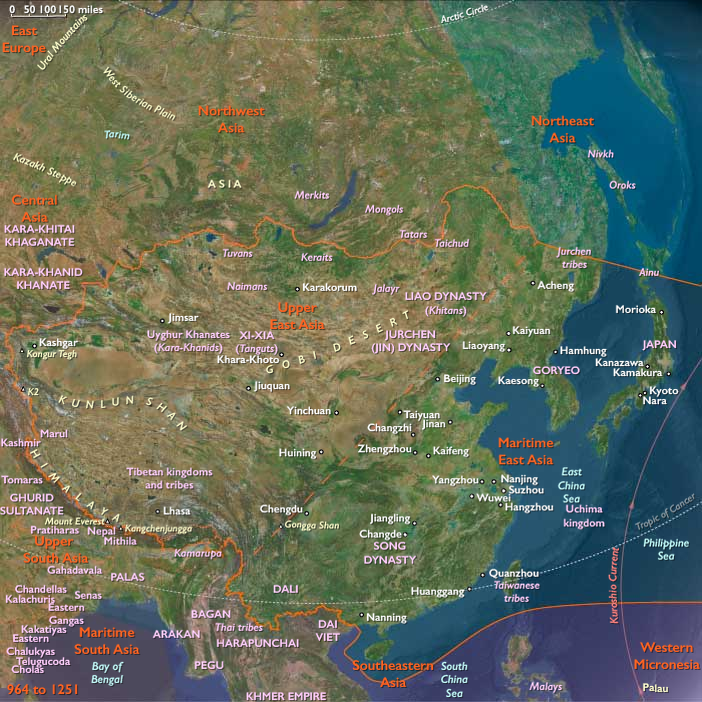
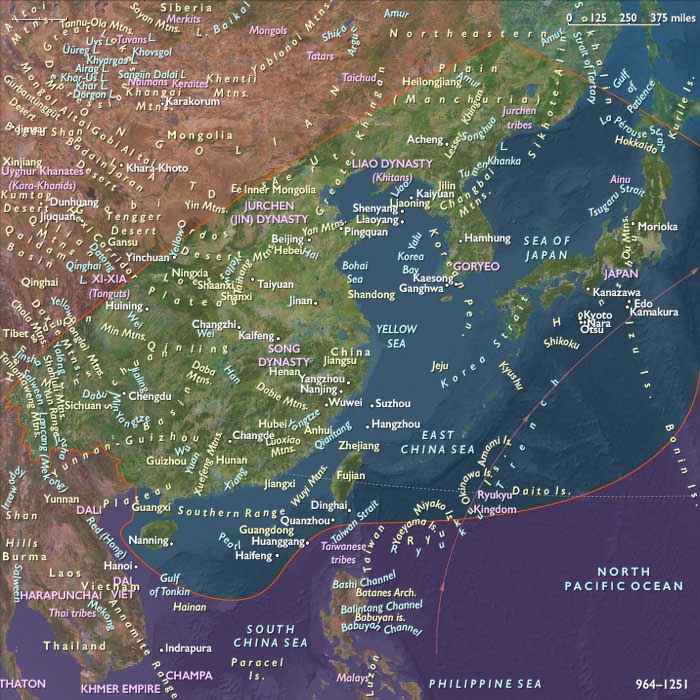
The Jurchens try to conquer southern China in the 1130s, but become bogged down by a pro-Song insurgency in the north and a counteroffensive by the Song generals Yue Fei, Han Shizhong, and others.
The generals regain some territories but retreat on the orders of the Southern Song emperor, who supports a peaceful resolution to the war.
The Treaty of Shoaling in 1142 settles the boundary between the two empires along the Huai River, but conflicts between the two dynasties will continue until the fall of the Jin in 1234.
The wars engender an era of technological, cultural, and demographic changes in China.
Battles between the Song and Jin bring about the introduction of various gunpowder weapons.
The siege of De'an in 1132 is the first recorded appearance of the fire lance, an early ancestor of firearms.
There are also reports of battles fought with primitive gunpowder bombs like the incendiary huopao or the exploding tiehuopao, incendiary arrows, and other related weapons.
In northern China, the Jurchen tribes are the ruling minority of an empire that is predominantly inhabited by former subjects of the Northern Song.
Jurchen migrants settle in the conquered territories and assimilate with the local culture.
The Jin government institutes a centralized imperial bureaucracy modeled on previous Chinese dynasties, basing their legitimacy on Confucian philosophy.
Song refugees from the North resettle in southern China.
The North is the cultural center of China, and its conquest by the Jin diminishes the international stature of the Song dynasty.
The Southern Song quickly return to economic prosperity, however, and trade with the Jin is lucrative despite decades of warfare.
The Southern Song capital, Hangzhou, expands into a major city for commerce.
People
Groups
- Confucianists
- Chinese (Han) people
- Jurchens
- Jin Dynasty (Chin Empire), Jurchen
- Chinese Empire, Nan (Southern) Song Dynasty
Topics
Commodoties
Subjects
Regions
Subregions
Related Events
Showing 10 events out of 91 total
Years: 1132 - 1143
People
Groups
- Confucianists
- Chinese (Han) people
- Jurchens
- Jin Dynasty (Chin Empire), Jurchen
- Chinese Empire, Nan (Southern) Song Dynasty
Topics
Commodoties
Subjects
Regions
Subregions